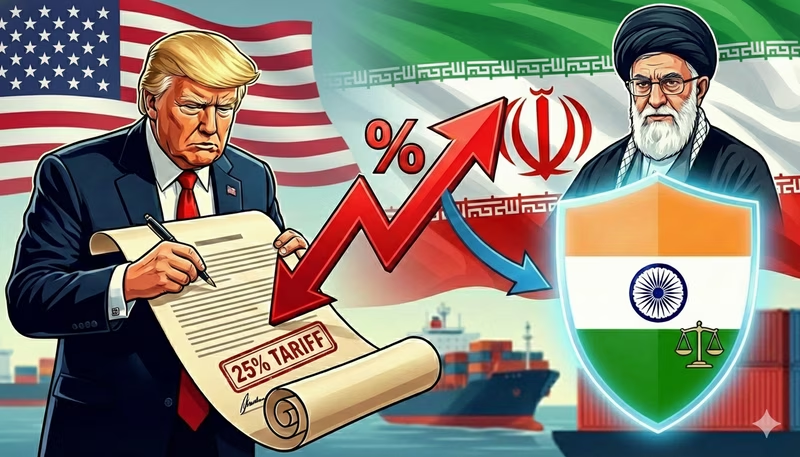
When the United States announced a fresh wave of sanctions and additional 25% tariffs targeting Iran’s trade networks in early 2026, global markets braced for ripple effects. But in New Delhi, the mood was notably calm. According to senior government sources, **India is expected to face minimal impact from the latest US sanctions on Iran**—a stance backed by data, policy alignment, and the nature of current bilateral trade. While geopolitical tensions simmer, India’s strategic positioning and strict adherence to international norms appear to have insulated its economy from direct fallout.
Table of Contents
- What Do the New US Sanctions on Iran Actually Cover?
- The Real State of India-Iran Trade in 2026
- Why Experts Say Impact on India Will Be Minimal
- How Indian Exporters Are Staying Compliant
- The Real Threat: Rupee Depreciation, Not Sanctions
- Chabahar Port: A Strategic Asset Beyond Trade Volumes
- Conclusion: Navigating Geopolitics with Pragmatism
- Sources
What Do the New US Sanctions on Iran Actually Cover?
The latest US measures, unveiled as part of a broader strategy to curb Iran’s regional influence, target entities involved in oil exports, arms trafficking, and financial facilitation. Crucially, however, they **explicitly exempt humanitarian trade**—including food, agricultural products, medicine, and medical devices . This carve-out is not new; it has been a consistent feature of US sanctions policy for years, designed to avoid harming civilian populations.
The “additional 25% tariffs” referenced in media reports apply specifically to non-humanitarian goods transiting through third countries that knowingly facilitate prohibited Iranian trade. For nations like India, which have already scaled back non-essential commerce with Tehran, this poses little direct risk.
The Real State of India-Iran Trade in 2026
Gone are the days when India imported over 400,000 barrels of Iranian crude oil per day. Following US pressure and the reinstatement of sanctions in 2018, India effectively halted oil imports from Iran by 2019. Today, bilateral trade stands at a modest **$2–3 billion annually**, down from a peak of $17 billion in 2011–12 .
Critically, nearly all current Indian exports to Iran fall squarely within the humanitarian exemptions:
- Rice, wheat, and other food grains
- Pharmaceuticals and generic medicines
- Agricultural machinery and spare parts
“We only ship items that are clearly permitted under US OFAC guidelines,” confirmed a Mumbai-based exporter who ships pharmaceuticals to Tehran. “Every invoice is vetted, and we use only compliant banking channels.”
Why Experts Say Impact on India Will Be Minimal
Government economists and trade analysts point to three key reasons why the US sanctions on Iran won’t significantly disrupt India’s economy:
- Limited Exposure: With no major energy or defense deals active, India’s commercial footprint in Iran is now narrow and low-risk.
- Proactive Compliance: Indian banks and exporters have adopted rigorous due diligence since 2018 to avoid secondary sanctions.
- Diversified Trade Partners: India has aggressively expanded trade with the UAE, Saudi Arabia, and Central Asia, reducing reliance on any single Middle Eastern partner.
As one Department of Commerce official noted anonymously, “We’ve been living under the shadow of these sanctions for years. Our systems are already calibrated for them.”
How Indian Exporters Are Staying Compliant
To maintain access to the US financial system—a far more critical market than Iran—Indian businesses have implemented strict protocols:
- Using only SWIFT-compliant banks with no ties to sanctioned Iranian entities.
- Avoiding transactions in Iranian rial; most deals are settled in euros or dirhams via third-country intermediaries.
- Maintaining detailed records proving the end-use of exported goods (e.g., pharma shipments to licensed hospitals).
This cautious approach has allowed humanitarian trade to continue without triggering US penalties—a delicate balance that requires constant vigilance.
The Real Threat: Rupee Depreciation, Not Sanctions
While the US sanctions on Iran grab headlines, Indian businesses are far more concerned about a quieter crisis: **rupee depreciation**. With the INR hovering near ₹84 to the dollar in early 2026, import costs for everything from electronics to edible oils are soaring .
“Sanctions on Iran won’t hurt us, but a weak rupee absolutely will,” said Anjali Sharma, CFO of a mid-sized agri-export firm. “Our input costs in dollars are up 12% this year alone.”
Economists agree: currency volatility poses a far greater macroeconomic risk than distant geopolitical sanctions, especially as India runs a persistent current account deficit.
Chabahar Port: A Strategic Asset Beyond Trade Volumes
It’s worth noting that India’s engagement with Iran isn’t purely commercial. The **Chabahar Port project**—a deep-sea port in southeastern Iran—remains a cornerstone of India’s connectivity strategy to Afghanistan and Central Asia, bypassing Pakistan .
Crucially, the US has granted India a **special waiver** for Chabahar development, recognizing its strategic importance for regional stability and humanitarian aid delivery. This exemption ensures that even under tightened sanctions, India can continue its infrastructure investments without fear of reprisal.
Conclusion: Navigating Geopolitics with Pragmatism
India’s response to the renewed US sanctions on Iran reflects a mature, pragmatic foreign economic policy. By strictly limiting trade to humanitarian essentials, maintaining rigorous compliance, and leveraging diplomatic waivers for strategic projects like Chabahar, New Delhi has effectively neutralized a potential flashpoint. The real economic challenges lie closer to home—in currency management, inflation control, and global supply chain resilience. For now, at least, the Iran sanctions storm is one India can weather from a safe distance.
Sources
- Times of India: US sanctions on Iran to have minimal impact on India, say govt sources
- U.S. Treasury – OFAC: Iran Sanctions Program Overview
- Ministry of Commerce & Industry, India: India-Iran Trade Data Dashboard
- MEA Statement on Chabahar: Joint Statement on Chabahar Development
- Reserve Bank of India: Exchange Rate Trends Q1 2026
- [INTERNAL_LINK:india-iran-chabahar-port-strategy]
- [INTERNAL_LINK:how-us-sanctions-affect-global-trade]