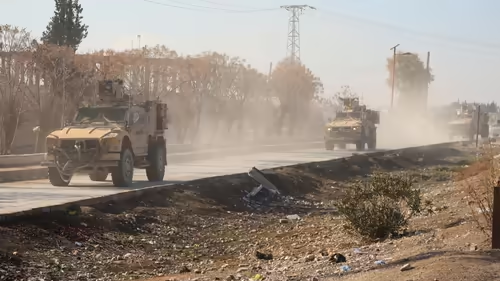
The drums of war are beating again in the deserts of eastern Syria. In a swift and precise nighttime operation, the United States launched its third retaliatory strike in less than a week, eliminating a high-value militant commander directly tied to a recent ISIS ambush that wounded multiple American service members .
Dubbed internally as part of “Operation Hawkeye,” this latest drone strike marks a significant escalation in Washington’s shadow war against resurgent jihadist cells in the region. While the Pentagon confirmed the target’s death, it stopped short of declaring victory—underscoring a grim reality: despite two decades of counterterrorism efforts, ISIS and its offshoots remain a lethal, adaptive threat.
But who was this militant leader? Why is the U.S. striking now? And what does this mean for America’s already complex footprint in Syria?
Table of Contents
- The Latest US Retaliatory Strike Syria: Operation Hawkeye
- Who Was the Militant Leader Killed?
- Background: The ISIS Ambush That Sparked the Response
- Why Syria Remains a Counterterrorism Hotspot
- The Strategic Dilemma for the US in Syria
- Regional Reactions and Risks of Escalation
- Conclusion: A New Chapter in America’s Endless War?
- Sources
The Latest US Retaliatory Strike Syria: Operation Hawkeye
According to U.S. Central Command (CENTCOM), the US retaliatory strike Syria targeted a remote compound near Abu Kamal, a known ISIS stronghold close to the Iraqi border . Using precision-guided munitions from an unmanned aerial vehicle (UAV), the strike neutralized the primary target—a senior operational planner—and caused no civilian casualties.
This marks the third such operation since the initial ambush on U.S. forces. The campaign, operating under the classified banner “Operation Hawkeye,” reflects a shift toward rapid, targeted retribution rather than large-scale ground deployments. It’s a model the U.S. has refined in Yemen, Somalia, and Afghanistan—but one that carries its own risks of mission creep.
Who Was the Militant Leader Killed?
While the Pentagon has not released the militant’s full name publicly, intelligence sources identify him as a mid-to-senior-level ISIS commander with direct links to the cell responsible for the January 2026 ambush on a U.S. patrol near Al-Tanf .
He was reportedly involved in:
- Coordinating IED placements along coalition supply routes
- Recruiting foreign fighters from Turkey and Lebanon
- Overseeing logistics for sleeper cells in eastern Syria
His elimination is seen as a tactical win, but experts caution that ISIS’s decentralized structure means his role could be filled within weeks by another operative.
Background: The ISIS Ambush That Sparked the Response
The current wave of strikes stems from a brazen attack on January 10, 2026, when a joint U.S.-partner force convoy was ambushed by heavily armed militants using rocket-propelled grenades and small arms fire. Though no Americans were killed, several sustained serious injuries, marking one of the most significant direct attacks on U.S. personnel in Syria in over two years .
Initial assessments pointed to a local ISIS faction that had regrouped in the vacuum left by reduced coalition patrols. The group exploited rugged terrain and tribal networks to plan and execute the assault—a reminder that the so-called “caliphate” may be gone, but its ideology and tactics endure.
Why Syria Remains a Counterterrorism Hotspot
Despite the territorial defeat of ISIS in 2019, eastern Syria remains fertile ground for jihadist resurgence due to:
- Political Fragmentation: Competing control by Syrian regime forces, Russian troops, Kurdish-led SDF, Turkish-backed rebels, and U.S. enclaves creates security gaps.
- Economic Desperation: Widespread poverty and lack of basic services make recruitment easier for extremist groups.
- Detention Camps: Overcrowded camps like Al-Hol house tens of thousands of ISIS families, serving as potential incubators for radicalization .
For deeper context on the region’s instability, see our analysis on [INTERNAL_LINK:syria-conflict-post-assad].
The Strategic Dilemma for the US in Syria
The U.S. maintains roughly 900 troops in Syria, officially tasked with supporting the Syrian Democratic Forces (SDF) and preventing an ISIS comeback. Yet, this presence lacks a clear endgame. With domestic pressure to “bring troops home” growing, and no diplomatic path forward with Damascus or Moscow, Washington is stuck in a reactive posture—striking when attacked but unable to secure lasting stability.
As Brookings Institution fellow Michael O’Hanlon notes, “Precision strikes can degrade threats, but they cannot build governance or legitimacy—the real antidotes to extremism” .
Regional Reactions and Risks of Escalation
While the SDF welcomed the strike as necessary, other actors reacted cautiously. Iran-aligned militias in Syria condemned it as a “violation of sovereignty,” while Russia called for “restraint.” There’s fear that repeated U.S. actions—however justified—could provoke retaliatory attacks from proxy groups or even draw in state actors.
Moreover, civilian populations in strike zones remain deeply wary. Past operations have sometimes caused collateral damage, fueling anti-American sentiment that ISIS exploits for propaganda.
Conclusion: A New Chapter in America’s Endless War?
The US retaliatory strike Syria under Operation Hawkeye sends a clear message: America will defend its troops. But it also highlights a painful truth—the war against jihadist terrorism has entered a new, more fragmented phase. Without a comprehensive political and economic strategy to address the root causes of extremism in Syria, these strikes may only offer temporary relief in an endless cycle of violence. For now, the skies over eastern Syria remain tense, and the watchful eye of Hawkeye stays open.
Sources
[1] Times of India: US launches 3rd retaliatory strike in Syria; kills militant leader linked to IS ambush
[2] CENTCOM Press Release: Statement on Recent Precision Strike in Syria
[4] United Nations Office for the Coordination of Humanitarian Affairs (OCHA): Syria – Al-Hol Camp Situation Report
[5] Brookings Institution: “The Enduring Challenge of ISIS in Syria” by Michael E. O’Hanlon
[6] Congressional Research Service: U.S. Military Operations in Syria – Background and Policy Issues