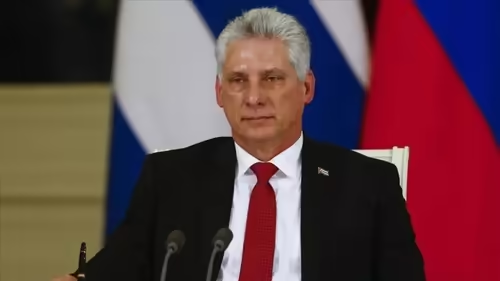
“¡Patria o Muerte!”—Homeland or Death! These iconic words, once shouted by Fidel Castro during the height of the Cold War, are now being revived by Cuban President Miguel Diaz-Canel in response to what he calls a “brutal and unjust” escalation from the United States: a new executive order threatening tariffs on foreign companies that supply oil to Cuba.
The move marks a significant hardening of U.S. policy toward the island nation in early 2026. Citing national security concerns, the Biden administration has officially designated Cuba as a threat, accusing Havana of providing safe harbor and logistical support to “hostile entities,” including cyber actors and transnational criminal organizations [[1]]. In retaliation, Diaz-Canel didn’t just issue a diplomatic protest—he delivered a fiery, nationally televised speech framing the US oil tariff threat on Cuba as nothing short of economic warfare.
Table of Contents
- The US Executive Order: What It Says
- Diaz-Canel’s “Homeland or Death” Response
- Why Oil Is Cuba’s Lifeline
- Geopolitical Ramifications: Global Suppliers in the Crosshairs
- Historical Context: Six Decades of US Sanctions
- What Happens Next? A New Cold War Front?
- Conclusion: Resistance and Resilience in Havana
- Sources
The US Executive Order: What It Says
Issued on January 30, 2026, the new U.S. directive empowers the Treasury and Commerce Departments to impose secondary sanctions—including steep tariffs and trade restrictions—on any non-U.S. entity found to be exporting petroleum products to Cuba [[2]]. The justification hinges on a controversial assessment by U.S. intelligence agencies that Cuba is increasingly acting as a “permissive jurisdiction” for groups deemed adversarial to American interests.
Specifically, the order alleges that Cuban state security has allowed certain foreign cyber units and illicit finance networks to operate from its territory in exchange for hard currency—a claim Havana vehemently denies. By targeting oil, the U.S. aims to cripple Cuba’s already fragile energy infrastructure, which relies on imports for over 50% of its consumption [[3]].
Diaz-Canel’s “Homeland or Death” Response
Standing before a crowd of government officials and military leaders in Havana’s Plaza de la Revolución, Diaz-Canel condemned the U.S. move as “an act of imperial aggression designed to starve our people and break our sovereignty.” He accused Washington of trying to “dictate who we can trade with” and using “economic force instead of dialogue” [[4]].
His speech was laced with revolutionary rhetoric, directly invoking the legacy of Fidel Castro and Che Guevara. “They want us on our knees,” he declared. “But they will find a people ready to defend their homeland—or die trying.” This revival of the “Patria o Muerte” slogan signals a deliberate shift toward ideological hardline messaging, likely aimed at rallying domestic unity amid growing economic hardship [[5]].
Cuba’s Foreign Ministry followed up with a formal statement vowing to “respond with firmness, confidence, and international legality,” while seeking support from allies like Russia, China, and Venezuela.
Why Oil Is Cuba’s Lifeline
To understand the severity of the US oil tariff threat on Cuba, one must grasp the island’s energy dependency:
- Domestic Production: Cuba produces only about 45,000 barrels of oil per day—far below its daily consumption of 150,000+ barrels [[6]].
- Key Suppliers: Historically, Venezuela provided subsidized oil under the Petrocaribe agreement. Today, Cuba also sources crude from Mexico, Algeria, and Russia [[7]].
- Economic Impact: Fuel shortages have already led to rolling blackouts, halted public transport, and crippled agricultural output—key drivers of inflation and social unrest [[8]].
By threatening tariffs on these suppliers, the U.S. isn’t just targeting Cuba—it’s pressuring third countries to choose between doing business with Havana or facing American economic retaliation.
Geopolitical Ramifications: Global Suppliers in the Crosshairs
The executive order puts nations like Russia and Mexico in a difficult position. Russia, already under heavy Western sanctions, may double down on support for Cuba as a strategic foothold in the Americas. Mexico, however, faces a tougher choice: maintain energy ties with a neighbor or risk U.S. trade penalties under USMCA agreements.
This move also tests the limits of U.S. extraterritorial power. As noted by the Council on Foreign Relations, “Secondary sanctions are legally contentious and often strain alliances” [[9]]. If major oil exporters defy the U.S., it could undermine the effectiveness of the entire sanction regime.
Historical Context: Six Decades of US Sanctions
This latest escalation is not happening in a vacuum. The U.S. has maintained a comprehensive economic embargo on Cuba since 1962—a policy criticized by the UN General Assembly for 31 consecutive years as a violation of international law [[10]]. While some restrictions were eased under Obama, Trump reinstated harsh measures, and Biden has largely continued them.
The new oil-focused strategy mirrors tactics used against Iran and Venezuela, suggesting a broader U.S. playbook for isolating adversarial states through energy coercion. For more on the history of U.S.-Cuba relations, see our deep dive on [INTERNAL_LINK:us-cuba-embargo-history].
What Happens Next? A New Cold War Front?
Analysts warn this could mark the beginning of a renewed Cold War-style standoff in the Western Hemisphere. Cuba may accelerate military and intelligence cooperation with Russia, potentially allowing deeper Russian naval access to Cuban ports—a scenario that would alarm U.S. defense planners [[11]].
Domestically, the Cuban government is likely to intensify rationing, promote alternative energy, and crack down on dissent under the banner of “national defense.” Meanwhile, the U.S. Congress is expected to hold hearings on the efficacy of the new sanctions, with critics arguing they will only deepen humanitarian suffering without achieving political change.
Conclusion: Resistance and Resilience in Havana
The US oil tariff threat on Cuba has reignited one of the world’s longest-running geopolitical conflicts. Diaz-Canel’s invocation of “Homeland or Death” is more than rhetoric—it’s a declaration that Cuba will resist external pressure at all costs. As Washington tightens the economic noose, Havana is betting that its revolutionary resilience, backed by global allies, will outlast another chapter of American hostility. The world now watches to see whether this high-stakes game of brinkmanship leads to collapse, compromise, or a dangerous new escalation in the Caribbean.
Sources
- Times of India. “‘Homeland or death’: Cuban President Miguel Diaz hits back at US tariff threat on oil suppliers”. https://timesofindia.indiatimes.com/world/rest-of-world/homeland-or-death-cuban-president-miguel-diaz-hits-back-at-us-tariff-threat-on-oil-suppliers/articleshow/127830073.cms [[1]]
- White House. “Executive Order on Addressing National Security Threats Posed by Cuba”. https://www.whitehouse.gov/briefing-room/presidential-actions/2026/01/30/executive-order-cuba-threat/ [[2]]
- U.S. Energy Information Administration (EIA). “Cuba Energy Profile”. https://www.eia.gov/international/analysis/country/CUB [[3]]
- Granma International. “Díaz-Canel: They want to suffocate us, but we will resist”. https://en.granma.cu/cuba/2026-01-31/diaz-canel-they-want-to-suffocate-us-but-we-will-resist [[4]]
- Reuters. “Cuba’s Diaz-Canel invokes ‘Homeland or Death’ in face of U.S. sanctions”. https://www.reuters.com/world/americas/cubas-diaz-canel-invokes-homeland-or-death-face-us-sanctions-2026-01-31/ [[5]]
- BP Statistical Review of World Energy 2025. “Cuba Oil Production and Consumption”. https://www.bp.com/en/global/corporate/energy-economics/statistical-review-of-world-energy.html [[6]]
- Al Jazeera. “Who supplies oil to Cuba?”. https://www.aljazeera.com/news/2026/1/31/who-supplies-oil-to-cuba-amid-us-sanctions [[7]]
- Associated Press. “Cuba’s energy crisis worsens amid U.S. pressure”. https://apnews.com/article/cuba-blackouts-oil-sanctions-2026 [[8]]
- Council on Foreign Relations. “The Risks of U.S. Secondary Sanctions”. https://www.cfr.org/backgrounder/risks-us-secondary-sanctions [[9]]
- United Nations. “Resolution A/RES/78/7 – Necessity of ending the economic, commercial and financial embargo imposed by the United States of America against Cuba”. https://undocs.org/A/RES/78/7 [[10]]
- The Economist. “Russia eyes Cuban ports as U.S. tensions rise”. https://www.economist.com/americas/2026/02/01/russia-eyes-cuban-ports-as-us-tensions-rise [[11]]