Table of Contents
- Rubio’s Bold Declaration After Maduro’s Capture
- What Does ‘US Not at War with Venezuela’ Really Mean?
- The Alleged Maduro–Drug Cartel Connection
- A New Strategy: Coercive Diplomacy or Regime Change?
- How Venezuelans and the World Are Reacting
- Implications for US–Latin America Relations
- Conclusion: Rhetoric, Realpolitik, or Red Line?
- Sources
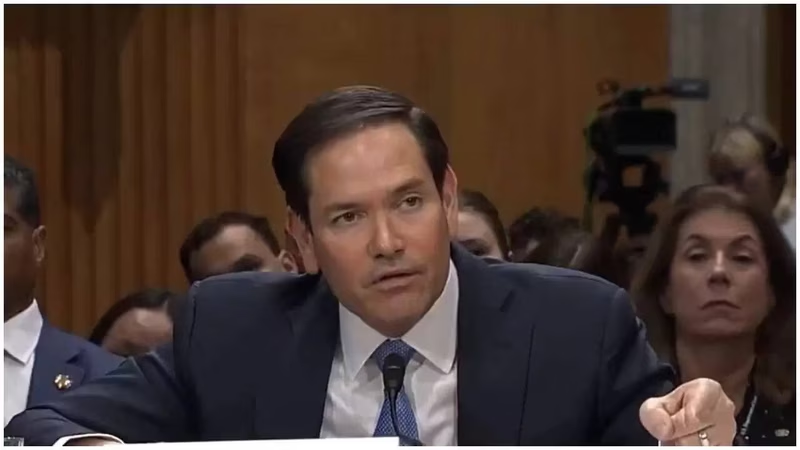
In a statement that blends reassurance with warning, U.S. Secretary of State Marco Rubio declared this week: “The United States is not at war with Venezuela—but with the transnational criminal organizations that have hijacked it.” The remarks came hours after unconfirmed but credible reports that Venezuelan President Nicolás Maduro had been captured in a covert U.S.-backed operation.
While details remain murky, Rubio’s framing—emphasizing that Washington’s target isn’t a nation but its alleged criminal networks—marks a sharp pivot in U.S. messaging. It’s a narrative designed to soothe allies, deter adversaries, and position America as a liberator, not an occupier. But beneath the diplomatic veneer lies a high-stakes gamble. And the phrase “US not at war with Venezuela” may be more strategic semantics than geopolitical reality.
Rubio’s Bold Declaration After Maduro’s Capture
Speaking from the State Department, Rubio confirmed that an operation had indeed removed Maduro from power, calling it a “decisive intervention against a regime that had become a narco-state.” He stopped short of claiming direct U.S. military involvement but acknowledged “close coordination with regional partners and internal dissidents.”
Crucially, Rubio stressed that the U.S. is “ready to work with Venezuela’s new leaders—if they choose the path of democracy, rule of law, and anti-narcotics cooperation.” If not, he added, “we retain full leverage through sanctions, asset freezes, and international isolation.”
This dual-track approach—offering partnership while holding threats in reserve—is classic coercive diplomacy. But labeling the mission as anti-cartel rather than anti-Venezuela is a deliberate effort to avoid triggering broader regional backlash.
What Does ‘US Not at War with Venezuela’ Really Mean?
Legally and diplomatically, declaring war requires congressional approval—a step no modern U.S. administration has taken since World War II. Instead, Washington relies on executive authority for military actions under the guise of counterterrorism, drug interdiction, or humanitarian intervention.
By insisting the U.S. is “not at war with Venezuela,” Rubio is:
- Avoiding legal escalation: No formal war = no need for Congress to debate military funding or troop deployment.
- Managing optics: Prevents Latin American nations from accusing the U.S. of imperialism.
- Framing morally: Positions America as fighting crime, not overthrowing a sovereign government.
Yet critics argue this is a distinction without a difference. As former UN Special Rapporteur Agnes Callamard noted, “When you depose a head of state via external force, the label doesn’t change the reality on the ground” .
The Alleged Maduro–Drug Cartel Connection
Washington’s narrative hinges on long-standing accusations that Maduro and his inner circle colluded with drug cartels—particularly the infamous “Cartel of the Suns,” a network of corrupt Venezuelan military officials.
In 2020, the U.S. Department of Justice indicted Maduro on narcoterrorism charges, accusing him of “flooding the United States with cocaine” . While those claims were dismissed by Caracas and some neutral observers as politically motivated, intelligence agencies maintain that Venezuela under Maduro became a hub for cocaine trafficking from Colombia to Europe and the U.S.
Rubio’s statement leverages this history to justify intervention: “We are not targeting a country. We are dismantling a criminal enterprise that happened to control a government.”
A New Strategy: Coercive Diplomacy or Regime Change?
This operation appears to signal a new U.S. playbook for dealing with adversarial regimes: swift, deniable, and framed as law enforcement rather than war.
Compare this to Iraq (2003) or Libya (2011), where large-scale military invasions led to prolonged instability. The Venezuela model—if successful—could become a template for future interventions in places like Iran or Myanmar, where direct war is politically untenable but regime pressure is desired.
However, the risks are immense. Without a legitimate transitional government, Venezuela could descend into warlordism, with rival militias—some backed by Russia, others by Colombia—filling the vacuum. As one Latin America analyst put it, “Removing a dictator is easy. Building a state is hard” [INTERNAL_LINK:regime-change-aftermath].
How Venezuelans and the World Are Reacting
Inside Venezuela, reactions are deeply polarized. Anti-Maduro activists in Caracas celebrated in the streets, waving U.S. and Venezuelan flags. But in poorer neighborhoods loyal to Chavismo, fear and anger are rising—many see this as a U.S. occupation disguised as liberation.
Globally, responses are cautious:
- Brazil and Colombia: Called for calm but stopped short of endorsing U.S. actions.
- Russia and China: Condemned the move as “illegal interference” and vowed support for “legitimate Venezuelan forces.”
- European Union: Urged a peaceful, democratic transition but expressed concern over “unilateral measures.”
The Organization of American States (OAS) remains deadlocked, reflecting the continent’s fractured stance on U.S. hegemony.
Implications for US–Latin America Relations
Rubio, a Cuban-American senator long known for his hardline stance on socialist regimes, is betting that Latin America will welcome Maduro’s ouster. But the region’s “Pink Tide” resurgence—leftist governments in Mexico, Chile, and Argentina—makes that uncertain.
Many Latin leaders still remember the U.S.-backed coups of the 20th century. Even if Maduro was authoritarian, his removal by foreign hands could fuel anti-American sentiment for years. As President Lula of Brazil warned: “The solution for Venezuela must be Venezuelan—not Washington-designed” .
Conclusion: Rhetoric, Realpolitik, or Red Line?
Marco Rubio’s insistence that the US not at war with Venezuela is a masterclass in diplomatic framing. But whether it holds water depends on what comes next. If Venezuela stabilizes under a reformist, democratic government that cracks down on cartels, the U.S. could be hailed as a force for good. If chaos follows, this operation may be remembered not as a liberation, but as another foreign overreach with tragic consequences.
For now, the world watches—not just Venezuela’s streets, but Washington’s promises.