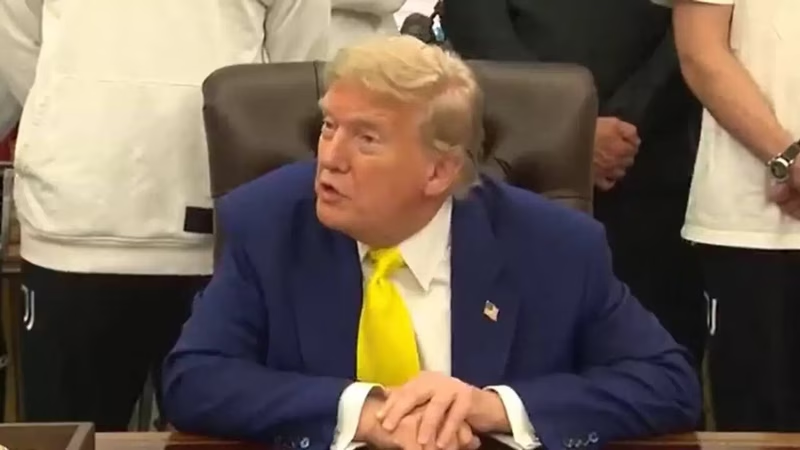
The White House Situation Room is a place where whispers can echo like thunderclaps across the globe. Recently, one such whisper has sent shockwaves through diplomatic and defense circles: a blunt message from America’s top military brass to former President Donald Trump—“need more time.” This urgent plea comes as Trump, known for his hawkish stance, is said to be actively considering military options against Iran, a nation already roiling in its third week of intense internal protests . The core of the military’s concern? A rushed US military Iran invasion could trigger a devastating regional war for which American forces are not yet fully prepared.
Table of Contents
- The Military’s Stark Assessment: Why They Need More Time
- Trump’s Iran Dilemma Amid Escalating Protests
- Potential Scenarios and Global Fallout
- Historical Context: A Long-Standing Hostility
- Conclusion: On the Precipice of a Fateful Decision
- Sources
The Military’s Stark Assessment: Why They Need More Time
The Pentagon’s primary mission is to ensure that any order from the Commander-in-Chief can be executed with maximum effectiveness and minimal risk to US personnel. In the case of Iran, this is an exceptionally complex task. US military officials have been clear: launching a strike or a full-scale US military Iran invasion without adequate preparation is a recipe for disaster . Their request for “more time” isn’t about delay for its own sake; it’s a strategic necessity.
Commanders are urgently pushing to consolidate US military positions across the Middle East. This involves reinforcing bases in Qatar, Bahrain, and Kuwait, ensuring air superiority, and pre-positioning critical assets like missile defense systems (such as THAAD and Patriot batteries) to counter the inevitable Iranian retaliation. Iran’s arsenal includes thousands of ballistic missiles and a vast network of proxy militias from Lebanon to Yemen, all capable of striking US interests simultaneously . Acting prematurely would leave these forward-deployed forces dangerously exposed.
Trump’s Iran Dilemma Amid Escalating Protests
The backdrop to this high-stakes military planning is the ongoing civil unrest inside Iran. Now in its third week, the protest movement has presented the Trump administration with both an opportunity and a profound risk . On one hand, the chaos within Iran could be seen as a moment of vulnerability. On the other, any overt US military action could instantly unify the fractured Iranian populace against a common foreign enemy, potentially crushing the protest movement and strengthening the very regime the US seeks to pressure.
Reports suggest the Trump administration was finalizing preliminary attack plans, which included the option of large-scale airstrikes on key Iranian nuclear and military facilities . However, the military’s cautionary note has seemingly injected a critical pause into this process. The dilemma for Trump is classic: act decisively and risk a wider war, or wait for perfect conditions that may never come.
Potential Scenarios and Global Fallout
If the US were to proceed with military action, several scenarios could unfold, each with severe global consequences:
- Limited Airstrikes: A targeted campaign against specific facilities. While less risky than a ground invasion, it would almost certainly provoke Iranian missile attacks on US bases and allies like Israel and Saudi Arabia.
- Naval Blockade/Strait of Hormuz Closure: Iran has repeatedly threatened to close the Strait of Hormuz, through which a fifth of the world’s oil passes. A US attempt to enforce a blockade or an Iranian closure would send oil prices skyrocketing and trigger a global economic crisis.
- Regional Proxy War Escalation: Iranian-backed groups like Hezbollah and the Houthis would likely launch coordinated attacks across the region, dragging the US and its allies into multiple, simultaneous conflicts .
Historical Context: A Long-Standing Hostility
This current flashpoint didn’t emerge in a vacuum. The animosity between Washington and Tehran dates back to the 1979 Islamic Revolution and the subsequent hostage crisis. Tensions have flared repeatedly, from the Iraq War to the killing of Iranian General Qasem Soleimani in 2020. Each cycle of escalation has brought the two nations closer to open conflict. Understanding this deep-seated hostility is crucial to grasping why the military’s call for patience is so vital. A misstep now could ignite a fire that has been smoldering for over four decades. For more on the roots of this conflict, see our deep dive on [INTERNAL_LINK:history-of-us-iran-relations].
Conclusion: On the Precipice of a Fateful Decision
The message from the US military is clear and unambiguous: a hasty US military Iran invasion is a path fraught with peril. The request for “more time” is a professional assessment born from a sober understanding of the immense logistical, strategic, and human costs involved. As President Trump weighs his options, he stands at a historic crossroads. His decision will not only shape the future of US-Iran relations but could also determine the stability of the entire Middle East and the global economy for years to come. The world watches, holding its breath.
Sources
- Times of India. “Iran warns Israel, US that if Washington attacks, military…”
- Times of India. “Iran protests enter third week as Trump considers military…”
- Various Defense Reports. “Trump admin weighing preliminary attack plans on Iran…”
- International News Archives. “Iran rachets up warnings against protesters, threatens U.S….”