Table of Contents
- Brink of Conflict: US and Iran on Edge
- Trump’s Announcement: The US Military Fleet Iran Deployment
- Tehran’s Response: ‘Finger on the Trigger’
- Root Causes Behind the Escalation
- What Does the US Naval Armada Include?
- Global Reactions and Diplomatic Fallout
- What This Means for Regional Stability
- Conclusion: A Dangerous New Chapter
- Sources
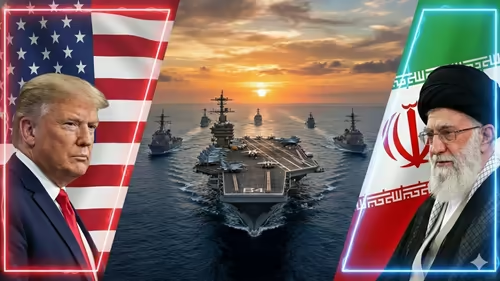
The Middle East is once again teetering on the edge of a major crisis. Former President Donald Trump has issued a stark warning, declaring that a “massive US military fleet” is moving toward Iran. This announcement comes amid heightened tensions following Tehran’s brutal suppression of nationwide protests and renewed concerns over its nuclear ambitions. In a chilling counter, Iranian officials have responded by stating they have their “finger on the trigger,” ready to retaliate against any perceived aggression. The phrase US military fleet Iran is now dominating headlines—and for good reason.
Brink of Conflict: US and Iran on Edge
This isn’t the first time the US and Iran have found themselves in a high-stakes standoff. However, the current situation is uniquely volatile due to a confluence of domestic unrest inside Iran, international scrutiny over its nuclear activities, and the return of hardline rhetoric from key political figures in Washington. The timing is especially sensitive, with ongoing internet blackouts in Iran making it difficult to verify reports from the ground—adding layers of uncertainty and fear.
Trump’s Announcement: The US Military Fleet Iran Deployment
In a series of public statements, former President Trump confirmed that an “armada” of US naval assets is being deployed to the Persian Gulf region. While he expressed hope that the show of force would not lead to actual conflict, his message was clear: the United States is prepared to act decisively if necessary. Though Trump is no longer in office, his influence on foreign policy discourse remains significant, and his comments are seen as reflective of broader hawkish sentiments within certain segments of the US government.
It’s important to note that while the Biden administration has not officially confirmed the scale of this deployment, US Central Command (CENTCOM) has acknowledged increased naval activity in the region—a standard practice during periods of heightened tension .
Tehran’s Response: ‘Finger on the Trigger’
Iran’s reaction was swift and defiant. Senior Iranian military officials declared that the country is fully prepared to defend itself. “We have our finger on the trigger,” one commander stated, signaling readiness to launch retaliatory strikes if attacked. This language echoes past confrontations but carries new weight given the current internal instability within Iran.
Adding to the complexity, both sides are disputing the death toll from recent anti-government protests. Iranian authorities claim only a handful of deaths, while human rights groups estimate hundreds have been killed during the crackdown. The information blackout makes independent verification nearly impossible, fueling international condemnation and calls for accountability.
Root Causes Behind the Escalation
Three key factors are driving this dangerous escalation:
- Protest Crackdown: Widespread civil unrest erupted after the death of a young woman in police custody, sparking nationwide demonstrations against the regime’s authoritarian rule.
- Nuclear Program Advances: Iran has reportedly resumed enriching uranium at levels close to weapons-grade, violating the terms of the stalled 2015 nuclear deal (JCPOA).
- Geopolitical Posturing: With elections looming in several Western nations, leaders may be using strong rhetoric to signal resolve—potentially miscalculating the other side’s willingness to de-escalate.
What Does the US Naval Armada Include?
While exact details remain classified, historical precedent suggests such a deployment likely includes:
- An aircraft carrier strike group (e.g., USS Gerald R. Ford or USS Dwight D. Eisenhower)
- Accompanying guided-missile cruisers and destroyers
- Submarines capable of launching cruise missiles
- Aerial reconnaissance and refueling support from nearby bases in Qatar and Bahrain
These assets provide the US with overwhelming conventional firepower, capable of enforcing blockades, conducting precision strikes, or deterring hostile actions without immediate ground involvement.
Global Reactions and Diplomatic Fallout
The international community is deeply concerned. The European Union has called for “maximum restraint,” while China and Russia have urged dialogue—but also criticized US “militarism.” The United Nations has appealed for transparency regarding the protest deaths and an end to internet shutdowns in Iran.
Meanwhile, regional allies like Saudi Arabia and Israel are watching closely. Both nations have long viewed Iran as an existential threat and may see this moment as an opportunity—or a risk—to recalibrate their own security postures.
What This Means for Regional Stability
A direct US-Iran conflict could ignite a wider regional war, disrupt global oil supplies, and trigger a humanitarian catastrophe. Even short of war, the current standoff increases the likelihood of proxy attacks, cyber warfare, and maritime incidents in the strategically vital Strait of Hormuz—through which nearly 20% of the world’s oil passes .
For ordinary citizens in Iran and neighboring countries, the stakes couldn’t be higher. Economic sanctions, inflation, and the threat of violence are already taking a heavy toll. Any further escalation could devastate civilian populations far beyond the battlefield.
Conclusion: A Dangerous New Chapter
The movement of a US military fleet Iran-ward marks a critical juncture in an already fraught relationship. While deterrence may prevent immediate conflict, the underlying issues—political repression, nuclear proliferation, and mutual distrust—remain unresolved. Without urgent diplomacy, the region risks sliding into a cycle of retaliation that could spiral out of control. For now, the world watches and waits, hoping cooler heads will prevail. To understand more about how global powers navigate such crises, explore our in-depth analysis on [INTERNAL_LINK:middle-east-geopolitics].
Sources
- Times of India: ‘Massive US military fleet moving towards Iran’: Trump after Tehran says it has ‘finger on trigger’
- U.S. Central Command (CENTCOM): Official Statements on Force Posture
- U.S. Energy Information Administration (EIA): Strait of Hormuz Oil Transit Data
- Human Rights Watch: Reports on Iran Protest Crackdown