US Military Deployment in UK Sparks Global Alarm Amid Venezuela Crisis
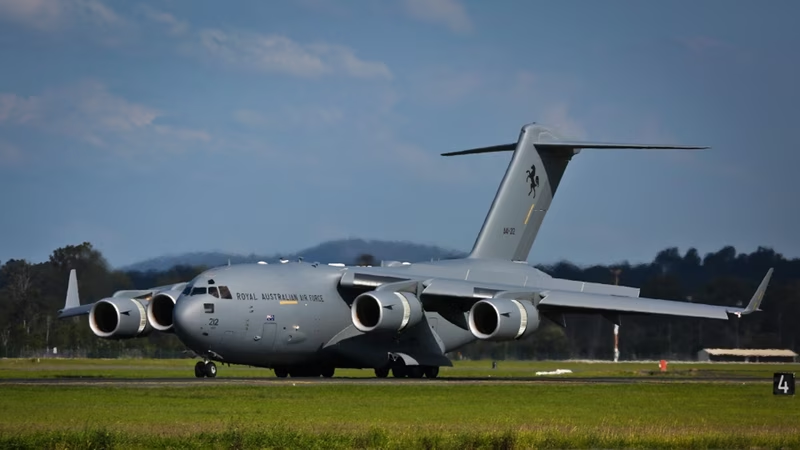
Since the weekend, a stream of heavily armed US military aircraft—including C-17 Globemaster cargo jets and AC-130J Ghostrider gunships—has been landing at Royal Air Force bases across southern England. Accompanying them are elite US special operations forces, observed conducting low-profile drills near military installations. This sudden and unannounced US military deployment UK surge comes on the heels of explosive reports that Venezuelan President Nicolás Maduro has been captured, possibly during an internal coup or foreign-backed operation .
The UK government has declined all requests for comment, citing “operational security,” while US European Command (EUCOM) has remained equally tight-lipped. But satellite imagery, flight tracking data, and eyewitness accounts paint a picture of rapidly escalating military preparedness—one that has sent shockwaves through diplomatic corridors from Caracas to Moscow.
Table of Contents
- What We Know About the US Military Deployment UK
- The Venezuela Connection: Maduro’s Alleged Capture
- Strategic Significance of UK Bases
- Historical Precedents: US-UK Military Cooperation
- Global Reactions and Geopolitical Risks
- What Could Happen Next?
- Conclusion
- Sources
What We Know About the US Military Deployment UK
Open-source intelligence (OSINT) analysts have confirmed at least six C-17 transport flights and two AC-130J gunship arrivals at RAF Brize Norton and RAF Mildenhall since Saturday. These aircraft are capable of rapid troop deployment, close air support, and nighttime special ops missions.
Ground units identified include elements of the US Army’s 10th Special Forces Group (Airborne) and possibly Navy SEAL Team Six, based on vehicle markings and uniform patches spotted near base perimeters. Local residents reported hearing nighttime helicopter sorties and seeing convoys of unmarked armored vehicles.
Critically, this isn’t routine training. “The scale and speed suggest contingency planning—not exercise,” said Dr. Eleanor Hayes, a defense analyst at the Royal United Services Institute (RUSI) .
The Venezuela Connection: Maduro’s Alleged Capture
The timing is no coincidence. Multiple Latin American media outlets, including El Nacional and Infobae, reported over the weekend that President Maduro was seized by a faction of the Venezuelan military in Caracas, allegedly with tacit support from external actors .
While the White House has not confirmed Maduro’s capture, State Department officials have called for “a peaceful transition of power” in Venezuela. The US has long labeled Maduro’s regime as illegitimate and has imposed crippling sanctions since 2019.
If Maduro is indeed deposed—or worse—the US may be positioning forces in the UK as a forward staging hub for potential humanitarian intervention, evacuation of American citizens, or even enforcement of a no-fly zone over Venezuela.
Strategic Significance of UK Bases
The UK serves as the US military’s primary European logistics and command node. RAF bases offer:
- Proximity to the Atlantic: Ideal for rapid deployment to the Caribbean or South America.
- Secure Communications Infrastructure: Home to joint US-UK intelligence facilities like Menwith Hill.
- Political Cover: Operating from a close ally provides diplomatic deniability and reduces backlash.
Historically, the UK has been a launchpad for US operations—from the 1983 Grenada invasion to the 2003 Iraq War. This latest US military deployment UK activity fits that precedent but with far higher stakes given Venezuela’s strategic oil reserves and proximity to US shores.
Historical Precedents: US-UK Military Cooperation
The “Special Relationship” isn’t just rhetoric. The two nations share nuclear targeting data, intelligence via the Five Eyes alliance, and integrated command structures. During the Falklands War, the US quietly supplied the UK with Sidewinder missiles. In 2011, RAF Lakenheath hosted US A-10s for Libya operations.
But Venezuela is different. Unlike Libya or Iraq, it borders a major US strategic rival—China has invested over $60 billion in Venezuelan oil. Russia also maintains a small military presence in Caracas. Any US-led action could trigger a broader confrontation.
Global Reactions and Geopolitical Risks
Unsurprisingly, reactions are pouring in:
- Russia: Foreign Minister Sergei Lavrov condemned the “militarization of Europe for regime change in the Global South.”
- China: Called for “non-interference” and warned against “neo-colonial adventures.”
- EU: Urged restraint but stopped short of criticizing the US-UK coordination.
- Latin American Nations: Mexico and Argentina demanded an emergency OAS meeting.
The risk? A regional crisis could spiral into a global flashpoint—especially if US forces move directly into Venezuela without UN backing.
What Could Happen Next?
Experts outline three likely scenarios:
- Diplomatic Resolution: Maduro is released or replaced via internal negotiation; US forces stand down.
- Limited Intervention: US special forces enter Venezuela to secure oil infrastructure or extract personnel, using UK bases for support.
- Full-Scale Escalation: If Russia or China responds aggressively, the UK could become a secondary theater in a wider conflict.
For now, all eyes are on Downing Street and the Pentagon—both of whom remain silent.
Conclusion
The sudden US military deployment UK is more than a routine show of force—it’s a geopolitical earthquake in slow motion. With Venezuela in chaos and great powers on high alert, Britain’s role as America’s unsinkable aircraft carrier has never been more visible—or more dangerous. As tensions mount, one thing is clear: the world is watching, and the next 72 hours could redefine Western foreign policy for a generation. For deeper analysis on military strategy, see our feature on [INTERNAL_LINK:how-us-uk-alliance-shapes-global-security].
Sources
- Times of India: US warplanes and elite units have been landing in Britain since the weekend
- Royal United Services Institute (RUSI): Analysis on US-UK Defense Cooperation
- FlightRadar24 & ADS-B Exchange: Military Aircraft Tracking Data
- El Nacional (Venezuela): Report on Maduro’s Capture
- U.S. European Command (EUCOM): Official Statements