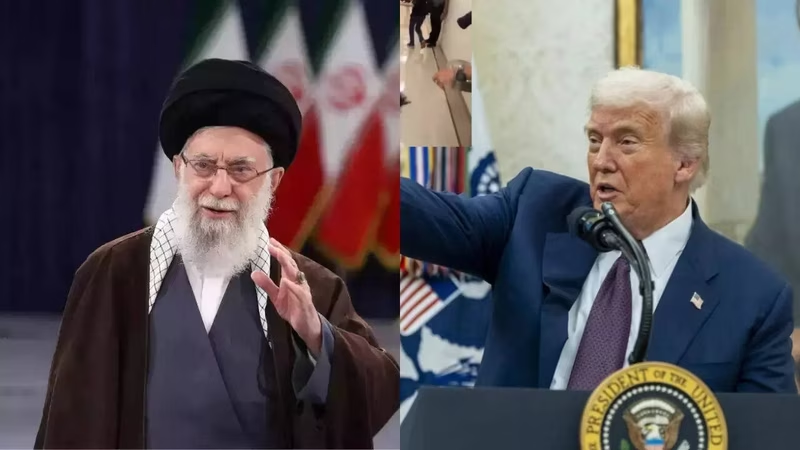
The world held its breath for 48 hours, bracing for a major military confrontation. Now, in a dramatic and swift turn of events, signs point to a significant de-escalation in the volatile standoff between the United States and Iran. US aircraft and personnel are streaming back into Qatar’s Al Udeid Air Base, while Iran has officially reopened its national airspace, which had been shuttered in anticipation of an American strike .
This rapid shift raises a critical question: has the immediate threat of a US military action against Tehran been called off? The answer appears to be a cautious ‘yes’—for now.
Table of Contents
- Signs of De-escalation: Troops and Airspace
- Trump’s Stance on Iran Protests
- What Happened at Al Udeid Air Base?
- Impact of Iran’s Airspace Closure
- Is the Crisis Really Over?
- Conclusion
- Sources
Signs of De-escalation: Troops and Airspace
The most concrete indicators of a cooling-off period are unfolding on the ground and in the skies. Following a heightened security alert that prompted a precautionary drawdown of non-essential personnel, the US military has begun a phased return to its largest air base in the Middle East, Al Udeid in Qatar . Concurrently, the Iranian government announced the reopening of its airspace after a roughly five-hour closure that had forced international airlines to reroute their flights across a vast region .
This coordinated reversal of defensive postures by both nations strongly suggests that direct communication channels may have been effective in pulling the situation back from the brink.
Trump’s Stance on Iran Protests
The entire crisis was ignited by the Iranian government’s brutal crackdown on widespread domestic protests. In response, President Donald Trump issued stark warnings of “serious consequences” if the violence against civilians continued . However, in a pivotal update, Trump stated on Wednesday, “we’ve been told killing has stopped” in Iran . This intelligence-driven claim appears to be the catalyst for the US decision to step back from its aggressive military posture.
It’s worth noting that public opinion in the US is heavily against military intervention. A recent Quinnipiac poll found that a staggering 70% of Americans oppose US military involvement in Iran, with strong majorities across all political parties sharing this view . This domestic pressure likely factored into the White House’s calculus.
What Happened at Al Udeid Air Base?
Al Udeid Air Base is the nerve center for US Central Command operations in the Middle East. On Wednesday, amid fears of an imminent Iranian retaliatory strike, Qatar confirmed the “departure of certain personnel” from the base as a precautionary measure . The US and its allies, including the UK, initiated a temporary reduction in their footprint there .
By Thursday, January 15, 2026, the security alert level at the base had been officially lowered, paving the way for the return of evacuated staff and aircraft . This move signals a return to normal operations and a significant reduction in the perceived threat level.
Impact of Iran’s Airspace Closure
Iran’s decision to close its airspace (OIIX/Tehran FIR) was a clear defensive maneuver, a standard procedure nations take when they anticipate incoming missile or air attacks . The closure, though brief, sent shockwaves through the global aviation industry.
Airlines were forced to implement emergency rerouting plans, leading to longer flight times, increased fuel costs, and passenger delays across routes connecting Europe, Asia, and the Middle East. The fact that Iran felt confident enough to reopen its skies so quickly is perhaps the strongest signal that it no longer believes an attack is imminent.
Is the Crisis Really Over?
While the immediate US Iran tensions appear to have subsided, experts urge extreme caution. The underlying issues—the violent suppression of protests in Iran and the deep-seated animosity between the two governments—remain entirely unresolved.
Here’s what we know for certain:
- The US has de-escalated its military posture based on a specific claim about the cessation of violence in Iran.
- Iran has reciprocated by reopening its airspace, suggesting it accepts the current status quo.
- The core grievances that sparked the protests are still present, meaning the situation inside Iran remains highly unstable.
As one analyst noted, this is less a resolution and more a temporary ceasefire. The fundamental US Iran tensions that have defined the region for decades are far from over. For a deeper historical context on this complex relationship, see our guide on [INTERNAL_LINK:history-of-us-iran-relations].
Conclusion
The events of January 15, 2026, offer a powerful reminder of how quickly geopolitical crises can escalate—and de-escalate. The return of US troops to the Al Udeid base and the reopening of Iranian airspace are undeniable signs that a major military conflict has been averted, at least in the short term. This reprieve seems directly tied to President Trump’s assertion that the Iranian regime has halted its deadly crackdown on protesters. However, the fragile peace is built on a single, unverified claim. The world must remain vigilant, as the tinderbox of US Iran tensions is still very much intact and could reignite at any moment.
Sources
[1] Reuters. (2026, January 15). Signs of Trump-Iran deescalation as US troops return to Qatar base.
[2] Times of India. (2026, January 15). US troops return to Qatar base; Iran reopens airspace.
[3] BBC News. (2026, January 14). US and UK pulling some personnel from Qatar military base.
[4] Al Jazeera. (2026, January 14). Qatar confirms personnel movement out of key US air base.
[6] CNN. (2026, January 15). US lowers security alert at Qatar air base, sources say.
[8] Reuters. (2026, January 15). Iran reopens airspace after temporary closure over US threats.
[10] Aviation Safety Network. (2026, January 15). Iran – Safe Airspace.
[11] Quinnipiac University Poll. (2026, January 2). Protests in Iran: Possible U.S. Responses and Issues for Congress.
[15] The White House Briefing. (2026, January 14). Trump says ‘we’ve been told killing has stopped’ in Iran.