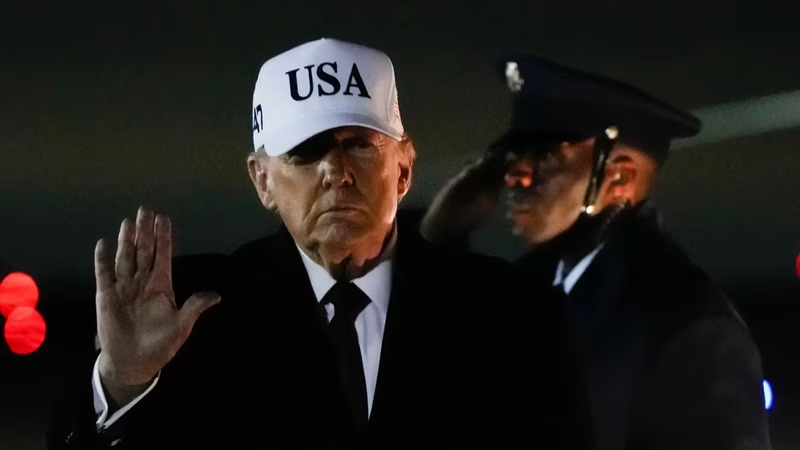
The fragile calm in the Persian Gulf just got a lot more volatile. In a move that has sent shockwaves through diplomatic corridors worldwide, former President Donald Trump has publicly declared that **airstrikes against Iran are still “on the table”**—and the White House has now officially confirmed this position. This isn’t just campaign trail bluster; it’s a deliberate signal that the U.S. is prepared to use military force to counter what it sees as an existential threat from Tehran.
Coming amid renewed concerns over Iran’s advancing nuclear capabilities and its support for proxy militias across the Middle East, this hardline stance raises urgent questions: Is the U.S. truly preparing for military action? What would such a strike achieve—and at what cost? And how might Iran respond?
Table of Contents
- What the White House Actually Said
- The Context Behind the US Iran Airstrikes Threat
- Trump’s History with Iran: From ‘Maximum Pressure’ to Near-War
- Potential Consequences of a US Strike on Iran
- Global Reactions and Diplomatic Fallout
- Conclusion: Is War Inevitable—or Is This Strategic Posturing?
- Sources
What the White House Actually Said
During a recent press briefing, a senior White House official, speaking on background, confirmed that “all options remain on the table” regarding Iran—including military action. This statement directly echoes remarks made by Donald Trump at a campaign rally, where he stated, “If they don’t come to their senses, we will take them out—fast and hard” .
While the current administration has not explicitly endorsed Trump’s phrasing, the confirmation that airstrikes are a considered contingency marks a significant hardening of U.S. posture. It suggests that behind closed doors, military planners are actively reviewing strike packages targeting Iran’s nuclear facilities, missile sites, and Revolutionary Guard command centers .
The Context Behind the US Iran Airstrikes Threat
This escalation doesn’t happen in a vacuum. Several key developments have fueled rising tensions:
- Nuclear Advances: The IAEA recently reported that Iran has enriched uranium to 60% purity—just a technical step away from weapons-grade levels .
- Regional Proxy Warfare: Iranian-backed groups like Hezbollah and the Houthis have intensified attacks on U.S. and allied interests in Iraq, Syria, and the Red Sea.
- Diplomatic Stalemate: Efforts to revive the 2015 JCPOA (Iran nuclear deal) have collapsed, leaving no active channel for de-escalation.
In this environment, the U.S. appears to be shifting from containment to deterrence-by-threat—a strategy that carries enormous risk.
Trump’s History with Iran: From ‘Maximum Pressure’ to Near-War
Trump’s Iran policy has always been defined by confrontation. In 2018, he unilaterally withdrew the U.S. from the JCPOA and launched a “maximum pressure” campaign of sanctions that crippled Iran’s economy. The tension peaked in January 2020, when a U.S. drone strike killed Iranian General Qasem Soleimani, bringing the two nations to the brink of war .
Iran retaliated with missile strikes on U.S. bases in Iraq, injuring over 100 American soldiers. Only last-minute restraint prevented full-scale conflict. Now, with Trump positioning himself as a potential 2026 commander-in-chief, his renewed threats may be aimed as much at domestic voters as at Tehran.
Potential Consequences of a US Strike on Iran
A military strike would not be a surgical solution. Experts warn of a cascade of retaliatory actions:
- Oil Price Shock: Iran could block the Strait of Hormuz, through which 20% of the world’s oil flows, triggering a global energy crisis.
- Regional War: Hezbollah could launch massive rocket barrages on Israel; Iraqi militias could besiege U.S. embassies.
- Nuclear Acceleration: Rather than halting its program, Iran might openly sprint toward a bomb, citing self-defense.
- Humanitarian Crisis: Civilian casualties and infrastructure damage could destabilize the entire region for years .
As former Defense Secretary Robert Gates once warned, “A war with Iran would be catastrophic—not just for the region, but for the United States.”
Global Reactions and Diplomatic Fallout
U.S. allies are deeply concerned. European leaders, who still support diplomatic engagement, fear being dragged into a conflict they cannot control. China and Russia, both critical of U.S. interventionism, have called for restraint but may also exploit the chaos to expand their own influence in the Gulf.
Even within the U.S., there is bipartisan skepticism. Many lawmakers recall the Iraq War and are wary of intelligence used to justify another Middle East conflict. The confirmation of airstrikes as a live option has already sparked calls for Congressional oversight hearings .
Conclusion: Is War Inevitable—or Is This Strategic Posturing?
The confirmation of US Iran airstrikes as a viable option is a dangerous gambit. While it may be intended to pressure Tehran into negotiations or rally domestic support, it risks triggering the very conflict it seeks to avoid. History shows that in the Middle East, miscalculation can be fatal. As the world holds its breath, the path forward demands not just strength, but wisdom, restraint, and a renewed commitment to diplomacy before the drums of war drown out all other voices.
Sources
- Times of India: US-Iran relations: Trump keeping airstrikes ‘on the table,’ confirms White House
- U.S. Department of State – Iran Policy Statements
- International Atomic Energy Agency (IAEA) – Iran Verification Reports
- [INTERNAL_LINK:trump-iran-policy-timeline]
- [INTERNAL_LINK:middle-east-geopolitical-analysis-2026]