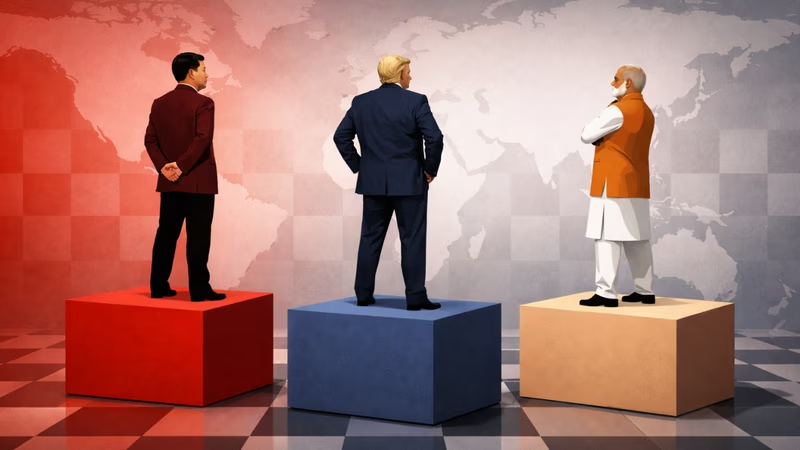
Imagine a world where China sits unchallenged at the top, while the United States and India nervously jockey for the runner-up spot—perpetual “second fiddles” in Beijing’s grand orchestra. Sounds dramatic, right? That’s exactly the narrative pushed by some analysts, including Keji Mao, who recently argued that America’s so-called “strategic altruism” toward India is fading under the weight of its own decline anxiety.
But here’s the reality check: this script is not only outdated—it’s dangerously misleading. The US-India-China relations triangle isn’t a linear race with a single winner. It’s a dynamic, contested, and multipolar chessboard where both Washington and New Delhi are actively shaping their own destinies, not waiting for Beijing’s permission slip.
Table of Contents
- The ‘Second Fiddle’ Fantasy Debunked
- What Is ‘Strategic Altruism’—And Is It Really Over?
- US Decline or Strategic Rebalancing?
- China’s Economic Headwinds and Geopolitical Overreach
- India’s Independent Path: Beyond Alignment
- The Emerging Multipolar World Order
- Conclusion: No Second Fiddles—Only Sovereign Players
- Sources
The ‘Second Fiddle’ Fantasy Debunked
The notion that the US and India are passive competitors for silver in a Chinese-dominated world order rests on three shaky assumptions:
- That US global influence is in irreversible decline.
- That China’s rise is unstoppable and linear.
- That India lacks agency and must rely on external patrons.
Each of these crumbles under scrutiny. Far from fading, the US is undergoing a strategic recalibration—shifting from unilateral dominance to coalition-based leadership. India, meanwhile, is leveraging its strategic autonomy to build partnerships without surrendering sovereignty.
What Is ‘Strategic Altruism’—And Is It Really Over?
Keji Mao uses the term “strategic altruism” to describe America’s past support for India’s rise—as if Washington were selflessly elevating a rival. But this misreads US foreign policy.
The truth? US engagement with India has always been rooted in mutual interest: countering shared threats (like terrorism and maritime coercion), balancing China’s assertiveness, and expanding democratic economic partnerships. As the Biden administration deepens the Quad and boosts defense tech transfers (like GE’s jet engine deal), it’s not altruism—it’s smart statecraft.
And far from ending, this cooperation is intensifying. The I2U2 grouping (India, Israel, UAE, US) and semiconductor supply chain pacts show a long-term alignment of strategic vision—not charity.
US Decline or Strategic Rebalancing?
Yes, the US faces domestic polarization and debt challenges. But its economic fundamentals remain strong. It leads in AI, quantum computing, and clean tech. Its dollar still anchors global finance. And its military spending ($877 billion in 2024) dwarfs China’s.
More importantly, the US is adapting. Instead of policing the world alone, it’s building resilient alliances—from NATO’s eastern flank to the Indo-Pacific. This isn’t decline; it’s maturity. For deeper analysis, see the Council on Foreign Relations on US strategic evolution.
China’s Economic Headwinds and Geopolitical Overreach
China’s growth is slowing. Its property sector is in crisis. Youth unemployment hovers near 15%. And its debt-to-GDP ratio exceeds 300%. Meanwhile, its “Wolf Warrior” diplomacy has alienated neighbors—from Vietnam to Australia—who are now hedging with the US and India.
Beijing’s Belt and Road Initiative, once a symbol of soft power, now faces debt-default backlash in Sri Lanka, Pakistan, and Zambia. And its military posturing in the South China Sea has pushed ASEAN states closer to Washington.
India’s Independent Path: Beyond Alignment
India is not a US proxy. It buys Russian oil despite sanctions. It abstains on Ukraine votes at the UN. It deepens ties with Iran and Central Asia. Yet it also participates in the Quad and buys American drones.
This isn’t contradiction—it’s strategic autonomy in action. India refuses to be boxed into blocs. As External Affairs Minister S. Jaishankar often says, “India is not a side—it’s a center of gravity.”
From the India-Middle East-Europe Corridor (IMEC) to its G20 presidency, India is crafting a multipolar world where no single power dictates terms.
The Emerging Multipolar World Order
The future isn’t unipolar (US), bipolar (US-China), or even tripolar. It’s networked multipolarity—where regional powers like India, Brazil, Indonesia, and the EU wield influence through issue-based coalitions.
In this world, success isn’t about ranking 1st or 2nd. It’s about sovereignty, resilience, and the ability to say “no” when needed. Both the US and India are mastering this art—and China is struggling to adapt.
Conclusion: No Second Fiddles—Only Sovereign Players
The “second fiddle” fantasy underestimates the agency of both the United States and India. The US-India-China relations dynamic isn’t a hierarchy—it’s a contest of visions. And in that contest, neither Washington nor New Delhi is playing a supporting role. They’re writing their own scripts, on their own terms.
Sources
- Times of India: ‘Second fiddle’ fantasy? Sorry, Beijing – US and India won’t settle for silver
- Council on Foreign Relations (CFR): US Foreign Policy and Global Strategy
- Ministry of External Affairs, India: Official Statements on Strategic Autonomy
- World Bank: China Economic Update