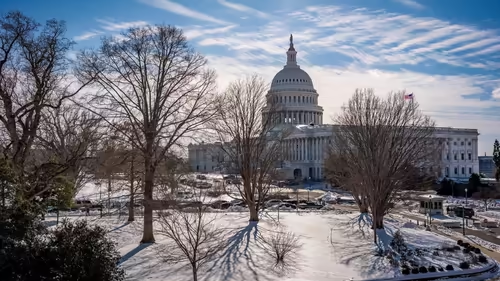
It’s official. The clock struck midnight on January 31, 2026, and with it, a US government partial shutdown became a reality. After weeks of tense negotiations and political brinkmanship, Congress failed to pass a crucial funding package, leaving a significant portion of the federal government scrambling to close its doors [[6]].
This isn’t a full-blown shutdown that grinds every agency to a halt, but it’s far from trivial. The lapse in funding affects six out of the twelve annual appropriations bills, meaning departments responsible for everything from national parks to food safety inspections are now operating in crisis mode [[5]].
Table of Contents
- What Happened? The Budget Breakdown
- What Is a Partial Shutdown (And How Is It Different)?
- Which Federal Agencies Are Affected?
- Real-World Impact: How This Affects You
- The Political Standoff Behind the Scenes
- How This Compares to Past Shutdowns
- Conclusion: What’s Next?
- Sources
What Happened? The Budget Breakdown
The immediate trigger was a failed vote in the Senate. On January 29, 2026, a key government funding package was blocked in a 45–55 vote. In a surprising twist, seven Republicans broke ranks and joined all Democrats in opposing the bill, effectively killing its chances [[1]]. This wasn’t just a partisan fight; it was a collapse of the usual legislative machinery.
Adding to the complexity, this shutdown follows a previous short-term funding deal that only kept the lights on until January 30, 2026. Congress’s chronic inability to pass a full-year budget on time has once again led the nation into a familiar, yet damaging, cycle of last-minute deals and eventual failure [[3]].
What Is a Partial Shutdown (And How Is It Different)?
Unlike a total government shutdown, a US government partial shutdown occurs when funding expires for only some of the twelve annual appropriations bills. In this case, six major spending bills have lapsed [[5]].
Agencies covered by the already-passed six bills—like Defense and Veterans Affairs—will continue to operate normally. However, the unfunded agencies must cease all non-essential functions. This means a confusing patchwork for the public: some services are available, others are not.
Which Federal Agencies Are Affected?
While the full list is extensive, the most noticeable impacts will likely come from these key departments whose funding has lapsed:
- Department of Homeland Security (DHS): This includes Customs and Border Protection, FEMA, and the Coast Guard. While border security is deemed essential, many administrative functions will halt.
- Department of Agriculture (USDA): Critical food safety inspections may continue, but many rural development programs and some research activities will stop.
- Department of the Interior: National parks and monuments will be affected. Some may close entirely, while others will remain open but with minimal staff and no maintenance.
- Environmental Protection Agency (EPA): Most of its operations, including environmental reviews and enforcement, will be suspended.
- Department of Housing and Urban Development (HUD): Many housing assistance programs could face delays.
Real-World Impact: How This Affects You
The consequences of a US government partial shutdown ripple far beyond Washington, D.C. Here’s what ordinary citizens might experience:
- Delayed Services: Passport and visa processing times can increase dramatically. Small business loan applications through the SBA may be put on hold.
- Economic Uncertainty: Furloughed federal workers (who are not paid during the shutdown) immediately cut back on spending, which can slow local economies. A prolonged shutdown can even impact the nation’s credit rating and stock market [[7]].
- <Health and Safety: While core food and drug safety inspections are often maintained, their scope can be reduced, potentially increasing public health risks.
- Travel Disruptions: While TSA agents are considered essential, their morale and staffing levels can be strained, potentially leading to longer airport security lines.
The Political Standoff Behind the Scenes
At its core, this shutdown is a symptom of a deep political divide. The specific sticking points in the failed funding package are varied, but typically involve contentious issues like border security funding, disaster relief allocations, or policy riders attached to the spending bills. The fact that members of the President’s own party voted against the measure suggests internal fractures and a lack of consensus on a path forward [[1]]. This political paralysis leaves millions of Americans caught in the crossfire.
How This Compares to Past Shutdowns
Government shutdowns have become a recurring feature of American politics. The longest on record, which lasted 35 days from December 2018 to January 2019, cost the economy an estimated $11 billion, according to the Congressional Budget Office. While this current US government partial shutdown may not reach that scale, even a short closure can have outsized effects on public trust and economic stability [[7]]. The key question now is whether lawmakers will find a compromise quickly or let the situation drag on.
Conclusion: What’s Next?
The ball is now in Congress’s court. To end the US government partial shutdown, lawmakers must either pass the remaining six appropriations bills or agree on a new Continuing Resolution (CR) to fund the government at current levels for a set period. Until then, hundreds of thousands of federal employees face an uncertain future, and the public will have to navigate a government that is only partially open for business. The hope is that this latest crisis will be short-lived, but history offers a cautionary tale about the fragility of the budget process in a deeply divided political climate.
Sources
- Wikipedia: 2026 United States federal government shutdown [[1]]
- Georgia Department of Labor: Partial Federal Government Shutdown Information [[6]]
- PilieroMazza PLLC: January 2026: Partial Government Shutdown Imminent [[3]]
- Committee for a Responsible Federal Budget: Congress Could End Government Shutdown Drama Once and For All [[5]]
- CBS News: What to know about the partial government shutdown [[7]]