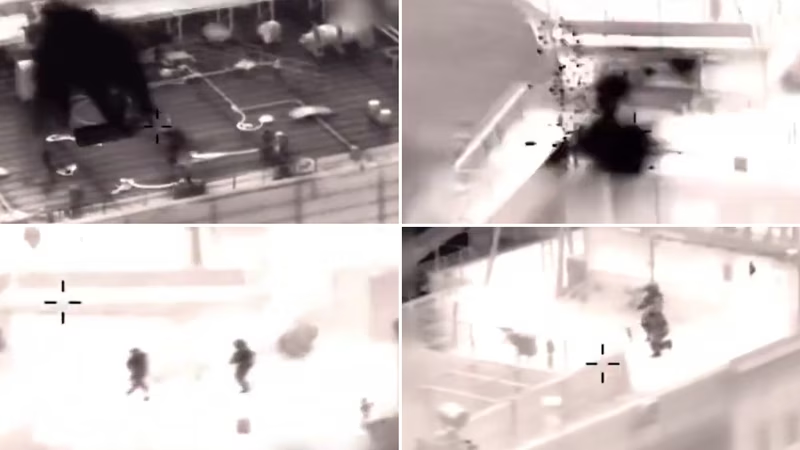
In a dramatic escalation of its maritime sanctions enforcement, US forces have once again boarded and seized a sanctioned oil tanker in the Caribbean Sea. This latest action, confirmed by the US military on January 9, 2026, is not an isolated incident but part of a coordinated, aggressive campaign targeting a clandestine network of vessels—dubbed the ‘shadow fleet’—that are allegedly facilitating a critical oil-for-weapons pipeline between two of America’s most adversarial regimes: Iran and Venezuela .
The interception sends a clear message: the United States is willing to project its power far beyond its shores to enforce its economic sanctions, turning the Caribbean into an unexpected new front in a global geopolitical struggle.
Table of Contents
- The Latest Interception: What We Know
- The Iran-Venezuela Pipeline: Fueling a Dangerous Alliance
- Operation Caribbe: The US Naval Buildup Explained
- The Shadow Fleet: How It Works and Why It’s a Threat
- Conclusion: A New Era of Maritime Enforcement?
- Sources
The Latest Interception: What We Know
While the specific name of the latest vessel has not been officially released by the US Coast Guard, this seizure marks a significant milestone. It is reportedly the third such sanctioned oil tanker stopped by US forces in the Caribbean during this current, intense enforcement push . Just weeks prior, in December 2025, the Treasury Department’s Office of Foreign Assets Control (OFAC) had already sanctioned four companies for operating in Venezuela’s oil sector and explicitly identified four associated oil tankers as blocked property .
This operation follows a string of similar actions. In early December, the tanker Skipper was seized off the Venezuelan coast after port call data revealed it had transported oil from both Venezuela’s Jose port and Iran’s Kharg Island—a smoking gun for the illicit trade . These aren’t just random ships; they are key assets in a sophisticated, state-sponsored smuggling operation that the US is now determined to dismantle piece by piece.
The Iran-Venezuela Pipeline: Fueling a Dangerous Alliance
The motivation behind these risky maritime ventures is a strategic alliance forged in mutual opposition to the United States. Venezuela, sitting on the world’s largest proven oil reserves, is desperate for refined products and advanced technology to revive its crippled energy sector. Iran, a pariah state under its own heavy sanctions, possesses the technical expertise and is eager for hard currency and a powerful ally in the Western Hemisphere.
The exchange is simple yet dangerous: Venezuelan crude for Iranian refined fuel, drones, and missile technology. In fact, just days before the latest tanker seizure, the US announced sanctions against 10 entities and individuals in Iran and Venezuela for their role in an alleged weapons trade, specifically citing Iran’s UAV and missile programs as a direct threat to US and allied security [[9], [11]].
This makes the oil flowing through these sanctioned oil tankers more than just a commodity—it’s the lifeblood of a partnership that directly challenges American interests and regional stability.
Operation Caribbe: The US Naval Buildup Explained
To combat this threat, the US has significantly ramped up its military presence in the region. What began in late August 2025 as a stated effort to combat drug trafficking has rapidly evolved into a full-scale maritime interdiction campaign [[15], [17]]. As of mid-December 2025, there were at least 10 US Navy warships actively patrolling the Caribbean, a formidable show of force dedicated to this mission .
This operation, often referred to in military circles as an extension of long-standing efforts like Operation Caribbe, now has a much sharper focus. It’s no longer just about narcotics; it’s about enforcing a complex web of economic sanctions and preventing the transfer of strategic resources that could empower hostile states. The US military’s willingness to conduct kinetic strikes on vessels affiliated with designated terrorist organizations in the region, as reported in December, underscores the seriousness of its intent .
The Shadow Fleet: How It Works and Why It’s a Threat
The vessels targeted by the US are part of what experts call the ‘dark’ or ‘shadow’ fleet. These are aging tankers that operate outside the mainstream, regulated shipping industry. They employ a range of deceptive tactics to evade detection:
- AIS Spoofing/Disabling: Turning off their Automatic Identification System (AIS) transponders to disappear from commercial tracking maps.
- Ship-to-Ship Transfers: Conducting risky oil transfers in the middle of the open ocean to avoid port inspections.
- Complex Ownership Structures: Using shell companies and flags of convenience to obscure their true ownership and destination.
In April 2025, OFAC even published a specific advisory for the maritime industry, providing guidance on how to detect and mitigate the risks associated with Iranian oil sanctions, highlighting just how pervasive and sophisticated these evasion tactics have become .
The US government views this shadow fleet not just as a sanctions-busting nuisance, but as a direct national security threat. By allowing rogue states to generate revenue and trade strategic goods, it undermines the entire international sanctions regime.
Conclusion: A New Era of Maritime Enforcement?
The repeated interception of a sanctioned oil tanker in the Caribbean signals a bold and assertive new chapter in US foreign policy. It demonstrates a willingness to use its unparalleled naval power to enforce economic statecraft in real-time, on the open seas. For countries like Iran and Venezuela, the cost of doing business just got significantly higher. For the global shipping industry, the message is clear: due diligence is no longer optional. The era of the shadow fleet may be facing its most formidable challenge yet, right in America’s own backyard.
For more on global security issues, see our coverage on [INTERNAL_LINK:geopolitical-risk-analysis] and [INTERNAL_LINK:international-sanctions-explained].
Sources
- Times of India: ‘Owning the sea’: Moment US forces intercepted sanctioned oil tanker in Caribbean Sea – watch
- The Canadian Press via Global News: US forces have intercepted another sanctioned oil tanker in Caribbean Sea
- Associated Press: US military says forces have intercepted another sanctioned oil tanker in Caribbean Sea
- US Department of the Treasury: Treasury Targets Iran-Venezuela Weapons Trade [[9], [11]]
- Kpler: Seized oil tanker Skipper hid location, visited Iran, Venezuela
- USNI News: Trump Vows Action Against Sanctioned Oil Tankers