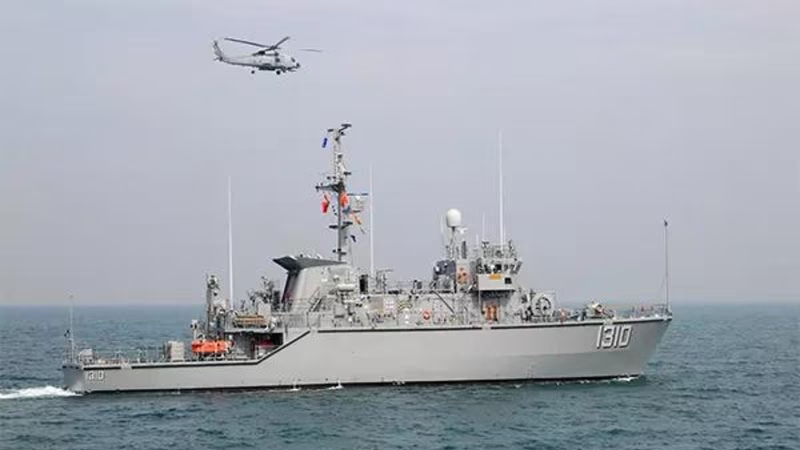
The world is watching with bated breath as a new flashpoint emerges in the already volatile relationship between China and Taiwan. In a stark and unequivocal statement, the United States has publicly called on Beijing to cease military pressure after a fresh round of aggressive China military drills Taiwan exercises sent shockwaves through the region .
These aren’t just routine maneuvers. They represent a calculated escalation that has Washington and its allies deeply concerned about the fragile peace in the Taiwan Strait. But what do these drills actually entail, and why is the US reaction so significant right now?
Table of Contents
- US Official Statement on China Military Drills
- The 2026 Drills: A Pattern of Escalation
- The International Community Reacts
- Why the US is So Invested in Taiwan Strait Stability
- What Happens Next: Potential Scenarios
- Conclusion: A Delicate and Dangerous Standoff
- Sources
US Official Statement on China Military Drills
The US State Department didn’t mince words. In its official press statement, it declared that China’s recent military activities around Taiwan have “unnecessarily” raised tensions in the region . The core of the US message is a direct plea to Beijing: exercise restraint and stop the military coercion .
This isn’t just a diplomatic nicety. The statement underpins a long-standing US policy of opposing any unilateral attempt to change the status quo in the Taiwan Strait by force . The US has consistently maintained that its position is not about taking sides in the sovereignty debate, but about preserving peace and stability—a principle that benefits the entire Indo-Pacific region.
This strong stance comes on the heels of the US approving an $11 billion arms package for Taiwan, a move that was itself a direct response to what Washington labeled as “provocative” Chinese military actions .
The 2026 Drills: A Pattern of Escalation
The latest China military drills Taiwan exercises, dubbed “Justice Mission 2025” by Beijing, involved a formidable show of force. Joint operations deployed air, naval, and rocket forces in a coordinated display of military might around the island .
While China claims these are standard exercises, the timing and scale tell a different story. Experts point to a clear and deliberate pattern of escalation. Historically, such large-scale drills have often been triggered by specific political events in Taiwan or high-level visits by foreign officials .
Looking back, the massive military response to US House Speaker Nancy Pelosi’s visit in 2022 set a new, more aggressive precedent . The 2026 drills appear to be a continuation of this strategy, designed to exert constant pressure on Taiwan’s government and deter any moves toward formal independence.
A Brief Timeline of China’s Military Pressure
- 2018-Present: A significant increase in the frequency and complexity of military drills around Taiwan, often linked to political developments on the island .
- 2022: Unprecedented “encirclement” drills following Speaker Pelosi’s visit, marking a major escalation .
- 2023: Continued aggressive patrolling and exercises, including in the South China Sea near Taiwan’s airspace .
- January 2026: The “Justice Mission 2025” joint exercises trigger a strong US-led international response .
The International Community Reacts
The US is not alone in its concern. The latest China military drills Taiwan activities have drawn serious criticism from a broad coalition of nations, signaling a united front against destabilizing actions.
Key International Reactions:
- The European Union: The EU has explicitly warned that these exercises are “raising cross-strait tensions and risking international peace” .
- Japan & Australia: Both nations, as key US allies in the region, have conveyed their “concern” directly to Beijing, a move that prompted a formal protest from China .
This collective response highlights how actions in the Taiwan Strait are no longer viewed as a purely regional issue but as a matter of global security and the rules-based international order.
Why the US is So Invested in Taiwan Strait Stability
The US’s interest goes beyond simple alliance politics. A stable Taiwan Strait is a cornerstone of its broader Indo-Pacific strategy. An armed conflict would have catastrophic economic consequences, disrupting global supply chains that run through this critical waterway.
Furthermore, the US sees its commitment to Taiwan as a test of its credibility as a security partner. Failing to respond to Chinese coercion could embolden Beijing in other territorial disputes and undermine trust among other allies in the region. The official stance is clear: the US will provide Taiwan with the means to defend itself, while consistently urging both sides to resolve their differences through peaceful dialogue .
What Happens Next: Potential Scenarios
The situation remains fluid and dangerous. Several potential paths forward exist:
- Diplomatic De-escalation: Beijing could heed the international calls for restraint, scaling back its military activities and re-engaging in dialogue. This is the best-case scenario but seems unlikely in the current climate.
- Continued Low-Level Pressure: China might maintain its current strategy of regular, smaller-scale drills and incursions to keep Taiwan on edge without triggering a major conflict.
- Further Escalation: A significant political event in Taiwan or a major US policy shift could provoke an even more forceful Chinese military response, potentially pushing the two sides closer to a dangerous brink.
For now, all eyes are on Beijing’s next move and whether its desire for a stable international environment will outweigh its strategic objectives regarding Taiwan.
Conclusion: A Delicate and Dangerous Standoff
The US demand for China to cease its military pressure on Taiwan is more than just a statement; it’s a critical moment in a long-simmering geopolitical crisis. The recent drills are a stark reminder of the fragility of the status quo in the Taiwan Strait. While the US and its allies have drawn a clear red line against the use of force, the path to lasting peace remains fraught with uncertainty. The world can only hope that cooler heads will prevail in this high-stakes game of strategy and deterrence.
Sources
- ABS-CBN News. “US says China’s drills around Taiwan ‘increase tensions unnecessarily’.” Published Jan 02, 2026.
- The Times of India. “US reacts to China’s drills around Taiwan; calls for restraint.”
- Reuters. “US recently approved $11bn arms package for Taiwan…”
- BBC News. “US Says China’s Taiwan Drills ‘Unnecessarily’ Raised Tensions.”
- Al Jazeera. “China military drills near Taiwan ‘unnecessarily’ raise tensions.”
- Associated Press. “US urges restraint after China military drills near Taiwan region.”
- South China Morning Post. “China stages live-fire military drills around Taiwan…”
- Bloomberg. “US urges China to stop military pressure on Taiwan.”
- The White House. “Read: Response to China’s Military Exercise Near Taiwan.”
- Reuters. “China protests after Japan, Australia, EU convey ‘concern’.”
- European Commission Press Release. “EU says China’s recent military exercise around Taiwan…”
- Deutsche Welle. “EU worried by China’s military exercise around Taiwan.”
- Council on Foreign Relations. “Tracking China’s April 2023 Military Exercises around Taiwan.”
- Foreign Policy. “Timeline of Pelosi’s Taiwan visit and the aftermath.”