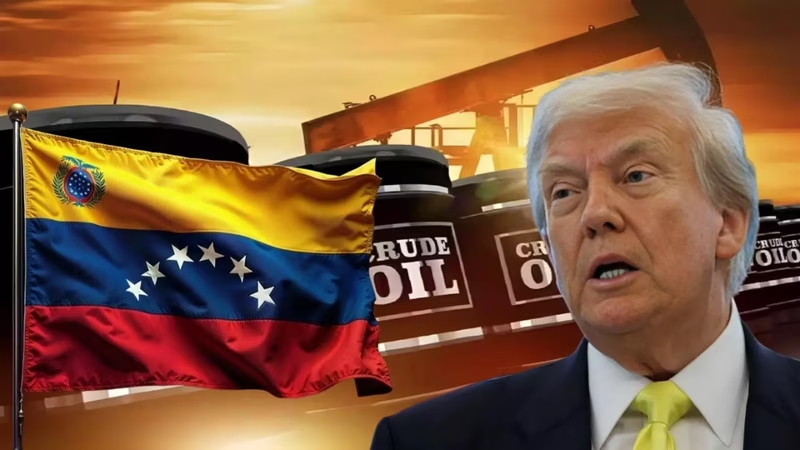
US Control of Venezuelan Oil: A Game-Changer for India’s $1 Billion Stake
For over a decade, a financial ghost has haunted India’s energy ambitions in Venezuela: nearly $1 billion in unpaid dues. Now, a dramatic and controversial shift in the South American nation’s oil sector, orchestrated by the United States, could finally lay that ghost to rest. This isn’t just about recovering money; it’s about reviving a strategic international asset and securing a slice of one of the world’s largest oil reserves. Let’s break down this complex geopolitical and financial puzzle.
Table of Contents
- The Billion-Dollar Ghost in Venezuela’s Oil Fields
- What’s Behind the US Grip on Venezuelan Oil?
- How India Stands to Benefit: A Double Win
- The San Cristobal Field: A Strategic Asset Poised for Revival
- The Road Ahead: Potential Hurdles and Opportunities
- Conclusion
- Sources
The Billion-Dollar Ghost in Venezuela’s Oil Fields
The core of this issue lies with ONGC Videsh Ltd (OVL), the overseas investment arm of India’s Oil and Natural Gas Corporation. OVL holds a significant 40% stake in the San Cristobal onshore oilfield in eastern Venezuela . For years, the company has been owed massive dividends from this investment—roughly $536 million for the period up to 2014 alone, with a nearly equivalent amount accrued since then, bringing the total close to the $1 billion mark .
At one point, a potential solution emerged: Venezuela offered to pay these dues in crude oil instead of cash. In early 2024, reports confirmed that Venezuela had agreed to supply OVL with oil worth $600 million in lieu of the pending dividend [[8], [9], [12], [14]]. While a step forward, this only covered part of the total debt and was contingent on the field’s ability to produce consistently—a major challenge under crippling US sanctions.
What’s Behind the US Grip on Venezuelan Oil?
The United States has long used sanctions as a primary tool to pressure Venezuela’s government. Executive Order 13850 has been the legal backbone for these sanctions, which have specifically targeted the country’s oil sector and its state-owned oil company, PDVSA .
However, recent geopolitical maneuvers suggest a more direct form of control is emerging. Reports indicate a “US-led takeover of Venezuela’s oil sector” is underway . This isn’t just about applying pressure; it’s about actively managing the flow of Venezuela’s most valuable resource. US oil giants like Valero and Marathon are already receiving a significant portion of Venezuela’s sanctioned exports, with data showing around 150,000 barrels per day flowing to the US in late 2025 .
This shift appears to be a calculated move. By easing sanctions for companies that operate under a US-approved framework (a so-called “Chevron model”), the US can effectively control Venezuela’s oil production and revenue streams, using them as a powerful bargaining chip .
How India Stands to Benefit: A Double Win
This new US-controlled environment presents a unique, albeit complex, opportunity for India. The primary benefit is clear: the potential recovery of the nearly $1 billion in long-pending dues. With the US now managing the sector, there’s a more structured and reliable pathway for payments or oil-for-dues swaps to occur without the previous risks of seizure or logistical nightmares.
The second, equally important benefit is the potential to revive crude production from the San Cristobal field. For years, the project has been largely stalled, a victim of Venezuela’s economic collapse and the sanctions regime. With the US easing its grip for compliant operators, OVL now has a realistic chance to restart its operations . This is a classic double win: get paid what you’re owed and get your asset working again.
The San Cristobal Field: A Strategic Asset Poised for Revival
The San Cristobal field is not just a line item on a balance sheet; it’s a strategic component of India’s long-term energy security plan. Holding a 40% stake in this onshore asset has been a point of pride and a significant overseas investment for OVL .
The revival of this field under the new US-Venezuela framework would mean:
- Secured Energy Supply: A steady stream of crude oil for the Indian market, reducing reliance on other volatile regions.
- Operational Expertise: A chance for OVL to leverage its technical skills in a challenging but resource-rich environment.
- Geopolitical Leverage: A successful project could strengthen India’s position as a serious player in global energy markets. As India’s embassy in Caracas has long encouraged, the nation is keen to participate in Venezuela’s development programs .
OVL has already been in talks with the Venezuelan government, seeking a license to operate under this new, US-sanctioned model, and is actively pursuing the necessary exemptions .
The Road Ahead: Potential Hurdles and Opportunities
While the outlook is more optimistic than it has been in years, the path forward is not without its challenges. The US’s grip on the Venezuelan oil sector is inherently unstable and tied to the volatile political situation in Caracas. A shift in US foreign policy or a hardening of Venezuela’s stance could easily derail the current arrangement.
Furthermore, the infrastructure in Venezuela’s oil fields is in dire need of investment and repair. As one analysis noted, a full recovery of the country’s oil industry would “take years and billions of dollars” . OVL and its partners would need to be prepared for a significant capital outlay to get San Cristobal back to its full potential.
For India, this situation represents a high-risk, high-reward opportunity. The potential to unlock a billion dollars and secure a long-term energy source is immense. The key will be for Indian policymakers and OVL to move swiftly and strategically within the narrow window of opportunity provided by the current US-Venezuela dynamic.
Conclusion
The US’s increasing control over Venezuelan oil is more than a regional power play—it’s a global energy market event with far-reaching consequences. For India, it offers a long-awaited solution to a decade-old financial headache. The potential to recover $1 billion in dues and breathe new life into the San Cristobal oilfield is a compelling proposition. While significant hurdles remain, the current geopolitical climate presents a unique and timely opportunity for India to secure a major win for its energy future. As the situation evolves, all eyes will be on how New Delhi and OVL navigate this complex new landscape. For more on global energy deals, see our analysis on [INTERNAL_LINK:global-energy-diplomacy].
Sources
[1] U.S. Department of the Treasury. “Venezuela-Related Sanctions.”
[2] Reuters. “Data on U.S.-bound exports from Venezuela.” (November 2025).
[8] Economic Times. “Venezuela offers ONGC Videsh oil in lieu of $600 mn.” (January 4, 2024).
[10] The Economic Times. “US Takes Venezuela Oil Helm: India Poised to Recover $1 Billion.”
[11] The Times of India. “Explained: Why US control of Venezuelan oil could free $1 billion in dues.”
[15] Business Standard. “ONGC Videsh nears approval for oil operations in Venezuela.” (August 30, 2024).
[17] Embassy of India, Caracas. “India in Venezuela.”
[18] Foreign Policy. “How Venezuelan Oil Factored Into US Seizure of Maduro.”
[23] The Times of India. “US control of Venezuelan oil may unlock $1 bn stuck dues.”