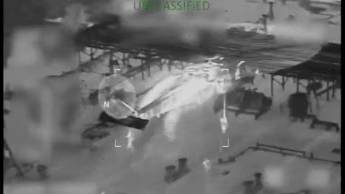
The early morning sky over international waters was shattered not by thunder, but by the roar of US military helicopters. Below, two massive oil tankers—the Motor Tanker Bella I and the Motor Tanker Sophia—became the target of a meticulously planned, high-risk operation. In a scene straight out of a geopolitical thriller, armed US troops fast-roped onto the decks of these vessels, part of the notorious ‘ghost fleet’ accused of moving illicit Venezuelan oil. This audacious move is the latest, and most visually dramatic, chapter in America’s escalating war against a smuggling network it claims funds narco-terrorism .
Table of Contents
- The Predawn Raids: A Play-by-Play
- What is the ‘Ghost Fleet’?
- The Venezuela and Russia Connection
- From Weeks-Long Pursuit to Final Boarding
- Kristi Noem’s Warning: Protecting America from Narco-Terrorism
- The Legal and Diplomatic Fallout
- Conclusion: A New Era of Maritime Enforcement
- Sources
The Predawn Raids: A Play-by-Play
The operation was a masterclass in coordinated military precision. As reported by the Times of India, the US Coast Guard, backed by other armed forces, launched a simultaneous assault on both tankers during the cover of darkness . Video footage from the scene shows helicopters circling the vessels, their spotlights cutting through the gloom as heavily armed personnel descended onto the decks. The goal was to secure the ships with minimal resistance and gather crucial evidence. The entire operation was executed under the authority of a federal court warrant, underscoring its legal basis in the US campaign against sanctioned entities .
What is the ‘Ghost Fleet’?
The term ‘ghost fleet‘ refers to a network of aging, often poorly maintained oil tankers that operate in the shadows of the global shipping industry. These vessels are infamous for engaging in Deceptive Shipping Practices (DSPs). This includes turning off their Automatic Identification System (AIS) transponders to become invisible to maritime trackers, conducting illicit ship-to-ship transfers of cargo on the high seas, and using flags of convenience from countries with lax oversight, like Russia or Cambodia . This cloak-and-dagger approach allows them to transport sanctioned oil from countries like Venezuela and Iran to eager buyers, bypassing international embargoes and lining the pockets of regimes the US seeks to isolate.
The Venezuela and Russia Connection
Both the Bella I and the Sophia have been directly linked to the embattled regime of Nicolás Maduro in Venezuela. The US government has long accused Caracas of using its vast oil reserves not to rebuild its crumbling economy, but to fund illicit activities, including its alleged support for groups the US designates as terrorist organizations . Russia’s role in this scheme is primarily that of an enabler. By providing its flag to these tankers, Moscow offers them a degree of superficial legitimacy and diplomatic cover, even as they engage in activities that violate US sanctions. This symbiotic relationship between Caracas and Moscow on the high seas is a direct challenge to Washington’s foreign policy objectives.
From Weeks-Long Pursuit to Final Boarding
The boarding of the Motor Tanker Bella I was the culmination of a tense, weeks-long cat-and-mouse chase across the Atlantic. The vessel had been under surveillance for its suspicious activities and attempts to evade US patrols. Its capture was not a matter of chance but the result of persistent tracking and intelligence gathering. The Sophia, on the other hand, was boarded in a more direct operation. The simultaneous nature of the raids sent a clear, unambiguous message to the entire ‘ghost fleet’: the US is now operating on multiple fronts and has the resources to track and interdict these vessels wherever they may be .
Kristi Noem’s Warning: Protecting America from Narco-Terrorism
Homeland Security Secretary Kristi Noem was unequivocal in her statement following the successful operations. She framed the seizures not just as an economic sanction, but as a critical national security measure. “We will find you, we will stop you, and we will seize your vessels and your cargo,” Noem declared, directly addressing the networks behind the smuggling. She explicitly linked the illicit oil trade to the funding of ‘narco-terrorism,’ arguing that the revenue generated from these sales poses a direct threat to the safety of American citizens . This powerful rhetoric elevates the maritime interdiction from a law enforcement action to a front line in the war on terror.
The Legal and Diplomatic Fallout
While the US has the legal authority under its own laws to seize assets linked to sanctioned activities, these high-profile actions inevitably create diplomatic friction. Russia, whose flag both tankers were flying, is likely to issue a formal protest, claiming a violation of its sovereignty. However, the US has a counter-argument. In many such cases, Washington has declared these vessels to be ‘stateless’—arguing that their registration was fraudulent or that the flag state (Russia) was not exercising proper control over them. This legal maneuver is crucial for justifying the seizures under international maritime law and for the subsequent forfeiture of the vessels and their cargo in US federal court [[2], [6]].
Conclusion: A New Era of Maritime Enforcement
The dramatic images of helicopters and armed troops boarding the Bella I and Sophia are more than just a news story; they are a symbol of a new, more aggressive phase in the enforcement of economic sanctions. The US boards ghost fleet tankers strategy is a clear departure from passive financial penalties. It is a declaration that the US is willing to use its military and law enforcement might to project its economic policies onto the global commons. This sets a powerful precedent that could deter future smuggling and reshape the rules of engagement on the high seas. The success of this campaign will be measured not just in tankers seized, but in the overall disruption of the illicit financial flows that sustain regimes hostile to American interests. For a deeper look at how economic sanctions are reshaping global trade, explore our analysis on [INTERNAL_LINK:global-sanctions-impact].
Sources
- Times of India: Watch: Helicopters & armed troops — US boards two ‘Ghost Fleet’ tankers
- US Coast Guard: News Release on Vessel Seizures
- U.S. Department of State: Venezuela Sanctions
- Department of Homeland Security: Secretary Noem’s Statement
- Radio Free Europe/Radio Liberty: How Russia’s ‘Ghost Fleet’ Helps Venezuela Bypass Sanctions
- Lawfare: Explaining the US Seizure of Venezuelan Oil Tankers