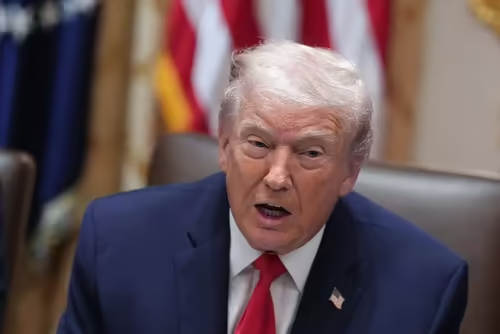
After nearly seven years of severed skies and strained relations, the United States is reopening its commercial airspace over Venezuela. In a surprise announcement on January 29, 2026, President Donald Trump declared that Americans will soon be able to fly directly to Caracas—a move that marks the most significant step yet toward normalizing ties between the two nations since the diplomatic rupture of 2019 [[1]].
The decision doesn’t just affect pilots and airlines; it’s a lifeline for thousands of Venezuelan-American families separated by politics, poverty, and pandemic-era restrictions. It also signals a major strategic pivot: with American Airlines already preparing to relaunch Miami–Caracas routes by March 2026, the US airspace over Venezuela is no longer a no-fly zone but a corridor of renewed connection—and commerce [[3]].
Table of Contents
- The Announcement: What Trump Actually Said
- Why Was US Airspace Closed in the First Place?
- A Broader Diplomatic Thaw
- American Airlines’ Pivotal Role in Reconnecting the Americas
- Who Really Benefits? Families, Business, or Politics?
- Risks and Challenges Ahead
- Conclusion: Skies Open, But Trust Still Fragile
- Sources
The Announcement: What Trump Actually Said
Speaking at a campaign rally in Florida—a state home to over 500,000 Venezuelan exiles—Trump declared: “Effective immediately, I am lifting all restrictions on US commercial aircraft flying over and into Venezuela. Our planes will land in Caracas again. Our people will be reunited.” He added that temporary diplomatic staff have already been deployed to the US Embassy in Caracas, which has operated at minimal capacity since 2019 [[1]].
While the Federal Aviation Administration (FAA) must still issue a formal Notice to Airmen (NOTAM) to officially rescind the 2019 ban, sources confirm the process is underway. The change would end a prohibition that forced US carriers to reroute flights around Venezuelan territory, adding time and fuel costs to South American routes.
Why Was US Airspace Closed in the First Place?
The FAA banned US airlines from flying over Venezuela in May 2019, citing “political instability, inadequate security conditions, and concerns about air traffic control reliability” following the collapse of diplomatic relations under the Trump administration [[5]]. At the time, the US recognized opposition leader Juan Guaidó as Venezuela’s legitimate president, while Nicolás Maduro retained control of state institutions—including airports and radar systems.
The ban wasn’t just symbolic. It grounded all direct commercial service between the US and Venezuela, severing one of the hemisphere’s busiest diaspora corridors. For years, travelers had to route through Panama, Colombia, or Mexico—adding hundreds of dollars and hours to their journeys.
A Broader Diplomatic Thaw
The reopening of US airspace over Venezuela is part of a quiet but accelerating rapprochement. Since late 2025, backchannel talks between Washington and Caracas have intensified, driven by mutual interests:
- For the US: Securing cooperation on migration, drug interdiction, and countering Chinese/Russian influence in Latin America.
- For Venezuela: Gaining relief from crippling sanctions and access to international financial markets ahead of its 2026 presidential election.
The return of even a skeleton US diplomatic team to Caracas—a first since 2019—is a powerful signal that both sides are willing to compartmentalize ideological differences for pragmatic gains [[7]].
American Airlines’ Pivotal Role in Reconnecting the Americas
American Airlines, which once operated up to 14 weekly flights between Miami and Caracas, confirmed it is “finalizing plans” to resume service as early as March 2026 [[9]]. The airline has maintained its Venezuela operating certificate throughout the ban and has been conducting crew training for the route.
“Reconnecting Miami and Caracas isn’t just about profit—it’s about people,” said an AA spokesperson. “Thousands of families have been waiting years for this moment.” Industry analysts estimate the route could generate $150 million annually in passenger revenue alone.
Who Really Benefits? Families, Business, or Politics?
On the surface, this is a humanitarian win. Over 2 million Venezuelan-Americans live in the US, many with aging relatives they haven’t seen in years. Direct flights mean more than convenience—they mean dignity, care, and connection.
But the timing raises eyebrows. With Trump campaigning hard in Florida, the move delivers a tangible victory to a key voting bloc. Meanwhile, Maduro gains international legitimacy and potential economic relief without making major concessions on democracy or human rights.
For deeper insights on diaspora politics, see our feature on [INTERNAL_LINK:venezuelan-diaspora-in-us-politics].
Risks and Challenges Ahead
Despite the optimism, significant hurdles remain:
- Infrastructure decay: Venezuela’s airports suffer from chronic underinvestment; power outages and equipment failures are common.
- Security concerns: While improved, crime and corruption at entry points remain issues for foreign travelers.
- Sanctions complexity: Most US economic sanctions on Venezuela remain in place; travelers must still navigate strict financial restrictions.
The U.S. Department of State still maintains a Level 3 travel advisory (“Reconsider Travel”) for Venezuela, underscoring that risks persist [[11]].
Conclusion: Skies Open, But Trust Still Fragile
The reopening of US airspace over Venezuela is a historic step—but it’s only the beginning. True normalization requires more than flights and diplomats; it demands transparency, accountability, and sustained dialogue. For now, however, the message is clear: after years of silence, the skies between the US and Venezuela are finally humming with the sound of hope—and jet engines.