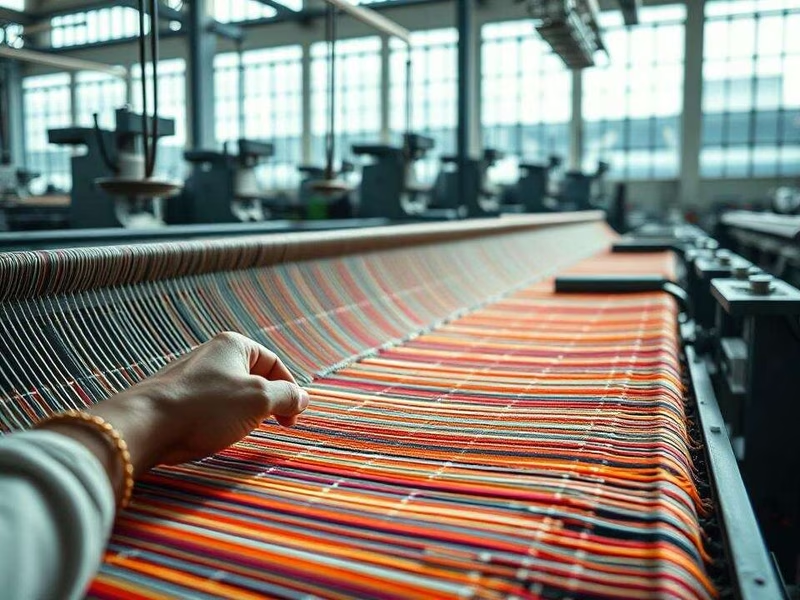
Imagine stitching thousands of winter jackets, sweaters, and dresses—only to find out they might never leave the warehouse because a single policy decision could make them five times more expensive overnight. That’s the terrifying reality facing India’s $44 billion garment export industry right now.
Rumors of a potential US 500% tariff threat have sent shockwaves through manufacturing hubs in Tirupur, Delhi, and Bengaluru. American buyers, already skittish after previous 50% duties, are pausing orders or demanding ironclad price guarantees. Yet Indian factories are pushing forward with production for the crucial fall-winter 2026 season—because stopping isn’t an option. “We have no choice but to take the risk,” admits one Tirupur-based exporter. “If we don’t produce, we lose the season. If the tariff hits, we lose everything” .
Table of Contents
- What Is the US 500% Tariff Threat?
- Why Indian Garment Makers Are in the Crosshairs
- US 500% Tariff Threat: Impact on Fall-Winter Cycle
- Industry Still Reeling from Previous 50% Duties
- How Exporters Are Coping with Uncertainty
- Broader Implications for India-US Trade
- Conclusion: A Fragile Lifeline for Millions
- Sources
What Is the US 500% Tariff Threat?
The threat stems from ongoing US trade investigations into alleged “transshipment” and “dumping” of textiles. US authorities suspect some Indian exporters may be routing goods through third countries (like Vietnam or Bangladesh) to bypass existing quotas or anti-dumping duties—though concrete evidence remains limited.
If confirmed, the US International Trade Commission (ITC) could impose **countervailing duties of up to 500%** on specific categories of Indian-made garments, including knitwear, cotton apparel, and synthetic blends. Such a move would effectively price Indian products out of the American market—the industry’s largest single destination, accounting for nearly 25% of total exports .
Why Indian Garment Makers Are in the Crosshairs
Several factors have drawn US scrutiny:
- Rising Indian exports: India’s garment shipments to the US grew by 18% in 2025, outpacing competitors like China and Bangladesh.
- Trade deficit concerns: The US runs a significant trade deficit with India in textiles, fueling protectionist sentiment.
- Geopolitical tensions: Broader US-China decoupling has shifted sourcing to India—but also made India a target for similar scrutiny.
Ironically, many Indian manufacturers argue they’re victims of circumstance—caught between global supply chain shifts and Washington’s aggressive trade enforcement.
US 500% Tariff Threat: Impact on Fall-Winter Cycle
The timing couldn’t be worse. The fall-winter collection—which includes holiday-season merchandise—is typically finalized by January. Orders are placed, fabrics procured, and production lines booked months in advance.
Now, American retailers are caught in limbo:
- Some are delaying purchase orders until clarity emerges,
- Others are shifting volumes to Turkey, Mexico, or Central America,
- A few are asking Indian suppliers to absorb potential tariff costs—a near-impossible demand given razor-thin margins.
“If the 500% duty is imposed retroactively, we could face losses of $200–300 million just for this season,” warns the Apparel Export Promotion Council (AEPC) .
Industry Still Reeling from Previous 50% Duties
This isn’t the first blow. In 2024, the US slapped 50% anti-dumping duties on certain Indian polyester fabrics, disrupting supply chains and forcing factories to re-engineer product lines. Many smaller units never recovered.
“We barely stabilized operations after the last shock,” says a Delhi-based unit owner. “Another 500% hit would shut us down permanently.” The sector employs over 12 million people—mostly women—in low-income communities, making it not just an economic issue, but a social one .
How Exporters Are Coping with Uncertainty
Faced with existential risk, Indian exporters are adopting survival tactics:
- Diversifying markets: Accelerating efforts to sell more to the EU, UK, and Middle East.
- Vertical integration: Controlling yarn-to-garment production to reduce cost volatility.
- Legal preparedness: Hiring US trade lawyers to contest any proposed duties at the ITC hearings.
- Transparency drives: Implementing blockchain-based traceability to prove origin and compliance.
Yet these measures take time—and time is running out.
Broader Implications for India-US Trade
A 500% tariff wouldn’t just hurt garment makers—it could derail the entire India-US trade relationship. Ongoing talks for a limited Free Trade Agreement (FTA) could stall, and cooperation on tech, defense, and climate may suffer collateral damage.
Experts at the Peterson Institute for International Economics warn that unilateral tariffs often backfire, raising consumer prices in the US while damaging strategic partnerships abroad.
Conclusion: A Fragile Lifeline for Millions
The US 500% tariff threat is more than a trade dispute—it’s a test of resilience for an industry that stitches together livelihoods across rural and urban India. While exporters brace for impact, the real question is whether Washington will choose protectionism over partnership.
For now, sewing machines keep humming in Tirupur and Ludhiana—not out of confidence, but out of necessity. Because in the high-stakes game of global trade, sometimes the only move left is to keep stitching and hope. For strategies on navigating international trade barriers, see our guide on [INTERNAL_LINK:export-compliance-best-practices].
Sources
- Times of India: US 500% tariff threat: Garment exporters ‘will have to take risk’
- Apparel Export Promotion Council (AEPC): Export Data 2025
- US International Trade Commission: Ongoing Textile Investigations
- Peterson Institute for International Economics: US-India Trade Relations: Key Facts