Table of Contents
- Why Are UP School Timings Being Revised?
- Official Details of the New Schedule
- Which Schools Are Affected?
- Health Risks of Early Morning Exposure in Winter
- Parent and Teacher Reactions
- What This Means for Daily Routines
- Conclusion: Prioritizing Safety Over Schedule
- Sources
Why Are UP School Timings Being Revised?
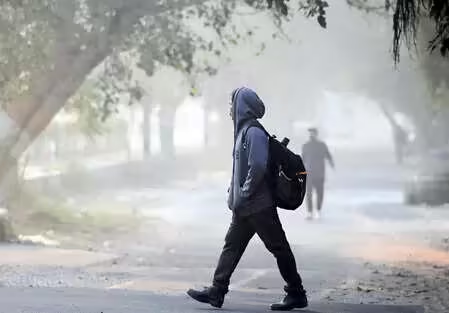
On Monday, January 19, 2026, students across Gautam Buddh Nagar woke up to a major change in their daily routine. The UP school timings revised order came into immediate effect as dense fog blanketed Noida, Greater Noida, and surrounding areas, reducing visibility to under 50 meters in some zones .
With temperatures hovering near 4°C and air quality slipping into the ‘Poor’ to ‘Very Poor’ category, the Uttar Pradesh government deemed early morning commutes too risky for children. “Student safety is non-negotiable,” stated a senior official from the Basic Education Department .
Official Details of the New Schedule
The revised school hours are now standardized across the district:
- Start time: 10:00 AM
- End time: 3:00 PM
- Effective from: January 19, 2026
- Duration: Until further notice (subject to weather improvement)
This directive was issued via an official circular signed by the District Magistrate and shared with all school management committees. The order explicitly states that **no school—government or private—may begin classes before 10 AM** during this period .
Which Schools Are Affected?
The revision applies universally across Gautam Buddh Nagar, covering:
- All government primary and upper-primary schools
- Government-aided secondary and senior secondary schools
- Private CBSE, ICSE, and UP Board-affiliated institutions
- Pre-schools and daycare centers operating under municipal guidelines
This ensures a level playing field and prevents any institution from gaining an unfair academic advantage while also protecting every child equally [INTERNAL_LINK:school-safety-guidelines-india].
Health Risks of Early Morning Exposure in Winter
Beyond poor visibility, early morning travel in such conditions poses serious health threats to children:
- Respiratory issues: Cold, damp air combined with high particulate matter (PM2.5) can trigger asthma and bronchitis.
- Hypothermia risk: Young children lose body heat faster; prolonged exposure below 5°C is dangerous.
- Accident vulnerability: With visibility near zero, school buses and two-wheelers face heightened collision risks.
According to the Indian Meteorological Department (IMD), January 2026 has seen one of the densest fog spells in the past five years in the National Capital Region (NCR) . The World Health Organization also warns that children are especially susceptible to air pollution during winter months .
Parent and Teacher Reactions
Initial reactions have been largely supportive. “My daughter was shivering at 7 AM last week—it’s inhumane to expect kids to travel in this,” said Priya Mehta, a parent from Sector 50, Noida.
However, some working parents expressed logistical concerns. “We’ll need to adjust our office hours or find temporary childcare,” noted Rajiv Kapoor, a software engineer in Greater Noida.
Teachers’ unions welcomed the move, calling it “long overdue.” The Noida Teachers’ Association stated, “Learning cannot happen if a child is sick or scared. This is a responsible decision.”
What This Means for Daily Routines
Families will need to adapt quickly:
- Breakfast timing: Shift from 6:30 AM to 8:30–9:00 AM
- Transport coordination: School bus routes may be adjusted; parents should confirm pickup times
- After-school activities: May be shortened or rescheduled due to earlier dismissal
- Academic calendar: The department assures no syllabus will be cut; schools may use Saturdays for compensation if needed
Importantly, online classes are **not** being introduced—this is strictly a shift in physical attendance hours to align with safer daylight conditions.
Conclusion: Prioritizing Safety Over Schedule
The decision to revise UP school timings revised in Gautam Buddh Nagar isn’t just bureaucratic—it’s a necessary, compassionate response to a genuine public health hazard. While inconvenient for some, it reflects a growing awareness that children’s well-being must come before rigid academic calendars. As fog continues to envelop North India, this policy may serve as a model for other districts facing similar winter challenges.
Sources
- Times of India: UP school timings revised in Gautam Buddh Nagar due to fog
- Uttar Pradesh Basic Education Department Circular, January 18, 2026
- Indian Meteorological Department (IMD) Fog Advisory, January 19, 2026
- World Health Organization (WHO): Ambient Air Pollution and Children’s Health
- For more on school safety protocols, see [INTERNAL_LINK:winter-health-tips-for-school-children]