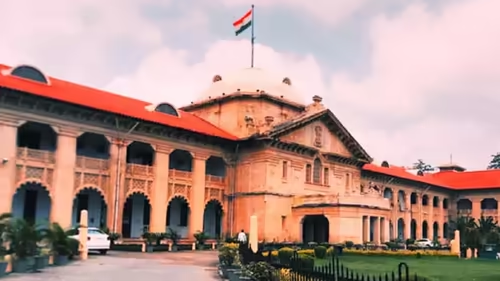
The era of unchecked ‘encounter killings’ in Uttar Pradesh may be coming to an abrupt end. In a landmark and fiercely-worded judgment, the Allahabad High Court has delivered a stinging rebuke to the state police, declaring in no uncertain terms that law enforcement officers are not above the law—and certainly not its executioners. The court’s central message was clear: “Cops can’t play the role of the judiciary.”
Presided over by Justice Arun Kumar Singh Deshwal, the ruling specifically targeted the disturbing trend of so-called ‘below-the-knee shootings’—a euphemism often used to describe extrajudicial killings disguised as legitimate police action. This practice, which has drawn criticism from human rights groups for years, has now been placed under the direct scrutiny of the highest court in the state [[1]].
Table of Contents
- The Court’s Scathing Indictment
- New Mandatory Guidelines for UP Police Encounters
- The Troubling Pattern of ‘Below-the-Knee Shootings’
- Why This Ruling is a Major Shift
- Contempt of Court Warning
- Conclusion: Reasserting the Rule of Law
- Sources
The Court’s Scathing Indictment
Justice Deshwal’s observations were unambiguous and powerful. He stated that the police force’s primary duty is to apprehend accused individuals and present them before a competent court of law. The power to punish, he emphasized, rests solely and exclusively with the judiciary—a cornerstone principle of any democratic society governed by the rule of law [[1]].
By taking the law into their own hands through staged encounters, the police are not just bypassing the legal system; they are actively undermining it. This, the court argued, erodes public trust in the entire justice delivery mechanism and sets a dangerous precedent where might makes right.
New Mandatory Guidelines for UP Police Encounters
To prevent future abuses, the High Court has mandated a strict set of protocols that must be followed in every single instance where police gunfire results in injury or death. These guidelines are designed to ensure transparency, accountability, and immediate judicial oversight:
- Immediate Magisterial Inquiry: A magistrate must conduct an on-the-spot inquiry into the encounter within 24 hours.
- Videography of the Scene: The entire crime scene must be videographed from multiple angles before any evidence is disturbed.
- Preservation of Evidence: All physical evidence, including weapons and cartridges, must be sealed and sent for forensic analysis without delay.
- Independent Oversight: The investigation into the encounter should be handed over to an independent agency, not the same police unit involved.
- Public Reporting: A detailed report of the incident, including the magisterial inquiry findings, must be made publicly available.
These measures aim to transform encounters from opaque, police-controlled narratives into transparent, legally-scrutinized events.
The Troubling Pattern of ‘Below-the-Knee Shootings’
The court’s ruling was particularly focused on the recurring pattern of suspects being shot in the legs, often resulting in death from blood loss. This method has been cynically used to create a veneer of legitimacy—that the police were merely trying to incapacitate a fleeing suspect. However, in many documented cases, these shootings have occurred at close range on individuals who were already in custody or posed no immediate threat [[2]].
Human rights organizations have long argued that these are nothing short of cold-blooded murders, used to deliver instant, extra-judicial ‘justice’ and boost the image of a ‘tough’ police force. The Allahabad HC’s judgment is a direct challenge to this narrative, demanding that every such incident be treated as a potential homicide until proven otherwise through a rigorous, independent process.
Why This Ruling is a Major Shift
Historically, courts in India have often given the police the benefit of the doubt in encounter cases, accepting their version of events with minimal scrutiny. This ruling marks a significant departure from that passive stance. By proactively issuing binding guidelines and framing the issue as a fundamental breach of the separation of powers, the Allahabad High Court is taking a far more assertive role in safeguarding constitutional rights.
This decision could have ripple effects across the country, setting a powerful precedent for other high courts to follow. It signals that the judiciary is no longer willing to be a silent spectator to the erosion of due process.
Contempt of Court Warning
Justice Deshwal didn’t just issue recommendations; he issued a stern warning. The court explicitly stated that any failure by the Uttar Pradesh Police to comply with these new mandatory protocols will be treated as contempt of court [[1]]. This is a serious legal consequence that can result in fines or even imprisonment for the responsible officers.
This threat of contempt proceedings transforms the guidelines from mere suggestions into enforceable legal orders, giving them real teeth and ensuring they cannot be easily ignored by local police stations.
Conclusion: Reasserting the Rule of Law
The Allahabad High Court’s ruling is a powerful and necessary corrective to a dangerous trend. By unequivocally stating that the police cannot usurp the judiciary’s role, the court has reasserted a foundational pillar of Indian democracy: that no one is above the law, not even those tasked with enforcing it. The new guidelines for UP police encounters are a crucial step towards ensuring accountability, preventing abuse of power, and restoring public faith in a justice system that must be fair, transparent, and impartial for all.
Sources
[INTERNAL_LINK:india-encounter-killings-human-rights-report]
[INTERNAL_LINK:role-of-judiciary-in-indian-democracy]
Times of India: Cops can’t play role of judiciary: HC slams UP police on encounters [[1]]
National Human Rights Commission (NHRC) Guidelines on Encounter Deaths [[2]]
Supreme Court of India: Landmark Judgments on Police Accountability