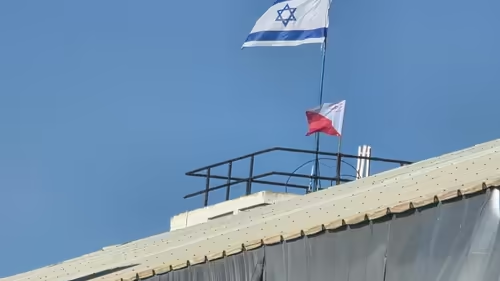
In a move that has sent shockwaves through the international community, Israeli forces rolled into East Jerusalem with bulldozers and reduced a United Nations Relief and Works Agency (UNRWA) compound to rubble. The agency, which provides critical aid to Palestinian refugees, called the destruction “an unprecedented attack on the UN” and unequivocally declared the action illegal under international law. This isn’t just the demolition of buildings—it’s a direct challenge to the very presence of international institutions in one of the world’s most contested cities. As tensions simmer in the Holy Land, the UNRWA headquarters razing could mark a dangerous new chapter in the Israel-Palestine conflict.
Table of Contents
- What Exactly Happened at the UNRWA Compound?
- Why East Jerusalem Is the Heart of the Conflict
- The UN’s Furious Response: “A Violation of International Law”
- Israel’s Stated Justification—and the Hidden Agenda
- Human Cost: What This Means for Palestinian Refugees
- Global Backlash and Diplomatic Fallout
- Broader Implications for the Middle East Peace Process
- Conclusion: A Symbolic Strike with Real Consequences
- Sources
What Exactly Happened at the UNRWA Compound?
Early Tuesday morning, Israeli military units accompanied by municipal inspectors and heavy machinery entered the Shuafat neighborhood of East Jerusalem. Without prior warning to UN staff, they began demolishing multiple structures within the UNRWA compound, including administrative offices, a health clinic, and storage facilities used for food and medical supplies. Eyewitnesses described scenes of chaos as workers scrambled to salvage documents and equipment. The entire operation lasted several hours, leaving behind a field of debris where a vital humanitarian hub once stood. UNRWA confirmed that no alternative arrangements were offered, and its ability to serve over 10,000 registered refugees in the area has been severely compromised.
Why East Jerusalem Is the Heart of the Conflict
East Jerusalem, captured by Israel in the 1967 Six-Day War and later annexed in a move never recognized by the international community, is home to some of the most sensitive religious sites for Jews, Muslims, and Christians. Palestinians view it as the capital of their future state. Israel, however, treats the entire city as its “eternal and undivided capital.” This competing narrative makes every construction project—or demolition—a potential flashpoint. The Shuafat area, in particular, lies just outside Israel’s controversial separation barrier, placing its residents in a legal gray zone that denies them full municipal services while subjecting them to frequent security operations.
The UN’s Furious Response: “A Violation of International Law”
UNRWA Commissioner-General Philippe Lazzarini did not mince words: “This is not just an attack on our premises—it is an attack on the principles of international humanitarian law.” He emphasized that the compound was clearly marked with UN flags and had operated legally for decades. The UN cited Article 103 of the UN Charter, which gives UN obligations precedence over other international agreements, and the Fourth Geneva Convention, which prohibits the destruction of property in occupied territories unless “absolutely necessary” for military operations—an argument Israel has not substantiated. The Secretary-General’s office has demanded an immediate investigation and called for accountability.
Israel’s Stated Justification—and the Hidden Agenda
Israeli authorities claimed the buildings lacked proper permits—a common pretext used to justify demolitions in East Jerusalem, where Palestinian residents are routinely denied building licenses. Critics argue this is a systemic policy designed to limit Palestinian presence in the city. Notably, the cleared land sits adjacent to the expanding Pisgat Ze’ev settlement, one of Israel’s largest in East Jerusalem. Urban planning experts suggest the demolition may pave the way for new settler infrastructure, further fragmenting Palestinian neighborhoods. This aligns with a broader strategy of “facts on the ground” that complicates any future two-state solution.
Human Cost: What This Means for Palestinian Refugees
The consequences are immediate and severe:
- Healthcare disruption: The destroyed clinic served mothers, children, and the elderly—many now face long journeys to overcrowded alternatives.
- Food insecurity: Stored aid meant for winter distribution is gone, leaving vulnerable families at risk.
- Psychological trauma: For refugees who’ve already endured displacement, seeing their last institutional lifeline erased is devastating.
- Economic loss: Local staff lost their jobs overnight, deepening poverty in an already marginalized community.
Global Backlash and Diplomatic Fallout
Nations worldwide have condemned the action. The European Union called it “deeply regrettable,” while Arab League states demanded an emergency UN Security Council session. Even traditional allies like Germany expressed “serious concern.” The U.S. State Department urged “restraint” but stopped short of labeling the act illegal—a stance likely to draw criticism from human rights groups. Meanwhile, pro-Palestinian activists are organizing global protests, arguing that funding UNRWA is now more urgent than ever.
Broader Implications for the Middle East Peace Process
This incident isn’t isolated. It reflects a hardening stance under Israel’s current government, which includes far-right ministers openly advocating for the removal of Palestinians from Jerusalem. By targeting a UN agency, Israel risks alienating the very international bodies that have historically provided diplomatic cover. More alarmingly, it signals that even neutral humanitarian spaces are no longer safe—a precedent that could deter future aid operations across conflict zones. For Palestinians, it reinforces a sense of abandonment by the global community, potentially fueling radicalization.
Conclusion: A Symbolic Strike with Real Consequences
The UNRWA headquarters razing is more than a local demolition—it’s a geopolitical earthquake. It challenges the norms of international law, endangers vulnerable civilians, and undermines decades of fragile diplomacy. If left unchallenged, it sets a dangerous precedent for how occupying powers can treat neutral humanitarian entities. As the dust settles in East Jerusalem, the world must decide: will it uphold the rules-based order, or allow might to dictate right? For ongoing coverage of humanitarian crises in conflict zones, see our [INTERNAL_LINK:middle-east-humanitarian-crisis-updates].