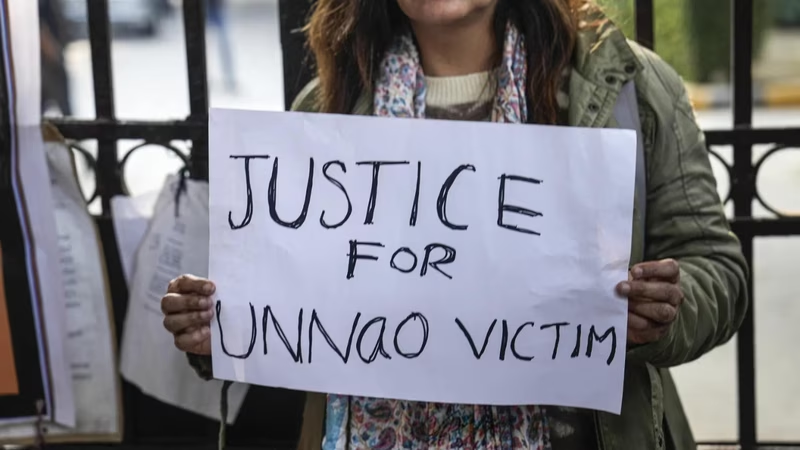
“My children are unsafe at home.”
These six words—raw, urgent, and terrifying—have once again thrust the Unnao rape case into the national spotlight. The survivor, who has endured unimaginable trauma since 2017, has now approached the Supreme Court with a desperate plea for protection, citing credible threats to her family’s safety. The timing is critical: the Court is scheduled to hear a key CBI petition tomorrow regarding the conduct of former BJP MLA Kuldeep Sengar, who was convicted in 2019 for raping the minor girl .
This isn’t just another courtroom update. It’s a stark reminder that even after conviction, justice remains fragile—and the survivor’s life is still under siege. How did we get here? And what does this latest development mean for India’s fight against impunity for sexual violence?
Table of Contents
- A Brief History of the Unnao Rape Case
- The Survivor’s Latest Plea and Fears for Her Children
- What the CBI Petition Seeks from the Supreme Court
- Why the Unnao Rape Case Still Matters
- The Ongoing Fight for Witness and Victim Protection
- Conclusion: A Test for India’s Justice System
- Sources
A Brief History of the Unnao Rape Case
The Unnao rape case first erupted in June 2017 when a 17-year-old girl accused Kuldeep Singh Sengar, then a powerful BJP MLA from Bangarmau, of raping her at his residence in Unnao, Uttar Pradesh. When local police refused to file an FIR, her family took their fight public—only to face brutal retaliation.
In April 2018, the survivor’s father was arrested on trumped-up charges and later died in police custody under suspicious circumstances—an incident that sparked national outrage . Weeks later, the survivor attempted to immolate herself outside the Chief Minister’s residence, demanding justice.
The case was finally transferred to the CBI, which filed charges against Sengar. In December 2019, a Delhi court convicted him under the POCSO Act and sentenced him to life imprisonment. The conviction was hailed as rare accountability for a politically connected perpetrator .
The Survivor’s Latest Plea and Fears for Her Children
Despite Sengar’s imprisonment, the survivor’s ordeal hasn’t ended. In a moving affidavit filed before the Supreme Court, she detailed a “climate of fear” that has made her household untenable. She claims that individuals linked to Sengar’s network continue to intimidate her and her relatives, including her young children .
“I cannot sleep at night thinking someone might harm my children,” she wrote. Her plea specifically requests round-the-clock security and relocation to a safer location under the central government’s Witness Protection Scheme .
This isn’t paranoia—it’s a pattern. In 2019, a truck rammed into the car carrying the survivor and her lawyer, killing two of her aunts and leaving her critically injured. The CBI later alleged it was a “pre-planned conspiracy” to silence her . Given this history, her current fears carry immense weight.
What the CBI Petition Seeks from the Supreme Court
Tomorrow’s hearing centers on a CBI petition challenging the Allahabad High Court’s 2023 order that granted Sengar a 60-day temporary suspension of his life sentence on medical grounds. The CBI argues that Sengar’s hospital stay was being misused for political and personal meetings, undermining the integrity of his conviction .
While the legal battle over his sentence continues, the survivor’s plea adds a human urgency to the proceedings. The Supreme Court now faces a dual responsibility: upholding the rule of law and ensuring the physical and psychological safety of the woman whose testimony helped convict one of India’s most notorious political offenders.
Why the Unnao Rape Case Still Matters
The Unnao rape case is more than a single tragedy—it’s a litmus test for India’s justice system. It exposed:
- Politicization of rape cases: How power can delay, distort, and deny justice.
- Systemic failure in victim protection: Despite landmark laws, survivors remain vulnerable.
- The courage of ordinary citizens: The survivor’s relentless pursuit of truth inspired a generation of activists.
According to the National Crime Records Bureau (NCRB), over 31,000 rape cases were reported in India in 2022 alone—but conviction rates hover around 27% . The Unnao case, with its high-profile conviction, offered a sliver of hope. But hope is meaningless if the survivor lives in perpetual fear.
The Ongoing Fight for Witness and Victim Protection
India enacted a Witness Protection Scheme in 2018 following a Supreme Court directive in the Mahender Chawla vs. Union of India case . Yet, its implementation remains patchy, especially in rural areas and high-stakes cases involving political figures.
The survivor’s current plea underscores a critical gap: legal victories mean little without holistic, long-term protection. Experts argue that witness safety must include psychological support, economic rehabilitation, and geographic relocation when needed—measures still largely absent in practice .
[INTERNAL_LINK:witness-protection-india] explores how other countries, like South Africa and the U.S., manage high-risk victim protection—and what India can learn.
Conclusion: A Test for India’s Justice System
Tomorrow’s Supreme Court hearing isn’t just about a convicted rapist’s medical furlough. It’s about whether India can protect the very people who dare to speak truth to power. The survivor’s simple yet devastating statement—“My children are unsafe at home”—is a question for the nation: Have we done enough?
Justice isn’t complete when a verdict is read. It’s complete when a survivor can sleep peacefully, knowing her children are safe. Until then, the Unnao rape case remains an open wound—and a call to action.
Sources
- The Times of India: ‘My children unsafe at home’: Unnao rape victim’s plea
- The Indian Express: Unnao Rape Case – A Complete Timeline
- NDTV: Kuldeep Sengar Sentenced to Life in Unnao Rape Case
- Supreme Court of India: Witness Protection Scheme, 2018
- CBI: Chargesheet in Unnao Car Crash Case
- Mint: CBI Objects to Kuldeep Sengar’s 60-Day Parole
- National Crime Records Bureau (NCRB) – Crime in India 2022
- Mahender Chawla vs. Union of India – Supreme Court Judgment on Witness Protection
- Human Rights Watch: India’s Failure to Protect Rape Survivors