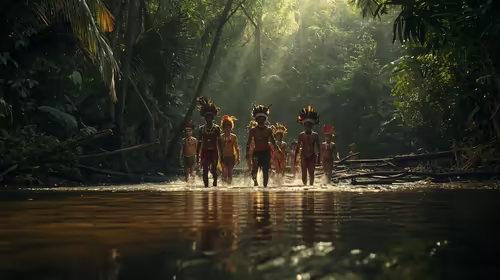
In the emerald heart of the Amazon, where the modern world’s noise fades into the symphony of the jungle, exists a reality untouched by time. It was in this remote theatre that renowned conservationist Paul Rosolie found himself on the sharp end of history—a tense, breathless standoff with an uncontacted Amazon tribe. His story isn’t just an adventure tale; it’s a stark warning about the fragile existence of these isolated peoples and the relentless pressures closing in on their world.
Table of Contents
- The Encounter: A Cloud of Butterflies and Bows
- Who Are the Mashco-Piro? The Largest Uncontacted Tribe
- Why Contact Is a Death Sentence for Isolated Tribes
- The Legal Shield: Protecting the Uncontacted
- Rosolie’s Mission: Beyond the Encounter
- Conclusion: A Fragile Line in the Sand
- Sources
The Encounter: A Cloud of Butterflies and Bows
Rosolie’s encounter, captured in unprecedented high-definition footage, is as haunting as it is beautiful. He describes the moment the tribe emerged onto a riverbank, not with a roar, but through a serene cloud of butterflies . Armed with longbows and arrows, they were a vision of a world operating on its own ancient terms. The initial interaction was cautious, even peaceful, with the tribe lowering their weapons after being offered food in a canoe .
However, the situation took a dark turn. What began as a moment of human curiosity escalated into violence against members of a nearby contacted community, underscoring the deep-seated trauma and fear that often drive these groups to defend their isolation so fiercely . Rosolie’s chilling question, “Which way is the arrow coming from?” captures the raw vulnerability of that moment—a world-first glimpse into a reality most will never see .
Who Are the Mashco-Piro? The Largest Uncontacted Tribe
The group Rosolie encountered is widely believed to be the Mashco-Piro, also known as the Nomole. Residing deep in the rainforests of southeastern Peru, they are considered the largest known uncontacted Amazon tribe on the planet, with population estimates exceeding 750 individuals [[20], [25]]. They are an Arawakan-speaking people, closely related to the Yine, who have chosen isolation, likely as a direct response to historical violence from rubber tappers and loggers .
Peru is home to the second-largest population of isolated tribes globally, after Brazil, with around 25 distinct ethnic groups totaling approximately 7,500 people . These groups, including the Nanti and Matsigenka, live in designated reserves that are increasingly under threat from outside forces .
Why Contact Is a Death Sentence for Isolated Tribes
The desire to make contact often stems from a place of fascination, but for these tribes, it can be a death sentence. Their immune systems have no defense against common diseases like the flu or measles, which can wipe out entire communities in a matter of weeks. This is why governments and organizations like Survival International are so adamant about a policy of non-contact.
Beyond disease, contact opens the door to exploitation, land theft, and cultural annihilation. Logging, mining, and agribusiness already threaten a staggering 65%, 40%, and 20% of these groups’ territories, respectively, with organized crime adding another layer of danger . The very act of approaching them, even with good intentions, can shatter their world forever.
The Legal Shield: Protecting the Uncontacted
Recognizing this existential threat, Peru has established one of the most comprehensive legal frameworks for protecting its isolated peoples. Law 28736 and its subsequent decree (DS 007) explicitly forbid any form of contact and mandate the government to protect their territories and right to self-determination [[10], [12]]. Even researchers are legally barred from seeking them out .
These laws are a critical shield, but they are only as strong as the political will to enforce them. In Brazil, there have been alarming moves to scrap emergency protection orders for uncontacted lands, opening them up to deadly exploitation . The fight to protect these peoples is as much a political battle as it is a physical one.
Rosolie’s Mission: Beyond the Encounter
Paul Rosolie’s work goes far beyond documenting a single encounter. His mission is deeply intertwined with the broader struggle for Amazon rainforest conservation. By working alongside indigenous communities who act as “watchmen” for their ancestral lands, he supports a model of protection that is both effective and culturally respectful .
His footage and testimony serve a crucial purpose: to humanize these distant groups and build a global case for their protection. As he explains, the goal is not to study them, but to ensure they can continue to live on their own terms, free from the encroachment of a world that has already taken so much . Experts agree that protecting uncontacted peoples requires not just stronger laws, but a fundamental shift in how we view them—not as relics of the past, but as contemporary societies with a right to their future .
Conclusion: A Fragile Line in the Sand
Paul Rosolie’s harrowing standoff with an uncontacted Amazon tribe is a powerful reminder of our planet’s remaining mysteries and the profound responsibility we hold towards them. These isolated communities are not lost in time; they are making a conscious choice to remain apart, a choice forged in survival. Our role is not to intrude, but to stand as a buffer between their world and the destructive forces at its edge. Their future, and the health of the Amazon itself, depends on it.
Sources
- Times of India: “They almost shot us with arrows”: Conservationist reveals shocking encounter with uncontacted Amazonian tribe
- Survival International: Information on the Mashco-Piro and other uncontacted tribes
- Peruvian Government: Law 28736 for the Protection of Uncontacted and Recently Contacted Indigenous Peoples