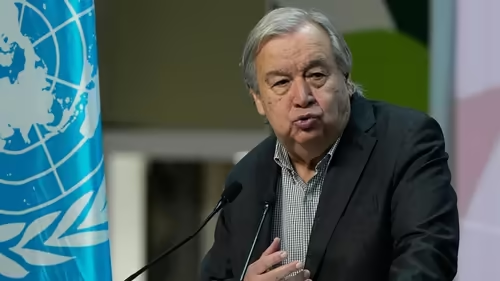
In a landmark address that has sent ripples through global diplomatic corridors, United Nations Secretary-General António Guterres has declared that reforming the UN Security Council is not just desirable—it’s “essential.” Speaking with unusual urgency, Guterres argued that the current structure of the world’s most powerful peacekeeping body is outdated, unrepresentative, and ill-equipped to handle 21st-century crises . For India, which has championed this cause for over seven decades, his words are more than just rhetoric—they could be the catalyst for a historic breakthrough.
Table of Contents
- What Did the UN Chief Say?
- Why Is UN Security Council Reform Needed?
- India’s Long Fight for a Permanent Seat
- The G4 Alliance and Global Support
- Roadblocks to Reform: The Veto Problem
- What This Means for India
What Did the UN Chief Say?
During a high-level forum on multilateralism, Guterres delivered a blunt assessment: “We must be bold enough to change. The Security Council, as it stands, does not reflect today’s geopolitical realities,” he stated . He emphasized that the Council’s composition—frozen in a post-World War II configuration—fails to represent the voices of Africa, Latin America, and much of Asia. His call wasn’t vague; he specifically endorsed expanding both permanent and non-permanent membership to make the body more democratic and effective.
This is significant because, while many member states have pushed for reform, the UN Secretary-General has traditionally avoided taking such a direct public stance. Guterres’ intervention adds immense moral and institutional weight to the campaign led by countries like India, Brazil, Germany, and Japan—the so-called G4 nations .
Why Is UN Security Council Reform Needed?
The current UN Security Council consists of 15 members: five permanent ones (the P5—China, France, Russia, the UK, and the US) with veto power, and ten non-permanent members elected for two-year terms. This structure was designed in 1945, when the world map and power dynamics were vastly different.
Critics argue that this setup leads to chronic paralysis, especially when P5 interests are at stake. Recent failures to act decisively on conflicts in Syria, Gaza, and now Ukraine highlight the Council’s limitations. A reformed Council, proponents say, would be more representative, more legitimate, and more capable of enforcing collective security.
India’s Long Fight for a Permanent Seat
India’s quest for a permanent seat on the UN Security Council is one of the longest-running diplomatic campaigns in modern history. It began almost immediately after independence in 1947, with Prime Minister Jawaharlal Nehru advocating for a more equitable international order. Over the decades, India has built a strong case based on its:
- Demographic weight: Home to nearly 1.4 billion people, soon to be the world’s most populous nation.
- Economic clout: A top-five global economy and a major contributor to UN peacekeeping missions.
- Democratic credentials: The world’s largest democracy, with a consistent record of upholding international law.
- Financial contributions: One of the largest funders of the UN regular budget and peacekeeping operations .
Every Indian Prime Minister since Rajiv Gandhi has made this a cornerstone of foreign policy, and it enjoys rare bipartisan consensus at home.
The G4 Alliance and Global Support
India doesn’t stand alone. It is part of the G4 bloc, which mutually supports each other’s bids for permanent membership. The group has garnered significant backing from across the globe. Over 120 countries have expressed support for India’s candidacy, including the United States, France, Russia, and the entire African Union, which sees India as a champion of Global South interests .
However, opposition remains fierce. The “Coffee Club” (or Uniting for Consensus group), led by Italy, Pakistan, Canada, and others, opposes new permanent seats, arguing instead for an expansion of non-permanent members only. Pakistan, in particular, has consistently blocked India’s bid, citing the Kashmir dispute—a move widely seen as politically motivated rather than principled .
Roadblocks to Reform: The Veto Problem
The biggest hurdle to UN Security Council reform is procedural. Any amendment to the UN Charter requires a two-thirds majority in the General Assembly and, crucially, ratification by all five permanent members of the Security Council. This means that even if a reform proposal passes overwhelmingly in the General Assembly, a single P5 nation can kill it with its veto.
This Catch-22 has stalled progress for decades. While some P5 members like the US, UK, and France have voiced support for India’s inclusion, they have stopped short of making it a formal diplomatic priority. China, meanwhile, has been ambivalent, often echoing Pakistan’s concerns . Without a unified and forceful push from the P5, real change remains elusive.
What This Means for India
Guterres’ strong endorsement is a major diplomatic win for India. It shifts the narrative from a regional aspiration to a global imperative for institutional legitimacy. His statement provides New Delhi with powerful new leverage in its negotiations and public diplomacy.
While it doesn’t guarantee a seat, it creates a more favorable environment. It pressures hesitant P5 members to clarify their positions and energizes the broader coalition of supporters. In the lead-up to the UN’s 80th anniversary in 2025, this momentum could be decisive. For India, the dream of a permanent seat on the UN Security Council may finally be moving from the realm of hope into the sphere of possibility.
Summary
UN Secretary-General António Guterres has made an unequivocal call for UN Security Council reform, labeling it “essential” for the body’s future relevance. This bold stance significantly bolsters India’s decades-long campaign for a permanent seat, providing fresh momentum to its diplomatic efforts. While formidable roadblocks remain—notably the P5 veto—the global conversation is shifting, and India’s case has never been stronger.