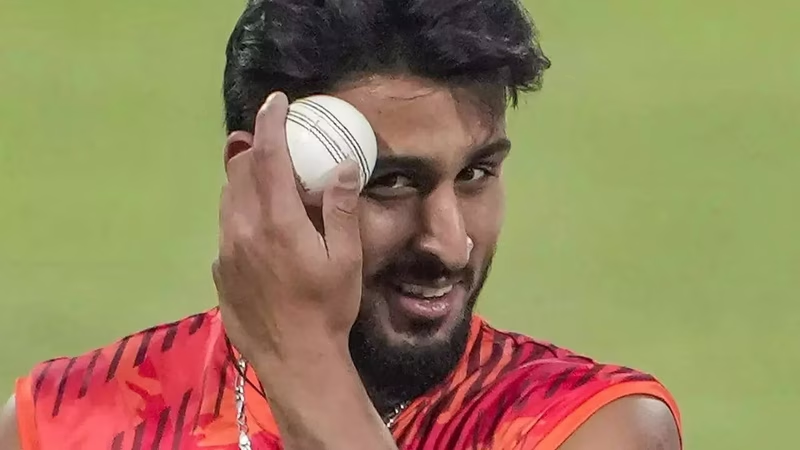
In a move that’s sent shockwaves through Indian cricket circles, Umran Malik—the fiery KKR pacer often dubbed the “Indian Shoaib Akhtar”—has been omitted from Jammu & Kashmir’s Ranji Trophy preparatory camp for Phase Two. The decision, while surprising to casual fans who know him from his IPL heroics, is rooted in a harsh but fundamental truth of Indian domestic cricket: consistent performance in first-class matches matters more than T20 fireworks .
Malik, who earned a ₹75 crore IPL contract and even donned the national jersey, played just one Ranji Trophy match last season—and failed to make an impact. His exclusion, alongside opener Qamran Iqbal, underscores J&K selectors’ commitment to rewarding current form over past reputation or franchise hype . This isn’t just about one player; it’s a statement about the integrity of India’s domestic pathway. For more on how domestic performance shapes national selection, see our analysis on [INTERNAL_LINK:how-ranji-trophy-influences-team-india].
Table of Contents
- Who Is Umran Malik?
- Why Was Umran Malik Omitted from the J&K Ranji Camp?
- The Stark Gap Between IPL Stardom and First-Class Reality
- Historical Context: When Franchise Fame Isn’t Enough
- What’s Next for Umran Malik?
- Conclusion: A Wake-Up Call for India’s Fast-Bowling Hope
- Sources
Who Is Umran Malik?
Rising from the streets of Jammu, Umran Malik burst onto the scene with raw pace that regularly breached the 150 km/h mark—earning him comparisons to Pakistan’s legendary speedster Shoaib Akhtar. His breakout IPL season with Sunrisers Hyderabad in 2021 catapulted him into the national spotlight, leading to a call-up for India’s T20I series against South Africa in 2022 .
Known for his slingy action and aggressive line, Malik quickly became a fan favorite. However, his journey has been marked by inconsistency, especially when transitioning from the high-octane T20 format to the disciplined, strategic world of red-ball cricket.
Why Was Umran Malik Omitted from the J&K Ranji Camp?
The official reason is straightforward: poor domestic form. In the 2024–25 Ranji Trophy season, Malik featured in only one match for Jammu & Kashmir and delivered unimpressive figures. He was also earlier dropped from the Vijay Hazare Trophy (List A) squad, signaling a pattern of underperformance in non-T20 formats .
J&K’s chief selector emphasized that the camp is designed to prepare players for the rigors of the Ranji Trophy, and selections are based solely on recent performances in domestic tournaments—not IPL contracts or international appearances. This merit-based approach, while tough, aligns with the BCCI’s long-standing emphasis on domestic cricket as the true breeding ground for Test cricketers.
The Stark Gap Between IPL Stardom and First-Class Reality
Malik’s situation highlights a growing tension in modern Indian cricket: the disconnect between franchise league success and traditional domestic excellence. While the IPL offers visibility and financial rewards, the Ranji Trophy remains the ultimate proving ground for serious national contenders.
Consider these key differences:
- Match Duration: T20s last 3–4 hours; Ranji matches span four days, demanding stamina, patience, and tactical depth.
- Bowling Role: In T20s, pacers bowl 4 overs at max intensity. In first-class cricket, they must build pressure over long spells, reverse-swing old balls, and adapt to changing pitch conditions.
- Selection Criteria: National selectors still heavily weigh Ranji performances when picking Test and even ODI squads .
Without strong red-ball numbers, even the fastest bowler in India risks becoming a T20 specialist—a label that limits long-term career prospects.
Historical Context: When Franchise Fame Isn’t Enough
Malik isn’t the first IPL star to struggle in domestic cricket. Players like Siddarth Kaul and Basil Thampi showed early promise in the IPL but faded due to inconsistent first-class records. Conversely, stalwarts like Ravichandran Ashwin and Jasprit Bumrah built their reputations on solid domestic foundations before conquering the IPL and international stages .
This historical precedent shows that while the IPL can accelerate a career, it cannot replace the grind of domestic cricket. The J&K selectors’ decision is a return to this core principle.
What’s Next for Umran Malik?
For Malik, the path forward is clear: dominate the domestic circuit. He must use the upcoming inter-zonal Duleep Trophy or Irani Cup as opportunities to prove his red-ball credentials. A strong showing in local tournaments could force his way back into contention—not just for J&K, but for India’s Test and ODI teams.
His coaches have previously noted his need to improve line consistency and develop a reliable stock ball. If he addresses these technical gaps, his raw pace could become truly unstoppable in all formats.
Conclusion: A Wake-Up Call for India’s Fast-Bowling Hope
The omission of Umran Malik from the J&K Ranji camp is not a career-ending blow—it’s a necessary reality check. It reminds every young cricketer that no matter how bright the IPL spotlight shines, the heart of Indian cricket still beats in the dusty grounds of the Ranji Trophy. For Malik, this setback could be the catalyst for a more complete, resilient, and ultimately successful career across all formats.
Sources
- “Compared with Akhtar, KKR’s pacer omitted from J&K Ranji camp”. Times of India. https://timesofindia.indiatimes.com/sports/cricket/news/compared-with-shoaib-akhtar-kkrs-rs-75-lakh-pacer-umran-malik-omitted-from-jk-ranji-camp-heres-why/articleshow/126453764.cms
- J&K Cricket Association Selection Committee Statement, January 2026.
- “Umran Malik: From Jammu Streets to Indian Jersey”. ESPNcricinfo. https://www.espncricinfo.com/
- BCCI Domestic Cricket Guidelines, 2025 Edition.
- “The Making of an Indian Cricketer: Why Ranji Matters”. The Hindu Sportstar. https://sportstar.thehindu.com/