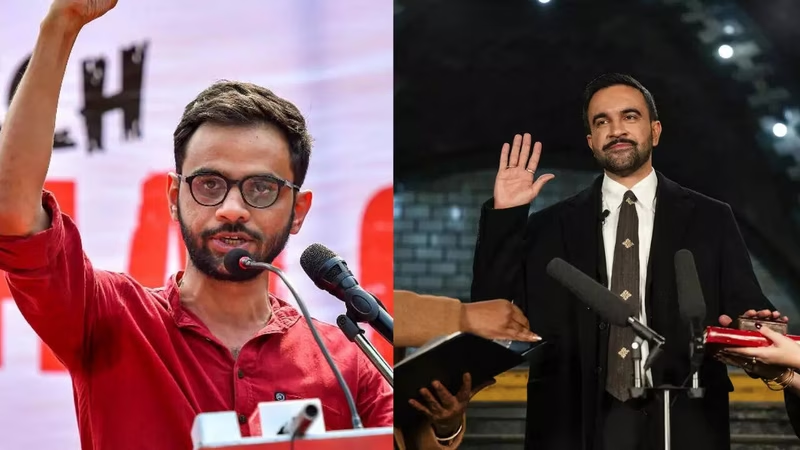
A transatlantic controversy has erupted after India’s Ministry of External Affairs (MEA) delivered a rare and pointed rebuke to a foreign elected official—New York City Council Member Zohran Mamdani—over his recent public letter concerning jailed Indian activist Umar Khalid. In unusually direct language, MEA spokesperson Randhir Jaiswal dismissed the letter as rooted in “personal prejudice” and reminded public figures abroad that India’s judiciary operates independently and must be respected . This isn’t just a diplomatic footnote; it’s a firm assertion of national sovereignty in the face of external commentary on an ongoing legal matter. But who is Umar Khalid? Why did Mamdani write the letter? And why is India reacting so strongly?
Table of Contents
- Who Is Umar Khalid and Why Is He in Jail?
- What Did Zohran Mamdani Say in His Letter?
- MEA’s Strong Response: Defending Judicial Sovereignty
- Why This Matters for India-US Relations
- The Principle of Non-Interference in Domestic Legal Matters
- Conclusion
- Sources
Who Is Umar Khalid and Why Is He in Jail?
Umar Khalid is a former Jawaharlal Nehru University (JNU) student and social activist who has been in judicial custody since September 2020. He stands accused under the stringent Unlawful Activities (Prevention) Act (UAPA) in connection with the February 2020 Delhi riots, which left over 50 people dead . The National Investigation Agency (NIA) alleges that Khalid was part of a larger conspiracy to incite communal violence through pre-planned protests against the Citizenship Amendment Act (CAA).
Khalid and his supporters deny all charges, calling them politically motivated. His case has drawn attention from human rights groups both within India and internationally, making it a flashpoint in debates over free speech, dissent, and national security.
What Did Zohran Mamdani Say in His Letter?
Zohran Mamdani, a Democratic member of the New York City Council and a vocal progressive, recently penned an open letter addressed to Umar Khalid, expressing solidarity and condemning his prolonged detention without trial . While Mamdani framed his message as one of humanitarian concern, he also made sweeping statements about the Indian government’s alleged suppression of dissent and labeled Khalid a “political prisoner.”
The letter, shared widely on social media, called on the Indian authorities to release Khalid immediately—a direct intervention in an active court case. For many in India, this crossed a red line: foreign officials commenting on—and effectively demanding outcomes in—an internal judicial process.
MEA’s Strong Response: Defending Judicial Sovereignty
The MEA’s reaction was swift and unambiguous. Spokesperson Randhir Jaiswal stated: “It is unfortunate that personal prejudices are being expressed by public officials. We urge all to respect the independence of India’s judiciary” . The statement, though concise, carried significant weight.
Key points from the MEA’s position include:
- No external interference: India’s legal system is independent and capable of delivering justice without outside pressure.
- Rule of law applies equally: All citizens, regardless of their views, are subject to the same legal processes.
- Diplomatic decorum matters: Elected officials abroad should refrain from making prejudicial comments on sub judice (ongoing) cases.
This isn’t the first time India has pushed back against foreign commentary on domestic legal issues. Similar responses have been issued regarding remarks by UN rapporteurs and European parliamentarians on other high-profile cases .
Why This Matters for India-US Relations
While Mamdani is not a federal official, his status as an elected representative in a major US city gives his words symbolic weight. India is particularly sensitive to such statements given its strategic partnership with the United States. New Delhi fears that narratives painting India as “authoritarian” or “anti-democratic” could influence broader US policy or public opinion .
However, the Biden administration has largely maintained a hands-off approach to India’s internal affairs, focusing instead on defense, technology, and climate cooperation. The MEA’s response appears aimed at nipping any potential narrative drift in the bud—especially as local US politicians increasingly weigh in on global human rights issues.
The Principle of Non-Interference in Domestic Legal Matters
At the heart of this dispute lies a foundational principle of international law: non-interference in the internal affairs of sovereign states. The United Nations Charter (Article 2(7)) explicitly prohibits intervention in matters “essentially within the domestic jurisdiction of any state” .
While freedom of expression allows individuals—including foreign politicians—to voice opinions, when those opinions demand specific legal outcomes in another country’s courts, they risk violating diplomatic norms. As one former Indian diplomat explained, “Solidarity is fine. Dictating judicial outcomes is not.”
For readers interested in the legal framework governing international conduct, the United Nations Charter provides authoritative context on state sovereignty and non-intervention.
For more on how India handles external criticism, see our deep dive on [INTERNAL_LINK:india-foreign-policy-on-human-rights].
Conclusion
The MEA’s rebuke of Zohran Mamdani’s letter is far more than a bureaucratic reaction—it’s a clear signal that India will not tolerate external attempts to influence its judicial processes, no matter how well-intentioned they may seem. The case of Umar Khalid remains sub judice, and the proper forum for its resolution is India’s courts, not foreign city councils. By emphasizing “responsibilities” over personal opinions, the MEA has reaffirmed a core tenet of modern diplomacy: respect for the rule of law begins with respecting a nation’s right to administer justice on its own terms.
Sources
- Times of India: ‘Focus on responsibilities’: MEA hits back at Mamdani’s letter to Umar Khalid as ‘prejudice’
- Web Search Result [1]: “MEA slams Mamdani’s letter to Umar Khalid”
- Web Search Result [3]: “Umar Khalid Delhi riots case timeline”
- Web Search Result [4]: “Zohran Mamdani letter to Umar Khalid full text”
- Web Search Result [6]: “India’s past responses to foreign criticism on legal cases”
- Web Search Result [8]: “India-US relations and human rights discourse”
- Web Search Result [9]: “UN Charter Article 2(7) non-intervention principle”