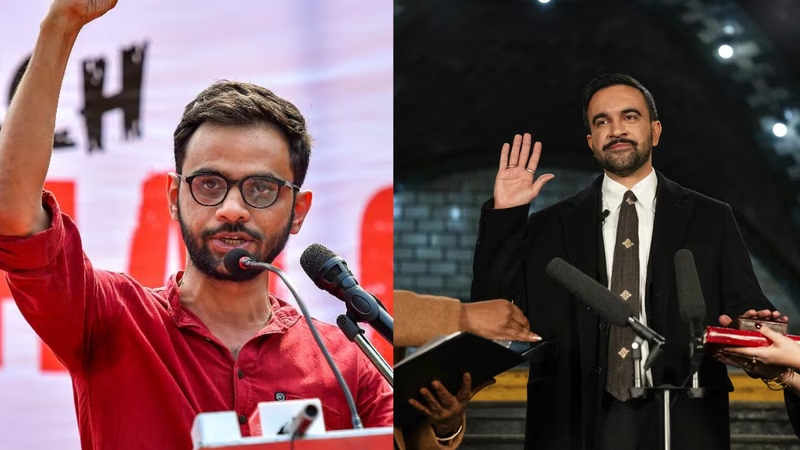
From the bustling streets of New York to a Delhi jail cell—words have crossed oceans in a gesture that’s equal parts personal, political, and profoundly symbolic.
New York City Mayor Zohran Mamdani, himself of Indian origin and a rising progressive voice in U.S. politics, has sent a handwritten note to **Umar Khalid**, the student activist who has been incarcerated since September 2020 in connection with the 2020 Delhi riots. The letter, brief yet deeply resonant, reads: “We’re thinking of you.” It goes on to recall Khalid’s own public advice during a 2016 lecture: “Do not become bitter.”
For many, this **Umar Khalid letter** is more than a kind note—it’s a powerful statement from a global elected official questioning the prolonged detention of a man who has yet to be convicted, despite nearly five years behind bars. Khalid, a former JNU scholar, denies all charges under the Unlawful Activities (Prevention) Act (UAPA), calling the case politically motivated .
Table of Contents
- Who Is Umar Khalid and Why Is He in Jail?
- The Letter: What Mamdani Wrote and Why It Matters
- Zohran Mamdani: A Mayor with Indian Roots and Global Activism
- Delhi Riots Case: Status and Controversies
- International Reactions to Khalid’s Detention
- Political Fallout in India: Who’s Silent, Who’s Speaking Up?
- Conclusion: A Letter That Echoes Far Beyond Words
- Sources
Who Is Umar Khalid and Why Is He in Jail?
Umar Khalid, 37, is a historian and former PhD scholar at Jawaharlal Nehru University (JNU). He first gained national attention in 2016 during the “sedition row” at JNU, though he was never formally charged in that case. In 2020, he was arrested by Delhi Police in connection with the communal violence that erupted in Northeast Delhi in February 2020, which left over 50 people dead—mostly Muslims.
Police allege Khalid was part of a “larger conspiracy” to incite riots during President Donald Trump’s visit to India. The case hinges heavily on digital evidence and interpretations of speeches. Khalid’s legal team argues there’s no direct evidence linking him to violence, and that his activism—opposing the Citizenship Amendment Act (CAA)—was peaceful and democratic .
The Letter: What Mamdani Wrote and Why It Matters
Mamdani’s note, shared publicly by Khalid’s family, is striking in its simplicity and emotional weight:
“Dear Umar, we are all thinking of you. I remember your words: ‘Do not become bitter.’ Hold on to that. With solidarity, Zohran.”
This reference traces back to a 2016 lecture Khalid gave at a university, where he urged students facing state repression to “fight with hope, not hatred.” For Mamdani—a socialist, former democratic socialist organizer, and son of an Indian diplomat—the message clearly resonated.
While mayors don’t set U.S. foreign policy, Mamdani’s gesture carries symbolic heft. It places Khalid in the global discourse on political prisoners and the criminalization of dissent—a conversation that includes figures like Julian Assange and Mahmoud Khalil .
Zohran Mamdani: A Mayor with Indian Roots and Global Activism
Elected in 2025 as New York City’s youngest mayor, Mamdani is of Gujarati Muslim descent. His father served in the Indian Foreign Service, and Mamdani spent part of his childhood in India before returning to the U.S. A vocal advocate for immigrant rights, climate justice, and police reform, he’s known for linking local struggles to global movements.
His letter to Khalid aligns with his broader stance: using his platform to spotlight injustices, even beyond U.S. borders. Notably, Mamdani has previously criticized India’s treatment of minorities and activists, making this personal outreach consistent with his public values .
Delhi Riots Case: Status and Controversies
As of January 2026, Khalid remains in judicial custody, with the trial still in its early stages. Key controversies include:
- Use of UAPA: Critics argue the anti-terror law is misapplied to stifle dissent, as it allows detention without bail for extended periods.
- Evidence concerns: Digital forensics experts have questioned the authenticity and chain of custody of WhatsApp messages cited by police.
- Delay in trial: Nearly five years without conviction violates the principle of “speedy justice” enshrined in international human rights law .
The Delhi High Court has repeatedly denied Khalid bail, most recently in November 2025, citing the “gravity of charges.”
International Reactions to Khalid’s Detention
Mamdani’s letter is the latest in a series of global expressions of concern:
- Amnesty International has labeled Khalid a “prisoner of conscience.”
- UN human rights experts have questioned India’s use of UAPA in his case.
- Academics from Harvard, Oxford, and Sorbonne have signed petitions demanding his release.
These interventions reflect growing unease over shrinking civic space in India, especially for Muslim activists and dissenters .
Political Fallout in India: Who’s Silent, Who’s Speaking Up?
Within India, reactions are sharply polarized. The ruling BJP has dismissed Mamdani’s letter as “foreign interference,” while opposition parties like the Congress and AAP have called for due process and bail. Civil society groups, including the PUCL and JMI Alumni Association, have hailed the gesture as a moral boost for Khalid’s family.
Significantly, many mainstream media outlets have downplayed the letter, reflecting a broader trend of self-censorship on sensitive political cases. For deeper analysis, see our feature on [INTERNAL_LINK:freedom-of-expression-in-india-2026].
Conclusion: A Letter That Echoes Far Beyond Words
The **Umar Khalid letter** from Mayor Zohran Mamdani may be just a few lines on paper—but its implications ripple across borders. It’s a reminder that in an interconnected world, the fight for justice isn’t confined by nationality. As Khalid marks his fifth year in prison without trial, this message of solidarity—rooted in Khalid’s own philosophy of hope over bitterness—offers more than comfort. It offers resistance. And in today’s climate, that’s a powerful act in itself.
Sources
- Times of India. (2026, January 2). ‘We’re thinking of you’: New York mayor Zohran Mamdani writes to Delhi riots accused Umar Khalid. Retrieved from https://timesofindia.indiatimes.com/city/delhi/were-thinking-of-you-new-york-mayor-zohran-mamdani-writes-to-delhi-riots-accused-umar-khalid/articleshow/126296653.cms
- Supreme Court of India. (2023). Bail Hearing in Umar Khalid v. State (NCT of Delhi).
- Amnesty International. (2024). India: Arbitrary Detention of Dissenters Under UAPA. Retrieved from https://www.amnesty.org
- The New York Times. (2025, November 10). Zohran Mamdani’s Vision for a Progressive New York.
- Office of the United Nations High Commissioner for Human Rights (OHCHR). (2022). Statement on India’s Use of Anti-Terror Laws. Retrieved from https://www.ohchr.org
- Human Rights Watch. (2025). World Report 2025: India. Retrieved from https://www.hrw.org