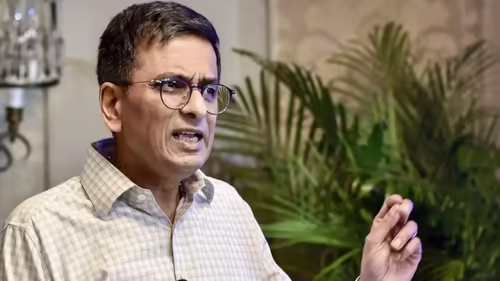
How long is too long to wait for a trial? For activist Umar Khalid, the answer is already over four years—and counting. Now, a powerful voice from the highest echelons of India’s judiciary has stepped in. A former Chief Justice of India (CJI) has publicly emphasized that when trials are unreasonably delayed, courts must grant bail as a matter of right—not privilege—citing Khalid’s case as a troubling emblem of a broken system .
This intervention comes at a time when public discourse around pre-trial detention, investigative overreach, and the erosion of the “presumption of innocence” is intensifying. With thousands languishing in jails across India without conviction, the ex-CJI’s remarks could signal a pivotal shift in judicial thinking—if the lower courts are willing to listen.
Table of Contents
- The Umar Khalid Case: A Timeline of Detention
- Ex-CJI’s Statement on Delayed Trials
- Legal Principle: Right to Speedy Trial
- Why Bail Is Denied Despite Delays
- National Context: Over 70% of Inmates Are Undertrials
- Conclusion: A Call for Judicial Compassion
- Sources
The Umar Khalid Case: A Timeline of Detention
Umar Khalid, a former JNU student and social activist, was arrested in September 2020 under the stringent Unlawful Activities (Prevention) Act (UAPA) in connection with the February 2020 Delhi riots. Accused of being part of a “larger conspiracy,” he has remained in judicial custody ever since—despite repeated bail applications .
Key milestones:
- Sept 2020: Arrested by Delhi Police Special Cell.
- 2021–2025: Multiple bail pleas rejected by trial court, Delhi High Court, and Supreme Court.
- Jan 2026: Trial still not concluded; charges framed but proceedings inch forward slowly.
His supporters argue that the evidence against him is circumstantial and politically motivated. Critics say the gravity of the charges justifies continued detention. But the ex-CJI’s recent comments cut through this debate with a constitutional principle: justice delayed is justice denied.
Ex-CJI’s Statement on Delayed Trials
Speaking at a legal symposium in Jaipur, the former Chief Justice stated plainly: “When an accused has been in custody for years without the trial concluding, it becomes the duty of the court to consider bail—even in serious cases.” He added, “The Umar Khalid bail situation reflects a systemic failure we can no longer ignore” .
He stressed that prolonged incarceration without conviction violates Article 21 of the Indian Constitution—the right to life and personal liberty—which includes the right to a fair and timely trial. “Detention should not become punishment before judgment,” he warned.
Right to Speedy Trial: A Constitutional Imperative
The Supreme Court has repeatedly affirmed the right to a speedy trial as intrinsic to Article 21. Landmark judgments like Hussainara Khatoon v. Home Secretary, Bihar (1979) established that undertrial prisoners cannot be forgotten in jail simply because the state moves slowly.
Yet, in practice, this right is often ignored—especially in cases involving anti-terror laws like UAPA, where bail is notoriously difficult to obtain. Section 43D(5) of UAPA requires courts to deny bail if the accusation appears “prima facie true,” creating a near-insurmountable hurdle for the accused.
However, even the Supreme Court, in Zahoor Ahmad Shah Watali v. NIA (2019), clarified that this doesn’t mean bail is impossible—it just requires deeper scrutiny. The ex-CJI’s remarks suggest it’s time to apply that scrutiny more humanely.
Why Bail Is Denied Despite Delays
Several factors contribute to the denial of bail in delayed cases:
- Political sensitivity: Cases linked to communal violence or national security are treated with extreme caution.
- Judicial backlog: Over 50 million cases are pending in Indian courts; trials take years to conclude.
- Prosecutorial strategy: Agencies sometimes use prolonged investigation as a tool to keep accused persons detained.
- Fear of backlash: Judges may hesitate to grant bail in high-profile cases due to media or public pressure.
This creates a paradox: the very laws meant to protect national security end up undermining fundamental rights.
National Context: Over 70% of Inmates Are Undertrials
According to the National Crime Records Bureau (NCRB) 2023 report, a staggering 77% of India’s prison population consists of undertrial prisoners—many detained for longer than the maximum sentence they’d receive if convicted .
This isn’t just a legal issue; it’s a humanitarian crisis. Families are torn apart, livelihoods destroyed, and reputations ruined—all without a single conviction.
For deeper insights into prison reform and undertrial rights, the Common Cause organization provides extensive research and advocacy resources.
Conclusion: A Call for Judicial Compassion
The ex-CJI’s invocation of the Umar Khalid bail case is more than commentary—it’s a moral challenge to the judiciary. If the system cannot deliver timely justice, it must at least ensure that liberty isn’t sacrificed indefinitely on its altar. As India grapples with balancing security and freedom, this moment demands courage from judges to uphold the spirit of the Constitution, not just its letter. After all, no democracy can afford to forget that innocence is presumed—not proven—until the gavel falls.
Sources
- Times of India: Grant bail in case of delayed trial: Ex-CJI cites Umar Khalid case
- National Crime Records Bureau (NCRB), Prison Statistics India 2023
- Supreme Court Judgments: Hussainara Khatoon v. State of Bihar (1979), Zahoor Ahmad Shah Watali v. NIA (2019)
- Common Cause – Legal Advocacy for Undertrial Rights