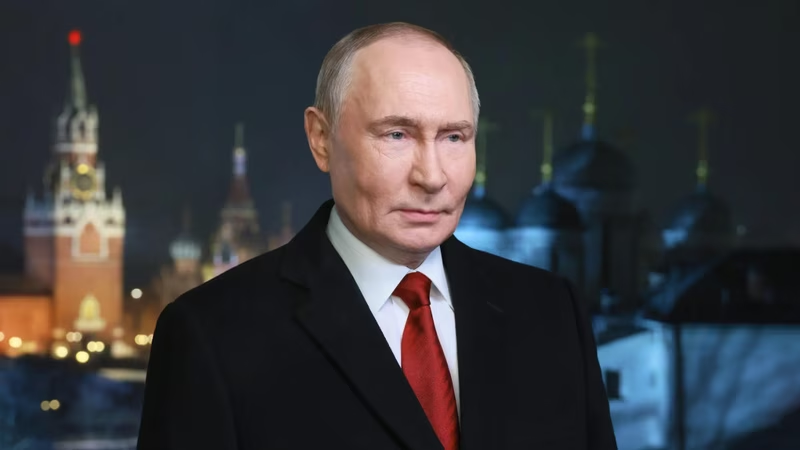
A sensational claim from Moscow sent shockwaves through global security circles: Ukraine allegedly attempted a drone strike on Russian President Vladimir Putin’s personal residence. But within hours, U.S. intelligence agencies moved swiftly to shut it down—not with silence, but with an official and unequivocal rebuttal.
The Ukraine drone plot against Putin, as portrayed by Russian state media, has been firmly rejected by the Central Intelligence Agency (CIA) and senior U.S. officials, who say there is no credible evidence to support the allegation . This development arrives at a particularly delicate moment—just after a high-stakes meeting between former President Donald Trump and Ukrainian President Volodymyr Zelenskyy, where hopes for a breakthrough in peace talks sputtered out with little progress .
So, what’s the truth behind this explosive accusation? Why would Russia make such a claim? And what does the U.S. stance reveal about the fragile state of intelligence diplomacy in the ongoing war?
Table of Contents
- The Russian Claim: What Was Alleged?
- U.S. Intelligence Response: The CIA Sets the Record Straight
- Trump’s Reaction: From Alarm to Caution
- Why Timing Matters: The Zelenskyy-Trump Meeting Fallout
- Propaganda or Strategy? Decoding Russia’s Motives
- Global Implications: Escalation Risks and Diplomatic Fallout
- Conclusion: Truth, Trust, and the Fog of War
- Sources
The Russian Claim: What Was Alleged?
Russian state media outlets reported that Ukrainian forces had deployed a drone in a covert operation aimed at Putin’s fortified residence near Moscow. The narrative was amplified by Russian security services, who described it as a brazen act of terrorism intended to destabilize the Russian leadership .
No physical evidence—such as drone wreckage, intercepts, or verified video—was publicly presented. The claim surfaced without independent corroboration, relying heavily on anonymous “security sources” cited by Kremlin-aligned news agencies.
U.S. Intelligence Response: The CIA Sets the Record Straight
In a rare public refutation of a foreign intelligence assertion, the CIA issued a clear statement: “We have seen no evidence to substantiate Russia’s claims of a Ukrainian drone plot against Putin.” This was echoed by multiple U.S. officials who spoke on background, emphasizing that American surveillance and intelligence assets in the region detected no such operation .
This direct contradiction of a Russian claim is significant. It reflects not only confidence in U.S. technical collection capabilities—such as satellite imagery, signals intelligence, and cyber monitoring—but also a strategic decision to counter what many analysts believe is a deliberate disinformation campaign.
The U.S. stance aligns with its broader policy of supporting Ukraine while cautioning against actions that could trigger direct confrontation with nuclear-armed Russia. Publicly debunking the claim helps prevent unnecessary escalation and maintains credibility with European allies.
Trump’s Reaction: From Alarm to Caution
Initially, former President Donald Trump expressed concern over the Russian allegation, stating he was “troubled” by reports of an attack on a world leader’s residence—a red line in international norms . However, after being briefed by advisors and reviewing the lack of corroborating intelligence, Trump walked back his initial reaction.
“I don’t know if it happened,” he later said. “There’s no confirmation. So we have to be very careful.”
This pivot highlights how even seasoned political figures can be momentarily swayed by sensational headlines—underscoring the power of information warfare in the modern era, and why verified intelligence matters more than ever.
Why Timing Matters: The Zelenskyy-Trump Meeting Fallout
The drone claim emerged just days after President Zelenskyy met with Trump—an encounter that was widely seen as an effort to garner bipartisan U.S. support ahead of the 2026 U.S. congressional elections. The meeting yielded few concrete outcomes; Trump reiterated his belief that the war “should have never started” and that he could end it “in 24 hours,” but offered no new aid or policy shifts .
Analysts suggest the Russian narrative may have been timed to:
- Undermine Zelenskyy’s diplomatic credibility in Washington.
- Stoke U.S. political divisions over Ukraine support.
- Justify further domestic repression or military mobilization under the guise of “national security.”
Propaganda or Strategy? Decoding Russia’s Motives
Experts from institutions like the RAND Corporation and the Atlantic Council note that such unverified claims are a classic Russian hybrid warfare tactic. By floating dramatic allegations—even if easily debunked—they keep adversaries off balance, dominate global news cycles, and muddy the waters of public perception.
Even if the world knows the claim is false, the mere mention of a “plot against Putin” can be weaponized internally to rally nationalist sentiment and externally to portray Ukraine as reckless or desperate.
Global Implications: Escalation Risks and Diplomatic Fallout
If left unchallenged, false narratives like this could have dangerous consequences:
- Military escalation: Russia might use the claim to justify intensified strikes on Ukrainian infrastructure.
- Sanctions backlash: Skeptical lawmakers in the U.S. or EU could cite such incidents to argue against further military aid.
- Erosion of trust: Repeated disinformation campaigns fatigue international audiences, making it harder to mobilize support when real atrocities occur.
That’s why the CIA’s transparent rebuttal isn’t just about one incident—it’s about defending the integrity of the information ecosystem in wartime.
Conclusion: Truth, Trust, and the Fog of War
The Ukraine drone plot against Putin appears to be another chapter in Russia’s long-running information war—not a factual event. With U.S. intelligence firmly rejecting the claim and global analysts treating it with deep skepticism, the episode serves as a stark reminder: in the age of hybrid warfare, the battle for truth is as critical as any on the front lines.
As the conflict grinds on, the international community must remain vigilant—not just against missiles and drones, but against the far more insidious threat of manufactured reality.