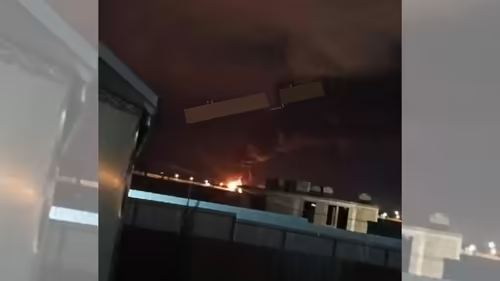
The war between Russia and Ukraine has entered a new, high-stakes phase, with energy infrastructure becoming a primary battlefield. In a brazen overnight operation, Ukrainian forces executed a precise Ukraine drone attack on Russian oil port at the Volna terminal in the Krasnodar Krai region. The result was catastrophic: a towering inferno that consumed four large oil product storage tanks, claimed at least three lives, and sent a clear message about Kyiv’s evolving military strategy .
Table of Contents
- The Volna Strike: What Happened on the Ground?
- Why Target an Oil Terminal? The Logic of Energy Warfare
- Part of a Broader Campaign: Consecutive Strikes on Krasnodar Krai
- The Economic Ripple Effect: Hitting Russia Where It Hurts
- The Gray Zone: Military Targeting of Energy Infrastructure
- Conclusion: A New Front in a Protracted Conflict
- Sources
The Volna Strike: What Happened on the Ground?
Late on Wednesday night, the quiet of the Volna oil terminal—a key logistics hub for Russian oil products—was shattered by a series of powerful explosions. According to local Russian authorities, Ukrainian drones successfully breached the facility’s defenses and struck multiple storage tanks filled with refined oil products . The impact triggered a massive fire that lit up the night sky, with flames reportedly visible for miles.
Emergency services battled the blaze through the night, finally bringing it under control by Thursday morning. The human cost was severe: at least three people were confirmed dead, with several others sustaining injuries. The physical damage to the four large tanks represents a significant blow to the terminal’s operational capacity, disrupting the flow of a critical commodity for Russia’s domestic and export markets .
Why Target an Oil Terminal? The Logic of Energy Warfare
This Ukraine drone attack on Russian oil port is not a random act of aggression; it’s a calculated component of a sophisticated long-term strategy. Ukraine has openly declared Russian energy infrastructure as a legitimate military target. The rationale is multi-pronged:
- Financial Pressure: Oil and gas exports are the lifeblood of the Russian economy, funding its war machine. By damaging export terminals and refineries, Ukraine aims to constrict this vital revenue stream.
- Logistical Disruption: Destroying storage capacity creates bottlenecks in the supply chain, making it harder for Russia to efficiently move its resources to where they are needed, both for its military and civilian sectors.
- Moral and Psychological Impact: Demonstrating the ability to strike deep inside Russian territory, even at heavily guarded industrial sites, undermines the Kremlin’s narrative of security and control.
Part of a Broader Campaign: Consecutive Strikes on Krasnodar Krai
The Volna attack was not an isolated incident. It was the second major drone strike on the Krasnodar Krai region in as many nights, indicating a sustained and focused effort by Ukrainian forces . This southern Russian region, which borders the Black Sea, is a crucial corridor for Russian energy exports and military logistics. By concentrating their efforts here, Ukrainian planners are likely attempting to paralyze a key artery of the Russian war economy. This pattern of consecutive strikes shows a level of planning, resource allocation, and intelligence gathering that speaks to the maturity of Ukraine’s long-range strike capabilities.
The Economic Ripple Effect: Hitting Russia Where It Hurts
The destruction of four large oil product tanks at Volna is more than just a physical loss; it’s an economic one. The immediate effect is a reduction in the terminal’s throughput, which can lead to a backlog of product and lost export opportunities. Over time, if such attacks become frequent, they could force Russia to invest billions in redundant infrastructure, hardened facilities, and advanced air defense systems—all resources diverted from its frontline war effort. For a deeper look at the economics of the conflict, see our analysis on [INTERNAL_LINK:russia-ukraine-war-economic-impact].
The Gray Zone: Military Targeting of Energy Infrastructure
While Ukraine justifies these strikes as legitimate acts of war against a key source of its enemy’s funding, the targeting of energy infrastructure exists in a legal and ethical gray zone under international humanitarian law. The principle of distinction requires parties to distinguish between combatants and civilians, and between military objectives and civilian objects. While an oil terminal that directly supports a military effort can be considered a legitimate target, the potential for widespread environmental damage and disruption to civilian life (e.g., fuel shortages) raises serious concerns. Organizations like the International Committee of the Red Cross (ICRC) provide guidance on these complex issues .
Conclusion: A New Front in a Protracted Conflict
The successful Ukraine drone attack on Russian oil port at Volna is a stark reminder that the war is no longer confined to the trenches of eastern Ukraine. It has expanded into a multi-domain conflict where economic assets are as much a target as tanks and troops. As Ukraine continues to refine its drone warfare tactics and extend its reach, Russia’s vast but vulnerable energy infrastructure will remain in the crosshairs. This new front promises to be a decisive, albeit destructive, theater in the long struggle for victory.
Sources
- Times of India: Drone attack: Russian oil port blasts, fuel tanks damaged in attack by Ukraine; 3 killed
- Reuters: Ukraine steps up attacks on Russian energy infrastructure
- International Committee of the Red Cross (ICRC): What is a military objective?
- [INTERNAL_LINK:ukraine-drone-warfare-capabilities]