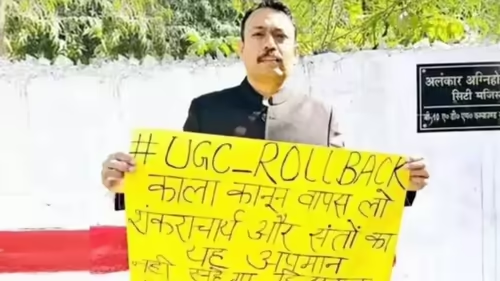
In a bold act of protest that has sent ripples through India’s administrative and political corridors, Alankar Agnihotri, a 2019-batch PCS officer and former Bareilly city magistrate, has resigned from his coveted government post. His reason? A fierce opposition to the University Grants Commission’s (UGC) new anti-discrimination regulations, which he has branded as “UGC rules anti-Brahmin.” This isn’t just a personal grievance; it’s a public declaration of a deeper social and political discontent, coupled with a stark warning about a “crisis of leadership” within his community and a potential plunge into the turbulent waters of politics [[4]].
Table of Contents
- Who is Alankar Agnihotri?
- The UGC Rules Anti-Brahmin Controversy Explained
- The Shankaracharya Insult: The Final Trigger
- Why Agnihotri Believes UGC Rules Are Harmful
- A Crisis of Leadership and a Political Plunge
- Conclusion: A Deepening Social Chasm
- Sources
Who is Alankar Agnihotri?
Alankar Agnihotri is not just any bureaucrat. He is a young, qualified officer who cleared the highly competitive Provincial Civil Services (PCS) exam in 2019, a testament to his academic prowess and dedication. His decision to walk away from a stable and prestigious career path is therefore seen as a significant and deeply personal statement. His resignation on Republic Day was not a quiet exit but a loud, public protest designed to draw national attention to his cause [[4]].
The UGC Rules Anti-Brahmin Controversy Explained
The core of Agnihotri’s protest lies in the UGC’s recently notified Promotion of Equity in Higher Educational Institutions Regulations, 2025. These regulations are designed with the noble goal of eliminating discrimination in universities and colleges on grounds of caste, religion, gender, and other identities. They mandate institutions to set up internal complaints committees and an Equal Opportunity Cell to address grievances [[16]].
However, critics like Agnihotri argue that the implementation of these rules could be weaponized. He contends that the vague language and broad scope of the regulations could lead to false accusations against students and faculty from the general category, particularly Brahmins, creating an atmosphere of fear and suspicion on campuses. He has gone so far as to label the new framework a “black law” that will harm merit and divide society further [[20]].
The Shankaracharya Insult: The Final Trigger
While the UGC regulations were the primary catalyst, Agnihotri cited another deeply personal and religious trigger for his resignation: the alleged “insult to Shankaracharya.” This refers to a recent controversy involving Jyotish Peeth Shankaracharya Swami Avimukteshwaranand Saraswati, a prominent Hindu religious leader. The dispute arose during the Magh Mela in Prayagraj, where the Shankaracharya reportedly faced administrative hurdles and a notice from the state government regarding his use of the title, which he perceived as a grave insult [[27]].
For Agnihotri, this incident was the final straw. He stated, “The insult to Shankaracharya deeply shook me,” linking what he saw as a broader attack on Sanatan traditions and its leaders to the perceived targeting of the Brahmin community through policy [[19]]. This confluence of a policy grievance and a religious slight created a powerful narrative for his protest.
Why Agnihotri Believes UGC Rules Are Harmful
Agnihotri’s core argument is that these well-intentioned regulations will have unintended, negative consequences. He believes they will:
- Target General Category Students: Create a hostile environment where students from the unreserved category are unfairly accused of discrimination, impacting their academic freedom and mental well-being [[7]].
- Undermine Meritocracy: Shift the focus from academic performance to identity politics, potentially diluting the quality of education and professional standards.
- Deepen Social Divides: Instead of fostering unity, the rules could exacerbate existing caste tensions by institutionalizing a system of complaint that may be prone to misuse [[6]].
A Crisis of Leadership and a Political Plunge
Perhaps the most intriguing aspect of Agnihotri’s resignation is his explicit statement about a “crisis of leadership within the upper caste” [[4]]. He feels that the community lacks strong voices to defend its interests in the current socio-political climate. By resigning, he is positioning himself as that voice. His declaration that “someone had to come forward” is a clear signal of his intent to enter the political arena to champion his cause and represent a constituency he believes is being marginalized [[4]].
This move places him at the intersection of a complex debate on social justice, affirmative action, and the rights of all citizens. His stance resonates with a segment of the population that feels anxious about changing social dynamics, while others see his actions as a resistance to necessary measures for equity. For more on the ongoing debate around reservation and social equity in India, see [INTERNAL_LINK:india-reservation-policy-debate].
Conclusion: A Deepening Social Chasm
Alankar Agnihotri’s resignation is far more than a personal career choice. It is a potent symbol of the deep anxieties and divisions within Indian society regarding issues of caste, equity, and identity. By framing the UGC rules anti-Brahmin and linking them to a perceived religious slight, he has crafted a powerful narrative that is already influencing public discourse. Whether his potential political journey will offer solutions or merely amplify existing tensions remains to be seen, but his dramatic exit has undoubtedly forced a national conversation on the delicate balance between protecting the vulnerable and ensuring fairness for all.
Sources
- Times of India. “‘UGC rules anti-Brahmin’: Former Bareilly city magistrate hints at political plunge.” https://timesofindia.indiatimes.com/city/meerut/i-might-join-politics-theres-a-crisis-of-leadership-within-upper-caste-someone-had-to-come-forward-alankar-agnihotri/articleshow/127723173.cms
- The Indian Express. “Bareilly city magistrate says resigning over UGC rules, Shankaracharya row.” https://indianexpress.com/article/political-pulse/anti-brahmin-campaign-going-on-in-up-govt-bareilly-city-magistrate-says-resigning-over-ugc-rules-shankaracharya-row-10496116/
- NDTV. “Bareilly City Magistrate Resigns, Cites Disagreement With New UGC Policies.” https://www.ndtv.com/india-news/bareilly-city-magistrate-alankar-agnihotri-resigns-cites-disagreement-with-new-ugc-policies-10889499
- Times Now. “UP’s Bureaucratic Revolt Has A Brahmin Subtext — And It’s Getting Political.” https://www.timesnownews.com/india/up-bureaucratic-resignation-brahmin-shankaracharya-ugc-rules-bareilly-magistrate-ayodhya-gst-commissioner-article-153515499
- University Grants Commission. “Draft Regulations on Promotion of Equity in Higher Educational Institutions, 2025.” https://www.ugc.gov.in/pdfnews/2968711_Draft-Regulation.pdf