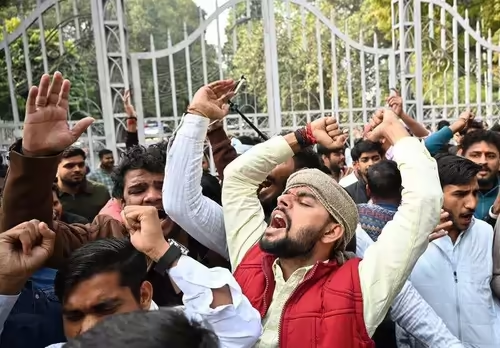
The air on university campuses across India is thick with tension. Chants of protest echo from the corridors of Delhi University to the grounds of Lucknow University, all centered on a single, controversial policy: the UGC equity rules of 2026. What was intended as a landmark step towards a more inclusive academic environment has instead become a flashpoint for national debate, drawing in students, politicians, and now, the highest court in the land.
Table of Contents
- What Are the UGC Equity Rules 2026?
- Why Are Students Protesting the UGC Framework?
- The Supreme Court Steps In to Decide the Fate of UGC Equity Rules
- Political Divide Deepens Over Campus Equity
- What This Means for Indian Higher Education
- Conclusion
- Sources
What Are the UGC Equity Rules 2026?
On January 13, 2026, the University Grants Commission (UGC) officially notified its new Promotion of Equity in Higher Education Institutions Regulations, 2026 [[24]]. These regulations are not born in a vacuum; they are the culmination of a decade-long legal battle, stemming from a 2019 Public Interest Litigation (PIL) filed by Radhika Vemula and Abeda Salim Tadvi—mothers of students who died by suicide following alleged caste-based harassment on campus [[7]].
The core objective of the UGC equity rules is to create a robust, standardized mechanism across all higher education institutions to prevent and address discrimination based on caste, gender, religion, disability, and other identities. Key provisions include:
- Mandating every university and college to establish an independent Equity Committee with significant autonomy.
- Defining specific acts that constitute discrimination and harassment, with a strong focus on caste-based atrocities.
- Outlining a clear, time-bound process for filing complaints and conducting inquiries.
- Requiring institutions to conduct regular sensitization programs for staff and students.
Proponents, including advocates like Disha Wadekar who represent the original petitioners, argue these rules are a necessary and just response to systemic inequities that have plagued Indian campuses for generations [[1]].
Why Are Students Protesting the UGC Framework?
Despite its noble intentions, the framework has ignited a firestorm of opposition, primarily from student groups representing the ‘General’ or ‘Unreserved’ categories. Their central grievance is the fear of reverse discrimination. Critics argue that the rules, particularly Section 3(c) which defines caste-based discrimination, are so broadly worded that they could be weaponized against students from non-reserved categories, leading to unfair penalties and a chilling effect on free speech [[4]].
The protests have been swift and widespread:
- Delhi University: Students gathered at the North Campus and outside the UGC headquarters, demanding a complete rollback of the regulations [[18], [22]].
- Uttar Pradesh: Major demonstrations have taken place in Lucknow, Varanasi, and other university towns, with some political leaders even resigning from their posts in protest [[5], [23]].
- Patna: Student unions have announced statewide agitations and boycotts, calling the rules “unconstitutional” [[19]].
The protesters’ primary demand is simple: scrap the UGC equity rules in their current form and initiate a more consultative process that addresses their concerns about fairness and due process.
The Supreme Court Steps In to Decide the Fate of UGC Equity Rules
With the situation escalating on the ground, the legal battle has moved to the Supreme Court of India. A petition has been filed challenging the constitutional validity of the regulations, specifically arguing that they violate the right to equality by creating a system that is inherently biased against certain groups of students [[2]].
The Court is now tasked with a delicate balancing act: upholding the fundamental right of marginalized students to a safe and dignified educational environment while ensuring that the rights of all students to a fair and unbiased process are protected. The outcome of this case will set a crucial precedent for how India’s higher education system tackles social justice in the 21st century [[8]].
Political Divide Deepens Over Campus Equity
The controversy has also exposed a stark political fault line. While many parties in the Hindi heartland are echoing student concerns, Tamil Nadu Chief Minister M. K. Stalin has emerged as a vocal supporter of the regulations. He has hailed the UGC equity rules as a “long-overdue reform” and has urged the Union government to stand firm against political pressure and not dilute the intent of these rules [[11], [15]].
This split highlights the complex intersection of social justice, electoral politics, and educational policy in India, where a policy designed for equity can quickly become a political football.
What This Means for Indian Higher Education
Regardless of the Supreme Court’s final verdict, the debate surrounding the UGC equity rules has already forced a long-overdue national conversation about the realities of discrimination on campus. It has pushed universities to confront uncomfortable truths and consider their role in either perpetuating or dismantling systemic barriers.
For students and faculty, the immediate future is one of uncertainty. Implementation of the rules is likely on hold pending the Court’s decision, leaving institutions in a state of limbo. However, the core issue—the need for truly equitable and safe learning spaces—remains unresolved and more urgent than ever.
Conclusion
The UGC equity rules of 2026 sit at a volatile crossroads of social justice, legal rights, and political will. While they aim to protect the most vulnerable, they have inadvertently alienated another section of the student body. The path forward requires more than just a legal ruling; it demands a national dialogue built on empathy, evidence, and a shared commitment to making India’s universities spaces of genuine learning and belonging for everyone. For now, all eyes are on the Supreme Court, whose decision will shape the future of campus life in India for years to come.
Sources
- [[1]] The Wire: “UGC’s 2026 Equity Rules: Justice for Marginalised”
- [[2]] Indian Express: “SC Challenge to UGC Equity Regulations 2026”
- [[4]] Scroll.in: “Top updates: UGC equity rules spark student protests”
- [[5]] Indian Express: “UGC’s equity regulations trigger widespread protests across Uttar Pradesh”
- [[7]] Live Law: “Explainer: UGC’s 2026 Regulations For Tackling…”
- [[8]] Zee News: “The Supreme Court is hearing petitions today challenging…”
- [[11]] The Economic Times: “Stalin hails UGC’s equity regulations as long-overdue…”
- [[15]] The Hindu: “T.N. CM Stalin welcomes UGC equity regulations…”
- [[18]] Times of India: “Massive protests against new UGC regulations in many…”
- [[19]] Times of India: “UGC equity rules hit the streets: Student protests across…”
- [[22]] The Hindu: “Student group protests outside UGC office in Delhi…”
- [[23]] The New Indian Express: “Student protests against UGC equity regulations intensify…”
- [[24]] UGC Official Website: Notification of Regulations