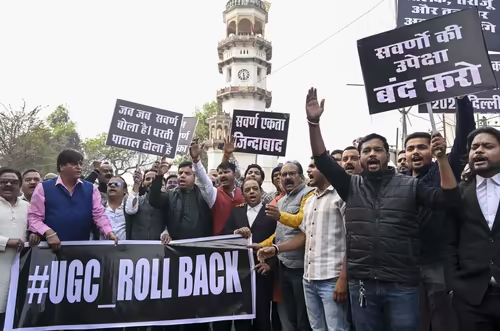
In a decision that has sent shockwaves through India’s academic corridors, the Supreme Court has officially stayed the implementation of the UGC Equity Regulations 2026. The court, led by Chief Justice of India Surya Kant, deemed the new rules as “vague” and “capable of misuse,” effectively pressing pause on a framework that had already ignited fierce national debate [[18]].
For now, the older UGC Regulations for Curbing Harassment of Students in Higher Educational Institutions, 2012 will remain the governing law until the next hearing scheduled for March 19, 2026 [[12]]. But what exactly are these new regulations, why did they spark such intense protests, and what does this judicial intervention truly signify for the future of equity in our universities?
Table of Contents
- What Are the UGC Equity Regulations 2026?
- Why Did the Supreme Court Stay the UGC Equity Regulations 2026?
- The Timeline of Protests and Political Fallout
- Key Differences: UGC 2026 vs. 2012 Rules
- What Happens Next for Indian Higher Education?
- Conclusion
- Sources
What Are the UGC Equity Regulations 2026?
Notified on January 13, 2026, the UGC Promotion of Equity in Higher Education Institutions Regulations, 2026 were designed as a robust successor to the 2012 guidelines [[16]]. Their primary goal was ambitious: to create a more enforceable and comprehensive mechanism to tackle caste-based discrimination, harassment, and bias against students from marginalized communities within universities and colleges.
Key mandates included:
- The compulsory establishment of an Equal Opportunity Centre (EOC) in every Higher Education Institution (HEI) [[8]].
- Setting up a dedicated Equity and Inclusion Committee to handle complaints swiftly.
- Introducing stricter timelines for inquiry and resolution of cases.
- Expanding the definition of protected groups and forms of discrimination beyond the 2012 framework [[21]].
While the intent was widely seen as a step towards a more inclusive campus, the execution and specific wording of the rules became a lightning rod for controversy.
Why Did the Supreme Court Stay the UGC Equity Regulations 2026?
The Supreme Court’s intervention was swift and decisive. The core objections raised by petitioners—and ultimately accepted by the court—centered on two critical flaws:
- Vagueness in Definitions: The regulations were criticized for using broad and ambiguous language, particularly around what constitutes an act of discrimination or harassment. This lack of clarity, the court reasoned, could lead to arbitrary application and potential misuse of the rules [[14]].
- Potential for Misuse: Critics, including many student groups, argued that the vague definitions could be weaponized, leading to a flood of frivolous complaints that could stifle free speech and academic freedom on campuses [[19]].
The court’s order essentially acknowledged that while the objective of preventing discrimination is noble, the means to achieve it must be legally sound, precise, and fair to all parties involved. Until these concerns are addressed, the 2012 regulations, which are more advisory in nature, will continue to apply [[12]].
The Timeline of Protests and Political Fallout
The journey from notification to a Supreme Court stay was remarkably short and turbulent.
Almost immediately after their announcement on January 13, protests erupted on university campuses nationwide. Students, particularly from the general category, took to the streets, arguing that the regulations were “biased and divisive” and could deepen existing social fissures rather than heal them [[31]]. Major demonstrations were reported at Delhi University, Lucknow University, and various institutions across Uttar Pradesh [[33], [35]].
The political landscape quickly became polarized. While some parties lauded the regulations as a necessary shield for vulnerable students, others condemned them as a politically motivated move that threatened meritocracy and social harmony. This intense public pressure and the legal challenges that followed created the perfect storm that culminated in the Supreme Court’s hearing just over two weeks later.
Key Differences: UGC 2026 vs. 2012 Rules
To understand the magnitude of the shift the 2026 regulations proposed, it’s crucial to compare them with the existing 2012 framework.
| Feature | UGC Regulations 2012 | UGC Equity Regulations 2026 (Stayed) |
|---|---|---|
| Nature | Advisory guidelines | Mandatory, enforceable regulations |
| Scope | Focused primarily on SC/ST students | Expanded to include OBCs, women, minorities, and other marginalized groups [[21]] |
| Implementation Body | Recommendation for an Internal Complaints Committee (ICC) | Mandatory Equal Opportunity Centre (EOC) and a dedicated Equity Committee [[8]] |
| Enforcement | Lacked strong punitive measures | Proposed clear penalties and a faster, more stringent inquiry process [[25]] |
This table highlights the government’s clear intent to move from a passive, recommendatory approach to an active, compliance-driven system. However, the speed and perceived lack of consultation in this transition fueled much of the backlash.
What Happens Next for Indian Higher Education?
The ball is now firmly in the government’s court. The Supreme Court has given it until March 19, 2026, to address the concerns about vagueness and potential misuse [[11]]. This presents a critical opportunity to engage in a more consultative process with all stakeholders—students, faculty, legal experts, and civil society—to draft a more balanced and legally watertight set of regulations.
For university administrators, the immediate task is to continue operating under the 2012 guidelines while preparing for a potential future where a revised version of the 2026 rules might come into force. The core challenge remains: how to build a genuinely safe and equitable learning environment without creating a system that breeds fear or is open to exploitation.
As we await the next chapter in this saga, one thing is certain: the conversation about equity, justice, and inclusion in our higher education institutions is more vital than ever. For more on how policy shapes our academic lives, check out our deep dive on [INTERNAL_LINK:higher-education-policy-in-india].
Conclusion
The Supreme Court’s stay on the UGC Equity Regulations 2026 is not a rejection of the need for stronger anti-discrimination measures in higher education. Instead, it’s a powerful reminder that good intentions must be matched by precise, fair, and well-considered legislation. The path forward requires a delicate balance between protecting the vulnerable and ensuring due process for all. The March 19 hearing will be a pivotal moment in determining whether India’s campuses can move towards a more just future without sacrificing the principles of fairness and clarity.
Sources
- [[11]] Sunday Guardian Live: New UGC Rules 2026 ‘Halted’
- [[12]] Live Law: Supreme Court Stays UGC Equity Regulations 2026
- [[14]] CNBC TV18: The Supreme Court stayed UGC Regulation 2026 on caste discrimination
- [[16]] Times of India: Supreme Court stays UGC equity regulations 2026
- [[18]] India Today: UGC Equity Rules discrimination case: Supreme Court pauses implementation
- [[19]] Best Colleges India Today: UGC Equity Regulations 2026 row: Supreme Court stays new rules
- [[21]] India Today: UGC anti-discrimination rules 2026 vs 2012
- [[25]] Times of India: UGC’s 2026 equity regulations: A serious idea, an uneven instrument
- [[31]] National Herald: Delhi University students protest against new UGC Equity Regulations 2026
- [[33]] Times of India: Timeline of protests, politics and court’s intervention
- [[35]] The New Indian Express: UGC’s equity regulations trigger widespread protests across UP