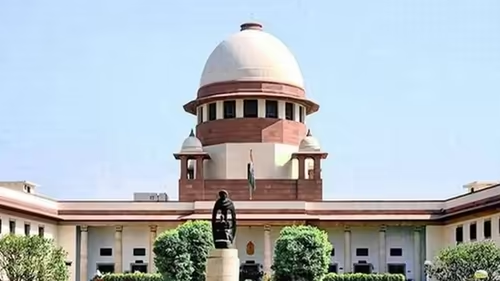
The academic world is in an uproar. Just weeks after their introduction, the UGC Equity Regulations 2026 have been effectively frozen by the Supreme Court of India. In an interim order, the apex court has reinstated the 2012 regulations, citing serious concerns about the new rules’ potential to create unequal access to justice on university campuses [[2]]. At the heart of this legal storm is a single, yet highly charged, clause: Regulation 3(c). This provision has ignited a fierce national debate on how to balance targeted protection for historically marginalized groups with the fundamental constitutional principle of equality for all.
Table of Contents
- What Are the UGC Equity Regulations 2026?
- The Core Controversy: Regulation 3(c) Explained
- Why the Supreme Court Intervened
- The 2012 Framework vs. The 2026 Draft: Key Differences
- Broader Implications for Indian Higher Education
- Conclusion: A Delicate Balance
- Sources
What Are the UGC Equity Regulations 2026?
Notified by the University Grants Commission (UGC) on January 13, 2026, these regulations were designed as a comprehensive overhaul of the existing 2012 framework [[1]]. Their stated goal was ambitious: to strengthen mechanisms for promoting equity and preventing discrimination in higher education institutions across India. They proposed more stringent measures to ensure inclusion for students from Scheduled Castes (SC), Scheduled Tribes (ST), Other Backward Classes (OBC), and other marginalized communities [[8]]. On the surface, the intent was laudable—a step towards creating safer, more inclusive campuses.
The Core Controversy: Regulation 3(c) Explained
The trouble began with the fine print. Regulation 3(c) of the 2026 draft defined “caste-based discrimination” in a way that was explicitly limited to acts of prejudice or harassment directed against individuals belonging to SC, ST, and OBC categories [[7]]. This seemingly targeted definition became the lightning rod for criticism. Opponents argued that it created a legal anomaly: if a student from a non-reserved category faced caste-based abuse, they would be unable to file a formal complaint under this specific, powerful regulation. Their grievance would have to be addressed under more general, and often less robust, university codes of conduct.
This, critics contended, established a two-tier system of justice—one set of strong, dedicated protections for some, and a weaker, generic process for others. It raised a fundamental question: can a law aimed at ensuring equality itself become a source of inequality by its very design?
Why the Supreme Court Intervened
Faced with multiple petitions challenging the constitutionality of the new rules, the Supreme Court acted swiftly. The court found the 2026 regulations to be “prima facie vague and capable of misuse” [[6]]. The justices were particularly troubled by the potential for the rules to be applied in a discriminatory manner, directly contradicting the spirit of Article 14 of the Indian Constitution, which guarantees equality before the law.
In its interim order, the court declared that the UGC Equity Regulations 2026 would be “kept in abeyance” until the next hearing scheduled for March 19, 2026 [[3]]. Crucially, it directed that the 2012 UGC regulations would remain in full force during this period, ensuring that a functional, albeit older, grievance redressal mechanism stays in place [[5]].
The 2012 Framework vs. The 2026 Draft: Key Differences
To understand the stakes, it’s essential to compare the two frameworks:
| Feature | UGC Framework 2012 | UGC Draft 2026 (Stayed) |
|---|---|---|
| Definition of Caste Discrimination | Generally applicable to all students. | Limited specifically to SC/ST/OBC complainants (Regulation 3(c)). |
| Grievance Redressal | Equal access to the same committee for all. | Potential for a two-tier system based on caste identity. |
| Primary Focus | Preventing discrimination broadly. | Strengthening protections for specific marginalized groups. |
The 2012 framework, while perhaps less detailed, offered a more universally applicable safety net. The 2026 draft, in its zeal to protect the most vulnerable, may have inadvertently excluded others from its strongest safeguards.
Broader Implications for Indian Higher Education
This case is far more than a bureaucratic dispute; it’s a philosophical test for modern India. It forces us to confront a complex reality: how do we provide special protections for communities that have suffered centuries of systemic oppression without violating the principle of equal citizenship for everyone? Universities are microcosms of society, and the rules governing them set a powerful precedent.
The outcome of this case will shape campus culture for years to come. It will influence how students interact, how faculty handle complaints, and ultimately, what kind of social contract exists within India’s halls of learning. As the legal battle unfolds, university administrations are left in a state of uncertainty, operating under the 2012 rules while awaiting the court’s final verdict [[10]].
Conclusion: A Delicate Balance
The Supreme Court’s stay on the UGC Equity Regulations 2026 is not a rejection of the need for stronger anti-discrimination measures. Instead, it’s a call for greater precision, fairness, and constitutional fidelity in their drafting. The path forward requires a delicate balance—crafting policies that are both powerfully protective of the historically marginalized and fundamentally just for every single student, regardless of their background. The court’s next hearing in March will be a critical moment in defining what true equity looks like in 21st-century India.
Sources
- Times of India. “Supreme Court stays UGC equity regulations 2026.” https://timesofindia.indiatimes.com/… [[1]]
- Newsonair. “Supreme Court stays UGC’s new equity regulations.” https://www.newsonair.gov.in/… [[2]]
- Sunday Guardian. “New UGC Rules 2026 ‘Halted’: 2012 Regulations to remain in force…” https://sundayguardianlive.com/… [[3]]
- The Hindu. “Supreme Court stays 2026 UGC equity rules, calls it ‘too sweeping’.” https://www.thehindu.com/… [[7]]
- LiveLaw. “Supreme Court Stays UGC Equity Regulations 2026.” https://www.livelaw.in/… [[6]]
- NDTV. “Supreme Court Stays UGC 2026 Rules, 2012 Regulations Continue.” https://www.ndtv.com/… [[10]]
- [INTERNAL_LINK:caste-discrimination-in-indian-universities]
- [INTERNAL_LINK:supreme-court-judgments-on-education]