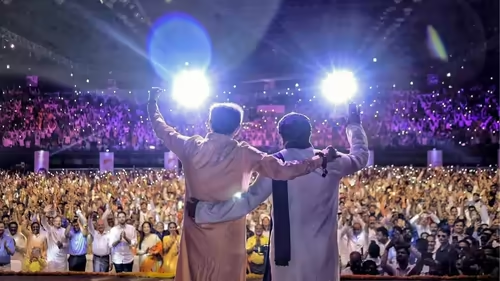
For decades, the name Thackeray was synonymous with Mumbai’s political soul—especially within the Brihanmumbai Municipal Corporation (BMC), India’s richest civic body. But in the 2026 BMC elections, that legacy took a stunning hit. Despite a dramatic, emotionally charged reunion between cousins Uddhav Thackeray and Raj Thackeray after nearly two decades, their combined forces couldn’t reclaim the city’s heart. Instead, the results exposed a deep erosion in the once-unshakable ‘Thackeray brand.’ Was the pivot toward ‘soft Hindutva’—a diluted version of the original Shiv Sena ideology—the fatal misstep?
Table of Contents
- The Great Thackeray Reunion: Hype vs. Reality
- Uddhav Thackeray’s Shift to Soft Hindutva
- Why Voters Felt Disconnected
- The Shinde Factor: A Rival Who Owns Hard Hindutva
- Is the ‘Marathi Manoos’ Narrative Still Relevant?
- What’s Next for the Thackeray Legacy?
The Great Thackeray Reunion: Hype vs. Reality
In late 2025, Maharashtra witnessed a political spectacle rarely seen in recent history: Uddhav Thackeray of Shiv Sena (UBT) and Raj Thackeray of MNS publicly burying the hatchet. Their joint rallies in Mumbai framed the BMC polls as nothing short of a cultural emergency—a battle to “save the Marathi manoos and Mumbai” .
The messaging was clear: this wasn’t just about civic governance; it was a referendum on identity, legacy, and regional pride. Yet, when votes were counted, the alliance underperformed dramatically. The Shiv Sena (UBT)-MNS combine won far fewer seats than projected, while Eknath Shinde’s Shiv Sena faction—backed by the BJP—consolidated power in the BMC.
Uddhav Thackeray’s Shift to Soft Hindutva
Since breaking away from the BJP in 2019 and forming the Maha Vikas Aghadi (MVA) government with the NCP and Congress, Uddhav Thackeray has been accused by hardliners of abandoning the core tenets of Bal Thackeray’s ideology. His version of Hindutva became more inclusive, less confrontational—what critics dubbed “soft Hindutva.”
While this move aimed to broaden his appeal beyond the traditional Marathi-Hindu base, it alienated loyalists who saw it as a betrayal. In contrast, Eknath Shinde’s faction doubled down on aggressive Hindutva rhetoric, temple politics, and anti-immigrant narratives—effectively claiming ownership of the original Shiv Sena identity .
Why Voters Felt Disconnected
Several factors contributed to voter disillusionment:
- Identity Confusion: Many long-time supporters couldn’t reconcile Uddhav’s alliance with secular parties like Congress after years of anti-Congress rhetoric.
- Lack of Grassroots Connect: While Raj Thackeray brought street energy, Uddhav’s campaign felt top-down and disconnected from ground realities like water shortages, waste management, and housing crises.
- Perceived Elitism: Critics painted Uddhav as out of touch—a billionaire politician living in Bandra’s Matoshree mansion while ordinary Mumbaikars struggled with inflation and infrastructure decay.
The Shinde Factor: A Rival Who Owns Hard Hindutva
Eknath Shinde didn’t just split the party—he strategically rebranded himself as the true heir to Bal Thackeray’s legacy. By aligning tightly with the BJP and championing issues like Marathi language enforcement, cow protection, and opposition to “outsider” dominance in jobs, Shinde captured the emotional core of the old Shiv Sainik.
According to political analysts, Shinde’s narrative was simple and effective: “Uddhav sold out. We are the real Sena.” This message resonated deeply in working-class neighborhoods where identity politics still trump policy promises .
Is the ‘Marathi Manoos’ Narrative Still Relevant?
Once a rallying cry for job reservations and cultural assertion, the “Marathi manoos” slogan is facing diminishing returns in a globalized, migrant-heavy Mumbai. Over 60% of the city’s population now consists of non-Maharashtrians, many of whom view the slogan as exclusionary .
Ironically, while Uddhav tried to soften this stance to appear inclusive, he lost his base without gaining enough new voters. Meanwhile, Shinde weaponized the same slogan—but with the backing of national machinery and media amplification—making it feel both nostalgic and urgent.
What’s Next for the Thackeray Legacy?
The BMC setback is more than an electoral loss—it’s a crisis of identity for the Thackeray family. To survive, Uddhav Thackeray must answer a fundamental question: Can he be both a progressive regional leader and the guardian of Marathi pride?
Possible paths forward include:
- Reclaiming grassroots connect through local issue-based campaigns.
- Clarifying his ideological stance—either fully embracing inclusive regionalism or reasserting a sharper cultural identity.
- Strengthening alliances without appearing opportunistic, possibly by forging a pan-Maharashtra front against BJP-Shinde dominance.
One thing is certain: the era of automatic loyalty to the Thackeray name is over. Legacy alone won’t win elections in today’s hyper-competitive, issue-driven urban politics.
Sources
- [1] Times of India: Did soft Hindutva hit Uddhav hard?
- [2] The Hindu: Shiv Sena Split and the Battle for Ideological Ownership
- [3] India Today Analysis: Why Shinde’s Hindutva Worked in BMC Polls
- [4] Census & Migration Data: Office of the Registrar General & Census Commissioner, India