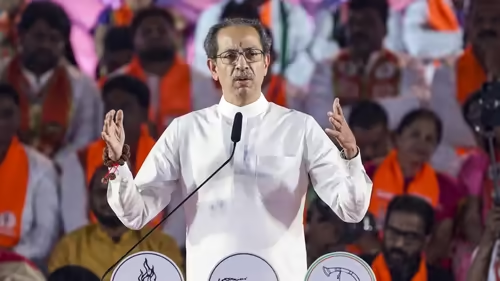
In a dramatic escalation of political tensions in Maharashtra, Shiv Sena (UBT) president Uddhav Thackeray has leveled explosive allegations against the ruling Mahayuti alliance, claiming that the recently concluded BMC elections were marred by widespread coercion, intimidation, and even kidnappings. Describing the contest as a “life-and-death election for them,” Thackeray painted a grim picture of electoral malpractice aimed at silencing dissent and securing victory at any cost .
Despite the Mahayuti alliance—comprising the BJP, Eknath Shinde-led Shiv Sena, and NCP (Ajit Pawar faction)—securing a clear majority in the Brihanmumbai Municipal Corporation (BMC), India’s richest civic body, Thackeray insisted his party stood firm against immense pressure. He publicly thanked voters for their support of the Shiv Shakti alliance (Shiv Sena UBT + Congress + NCP Sharad Pawar), framing the results not just as a political outcome but as a moral victory amid alleged systemic suppression .
Table of Contents
- The Allegations: Unpacking Uddhav’s “Life-and-Death” Claim
- BMC Elections: Why Mumbai’s Civic Polls Matter So Much
- Political Backdrop: The Shiv Sena Split and Its Aftermath
- Mahayuti vs. Shiv Shakti: A Clash of Alliances
- What Next for Uddhav Thackeray and Shiv Sena (UBT)?
- Conclusion: Democracy Under Pressure in Mumbai’s Streets
- Sources
The Allegations: Unpacking Uddhav’s “Life-and-Death” Claim
Thackeray’s statement wasn’t just rhetorical—it came with specific, disturbing accusations. He alleged that supporters and workers of his faction were subjected to threats, physical intimidation, and in some cases, outright abduction to prevent them from campaigning or voting freely. “This was not an election; it was a test of survival,” he said, emphasizing that the stakes were existential for his party following the 2022 political coup that ousted him as Maharashtra’s Chief Minister .
While concrete evidence of kidnappings hasn’t been independently verified by law enforcement as of January 2026, multiple local reports from Mumbai suburbs like Andheri, Kurla, and Ghatkopar cited instances of booth capturing, voter suppression, and aggressive mobilization by rival groups . These claims, if substantiated, could trigger formal complaints to the Election Commission of India—a body already under scrutiny for its handling of urban local body polls.
BMC Elections: Why Mumbai’s Civic Polls Matter So Much
The BMC elections are far more than a routine municipal vote. The Brihanmumbai Municipal Corporation controls an annual budget exceeding ₹50,000 crore—larger than that of several Indian states. It oversees critical infrastructure: water supply, waste management, public health, roads, and disaster response in India’s financial capital .
Control of the BMC translates into:
- Massive patronage power through contracts and appointments.
- Grassroots political dominance in over 247 wards across Mumbai.
- A strategic springboard for state and national elections.
For Uddhav Thackeray, losing ground in the BMC isn’t just a civic setback—it’s a direct threat to his party’s relevance in its traditional stronghold. Hence, his characterization of the poll as a “strange” and high-stakes contest reflects the deep emotional and political investment at play.
Political Backdrop: The Shiv Sena Split and Its Aftermath
To fully grasp the intensity of these allegations, one must revisit June 2022, when Eknath Shinde led a rebellion of 40+ MLAs, toppling the Maha Vikas Aghadi (MVA) government. This split fractured the 57-year-old Shiv Sena, with Shinde’s faction aligning with the BJP to form a new government .
Since then, Uddhav’s UBT faction has been fighting to reclaim its identity and voter base. Every electoral battle—from Lok Sabha to civic polls—is seen as a referendum on legitimacy. The BMC, where Shiv Sena once held unchallenged sway, has become the ultimate battleground for narrative control. As one political analyst noted, “Whoever owns Mumbai’s streets owns the soul of the Sena.”
Mahayuti vs. Shiv Shakti: A Clash of Alliances
The recent BMC elections featured two dominant coalitions:
- Mahayuti Alliance: BJP + Shinde Sena + NCP (Ajit Pawar). Riding on state-level momentum and administrative machinery.
- Shiv Shakti Alliance: Shiv Sena (UBT) + Congress + NCP (Sharad Pawar). Positioned as the “democratic resistance” against what they call “undemocratic forces.”
While Mahayuti secured a commanding lead, early trends suggested Shiv Shakti performed better than expected in key urban pockets, particularly among younger voters and Marathi-speaking middle-class communities loyal to Uddhav’s legacy . This resilience, Thackeray argues, is proof that fear tactics couldn’t entirely erase public sentiment.
What Next for Uddhav Thackeray and Shiv Sena (UBT)?
With the BMC results finalized, Uddhav’s next move is critical. Legal challenges based on electoral malpractice could be filed, though success is uncertain. More likely, he’ll double down on grassroots mobilization, using these allegations to galvanize public sympathy ahead of the 2029 Maharashtra Assembly elections.
For now, his message is clear: even in defeat, moral authority matters. As he told supporters, “They may win seats, but they cannot steal our dignity.” This narrative of victimhood and resistance could prove pivotal in rebuilding his party’s emotional connect with Mumbai’s electorate.
For deeper insights into Maharashtra’s evolving political landscape, see our analysis on [INTERNAL_LINK:maharashtra-political-alliances-post-2022].
Conclusion: Democracy Under Pressure in Mumbai’s Streets
The controversy surrounding the BMC elections underscores a troubling trend: as local bodies gain financial and political clout, they’re becoming flashpoints for undemocratic practices. Uddhav Thackeray’s allegations—whether fully proven or not—highlight the urgent need for transparent, secure, and impartial electoral processes at every level of governance. In a city that prides itself as India’s commercial nerve center, the integrity of its civic democracy must remain non-negotiable.