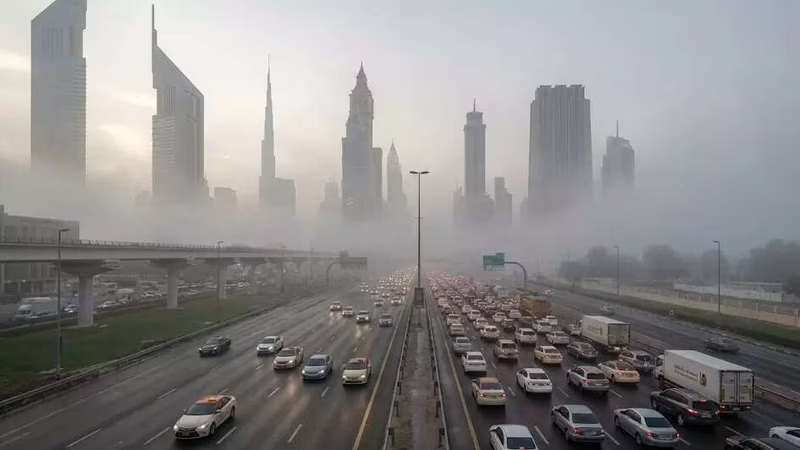
If you were stuck in bumper-to-bumper traffic in the UAE this Tuesday morning, you weren’t alone. A sudden and intense bout of dense fog rolled in overnight, slashing visibility to dangerous levels and turning the morning commute into a slow-motion crawl across the nation’s busiest emirates. The National Center of Meteorology (NCM) swiftly issued a formal UAE weather alert, warning residents of the hazardous conditions and advising drivers to proceed with extreme caution—or better yet, delay non-essential travel until the skies clear.
Table of Contents
- The Morning Chaos: Cities Grind to a Halt
- Official UAE Weather Alert: What Was Said
- Why Fog Hits the UAE in Winter
- Critical Driving Safety Tips During Dense Fog
- Forecast: When Will the Fog Lift?
- Historical Context: Has This Happened Before?
- Conclusion: Stay Informed, Stay Safe
- Sources
The Morning Chaos: Cities Grind to a Halt
The impact was immediate and widespread. In **Abu Dhabi**, visibility on key routes like Sheikh Zayed Road and Airport Road reportedly dropped to less than 500 meters in some areas, prompting authorities to reduce speed limits and deploy additional patrols . Commuters shared videos on social media showing ghostly outlines of skyscrapers barely visible through the haze.
**Dubai** wasn’t spared either. Major arteries such as Emirates Road and Al Khail Road experienced significant slowdowns, with average speeds plummeting during the peak 7–9 AM window. Traffic monitoring apps showed red and purple congestion lines snaking across the entire city map .
Meanwhile, in **Sharjah**, the E11 and E311 highways saw similar gridlock, with some reports of minor fender-benders due to sudden braking in near-zero visibility conditions . The collective effect was a region-wide disruption that tested the patience of even the most seasoned drivers.
Official UAE Weather Alert: What Was Said
The NCM didn’t mince words in its bulletin. The UAE weather alert explicitly stated that “visibility will decrease to less than 1,000 meters over coastal and internal areas,” classifying the event as a high-impact weather phenomenon . The advisory included clear, actionable instructions for the public:
- Use low-beam headlights only. High beams reflect off the fog, reducing visibility further.
- Maintain a safe following distance. Stopping distances increase dramatically in foggy conditions.
- Avoid sudden lane changes or braking. Signal early and move smoothly.
- Do not stop on the shoulder unless it’s an absolute emergency. Your vehicle becomes a hazard to others who can’t see it.
- Consider postponing your trip. If your journey isn’t essential, wait until conditions improve.
These guidelines are not mere suggestions—they are critical safety protocols designed to prevent the kind of multi-vehicle pileups that have occurred in the UAE during past fog events [[INTERNAL_LINK:uae-road-safety-winter]].
Why Fog Hits the UAE in Winter
For many, fog in a desert climate seems counterintuitive. However, the UAE’s winter months (December to February) create the perfect recipe for radiation fog. Clear nights allow the ground to cool rapidly. When this cool ground meets the relatively warmer, moisture-laden air from the Arabian Gulf and the Gulf of Oman, condensation occurs near the surface, forming dense fog banks .
This phenomenon is most common in low-lying areas and near bodies of water—precisely where the UAE’s major population centers and highways are located. Climate experts note that while not increasing in frequency, these fog events can be more intense in years with higher-than-average humidity, which has been the case in early 2026 .
Critical Driving Safety Tips During Dense Fog
Beyond the NCM’s advice, seasoned driving instructors and road safety experts recommend these additional best practices:
- Slow down significantly. Your normal speed is too fast for the conditions.
- Use your windshield wipers and defrosters. Keep your windshield as clear as possible from the inside and out.
- Listen for traffic you can’t see. Roll down your window slightly to hear other vehicles.
- Follow the road markings. Use the painted lines on the road as your guide, not the taillights of the car ahead, which can lead you astray.
- Have an emergency kit. Include a reflective vest, flashlight, and water in your car year-round, but especially in winter .
Forecast: When Will the Fog Lift?
The good news is that this type of fog is typically short-lived. As the sun rises higher in the sky and begins to warm the earth’s surface, the fog starts to evaporate. The NCM forecast for Tuesday, January 13, 2026, predicted that the dense fog would begin to dissipate by late morning, with visibility returning to normal by early afternoon . This pattern is consistent with most UAE winter fog events, which are a morning nuisance rather than an all-day hazard.
Historical Context: Has This Happened Before?
Absolutely. The UAE has a history of disruptive fog events. One of the most notable occurred in March 2013, when a massive fog bank caused a 200+ vehicle pileup on the Abu Dhabi-Dubai highway, resulting in multiple fatalities . That tragic event led to a complete overhaul of the UAE’s fog response protocols, including the implementation of variable message signs, enhanced police patrols, and the robust public alert system we see in action today. The current UAE weather alert system is a direct result of those hard lessons learned.
Conclusion: Stay Informed, Stay Safe
Tuesday’s dense fog was a stark reminder that even in a modern, hyper-connected nation like the UAE, nature can still bring daily life to a temporary halt. The swift issuance of the UAE weather alert and the clear guidance from authorities are crucial tools for public safety. By heeding these warnings, using common sense on the roads, and staying updated through official channels, residents can navigate these challenging conditions safely. Remember, no meeting or errand is worth risking your life over. When the fog rolls in, patience isn’t just a virtue—it’s a necessity.
Sources
- [1] National Center of Meteorology (NCM) Official Weather Alert Bulletin, January 13, 2026.
- [2] NCM Public Forecast Update, January 13, 2026.
- [3] Abu Dhabi Police Traffic Report, Morning Commute Summary, January 13, 2026.
- [4] Dubai RTA Traffic Monitoring Data, January 13, 2026.
- [5] Sharjah Police Media Statement on Road Conditions, January 13, 2026.
- [6] Explanation of Radiation Fog Formation, National Weather Service (USA).
- [7] UAE Climate Trends Analysis, World Meteorological Organization (WMO) Regional Report, Q4 2025.
- [8] UAE Road Safety Authority (RSA) Winter Driving Guidelines.
- [9] Historical report on the 2013 UAE fog pileup, Gulf News archives.
- [INTERNAL_LINK:uae-winter-weather-guide]
- [INTERNAL_LINK:dubai-abu-dhabi-commute-tips]