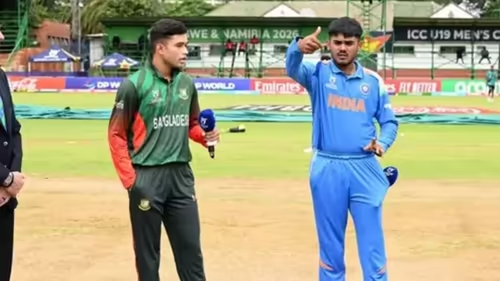
A simple handshake—a universal symbol of sportsmanship—became the center of a heated international debate during the ICC U-19 World Cup. The captains of India and Bangladesh skipped the customary pre-toss greeting, igniting social media fury and raising questions about the spirit of the game. Was it a deliberate snub or just an innocent oversight? The Bangladesh Cricket Board (BCB) has finally broken its silence to set the record straight.
Table of Contents
- The Incident That Sparked a Storm
- BCB’s Official Statement: What They Said
- Why the Confusion? A Perfect Storm of Circumstances
- The Broader Context: India-Bangladesh Cricket Rivalry
- What This Means for the Spirit of Cricket
- Conclusion: A Lesson in Jumping to Conclusions
- Sources
The Incident That Sparked a Storm
During the toss for the crucial Group D match between India and Bangladesh in the ICC U-19 World Cup, viewers noticed something unusual. Indian captain Ayush Mhatre and his Bangladeshi counterpart did not exchange the traditional handshake. In a sport where such rituals are deeply ingrained as a sign of mutual respect, this lapse was immediately flagged by fans and pundits alike. The moment went viral, with many accusing the young players of poor sportsmanship in a high-stakes rivalry .
BCB’s Official Statement: What They Said
Responding to the growing controversy, the Bangladesh Cricket Board (BCB) issued a formal press release to clarify the situation. Their statement was unequivocal: the absence of the U-19 World Cup handshake was “completely unintentional and resulted from a momentary lapse in concentration” . The BCB emphasized that there was no ill intent behind the missed gesture and reaffirmed their strong commitment to the spirit of cricket .
Adding another layer to the explanation, the BCB revealed that Bangladesh’s regular captain, Azizul Hakim, was unwell and unable to attend the toss. Instead, vice-captain Zawad Abrar stepped in to represent the team on the field for the coin toss . This unexpected change in personnel likely contributed to the confusion and the missed protocol.
Why the Confusion? A Perfect Storm of Circumstances
It’s easy to see how this incident unfolded. Imagine being a young cricketer, barely out of school, standing on a global stage for a high-pressure match against a fierce rival. Now, add these factors:
- Last-minute substitution: With the regular captain absent due to illness, vice-captain Zawad Abrar was suddenly thrust into the spotlight for the toss, a role he may not have been fully prepared for in that specific context .
- High-pressure environment: The India-Bangladesh rivalry is intense at every level of the game. The nerves and adrenaline of a World Cup match can easily cause a momentary mental slip.
- Ambiguous protocol: While the handshake is customary, it’s not a codified rule enforced by the umpires. Its absence, therefore, isn’t penalized, leaving room for human error.
In the heat of the moment, a simple, routine gesture was simply forgotten—a human error that was blown out of proportion in the digital age.
The Broader Context: India-Bangladesh Cricket Rivalry
The reaction to this minor incident speaks volumes about the current state of the India-Bangladesh cricketing relationship. Over the past decade, matches between the two nations have been charged with intense emotion, both on and off the field. Every interaction is scrutinized for signs of disrespect, making a missed handshake fertile ground for conspiracy theories and nationalistic outrage. It’s important to remember that these are teenagers, not seasoned diplomats. Their primary focus is on playing their best cricket, not navigating complex geopolitical sentiments .
What This Means for the Spirit of Cricket
The BCB’s swift clarification and its emphasis on its “commitment to the spirit of cricket” is a welcome reminder of what the game is truly about . The spirit of cricket isn’t just about shaking hands; it’s about playing hard but fair, respecting your opponent, and accepting victory and defeat with grace. In a heartening turn of events, reports confirm that at the end of the match, the players from both teams did indeed shake hands, demonstrating that the initial oversight was just that—an oversight .
For more on the values that underpin the sport, the Marylebone Cricket Club (MCC), the guardian of the Laws of Cricket, provides a detailed explanation of the Spirit of Cricket, which is a great resource for understanding the game’s ethos.
Conclusion: A Lesson in Jumping to Conclusions
The U-19 World Cup handshake drama serves as a powerful case study in our era of instant reactions and social media outrage. A momentary lapse by a teenager under immense pressure was instantly framed as a national insult. The BCB’s transparent and prompt response has thankfully cleared the air, reminding us all to give young athletes the benefit of the doubt. The true spirit of the game was evident not in the missed handshake at the start, but in the respectful one shared at the end of a fiercely contested match.
Sources
- BCB breaks silence on India vs Bangladesh U-19 World Cup handshake incident.
- BCB Statement on Toss-Related Incident in U19 World Cup.
- India and Bangladesh Captains Skip Handshake at Toss.
- BCB gives clarification on ‘no-handshake’ episode during U19 WC.
- BCB clarifies ‘no-handshake’ incident at U19 World Cup toss.
- India, Bangladesh players shake hands in U19 World Cup after toss controversy.