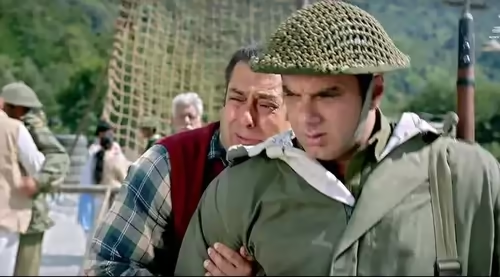
Revisiting Tubelight: The Film That Defied Salman Khan’s Star Persona
For over three decades, Salman Khan has been Bollywood’s undisputed king of mass entertainment. His name is a guarantee of high-octane action, witty one-liners, and a larger-than-life hero who always wins. So, when he stepped into the shoes of Laxman Singh Bisht—a gentle, intellectually disabled man searching for his brother during the 1962 Sino-Indian War—in Tubelight, it was a radical departure that left audiences and critics deeply divided.
Table of Contents
- The Box Office Behemoth
- Critical Reception: A House Divided
- Salman Khan’s Performance: Vulnerability or Vanity?
- The Character of Laxman Singh Bisht
- Director Kabir Khan’s Vision
- Conclusion: The Enduring Legacy of Tubelight
- Sources
The Box Office Behemoth
Despite the polarizing reviews, one thing is undeniable: Tubelight was a commercial juggernaut. Released in 2017, the film went on to collect a staggering ₹211.25 crore at the worldwide box office [[1]]. In India alone, it netted over ₹119 crore, making it one of the highest-grossing films of that year [[4]]. This massive financial success stands in stark contrast to its critical reception, creating a fascinating paradox in modern Bollywood history. It proved that Khan’s star power could still draw crowds, even for a film that dared to be so different from his usual fare.
Critical Reception: A House Divided
The critical response to Tubelight was overwhelmingly negative. Major publications slammed the film for its slow pace, lack of dramatic tension, and what many perceived as a misguided performance by its lead. The Hindu called it a “sparkle-less film” where Salman Khan was a “liability” [[14]], while NDTV bluntly stated that his portrayal was “one of the worst performances of his career” [[10]]. The consensus was that the film’s noble intentions were lost in a sea of sentimentality and a performance that felt more like an impersonation than a genuine embodiment of the character.
Salman Khan’s Performance: Vulnerability or Vanity?
This is the heart of the Tubelight debate. Director Kabir Khan had claimed before release that Salman’s performance in this film was “five times better than Bajrangi Bhaijaan” [[16]]. However, the final product told a different story for many viewers. Critics argued that Khan’s portrayal relied too heavily on physical tics and a childlike voice, lacking the nuanced depth required for such a sensitive role. They felt it bordered on caricature rather than a respectful depiction of a person with an intellectual disability [[12]]. Yet, some fans and a few reviewers saw a genuine attempt at vulnerability, a side of the superstar rarely seen on screen. The performance remains a contentious topic, a Rorschach test for how one views Khan’s acting range.
The Character of Laxman Singh Bisht
Laxman, nicknamed “Tubelight” by his peers for being “slow to light up,” is the emotional core of the film. He is a man of pure heart, whose simple faith and unwavering belief in goodness drive him on a perilous journey across the Himalayas to find his missing brother, Bharat, during wartime [[18]]. His character is defined by his innocence and his dependence on those around him, particularly his brother and his wise uncle, Banne Chacha (played by the late Om Puri) [[23]]. The film’s central theme is that true strength lies not in physical prowess but in the power of faith and love—a message that resonated with its massive audience despite the critical backlash.
Director Kabir Khan’s Vision
Kabir Khan, known for his socially conscious and often patriotic films like Bajrangi Bhaijaan and Ek Tha Tiger, aimed to create a fable about hope and humanity in the face of war and prejudice. He sought to challenge the typical Bollywood hero archetype by placing a vulnerable, non-violent protagonist at the center of a grand narrative. While the execution may have faltered in the eyes of critics, the ambition behind the project was clear. The film’s visual grandeur, captured in the stunning landscapes of Ladakh, and its earnest message were hallmarks of Khan’s directorial style, even if they couldn’t overcome the film’s perceived narrative flaws.
Conclusion: The Enduring Legacy of Tubelight
So, did Tubelight deserve more love? The answer depends on what you value in cinema. As a piece of art, it was widely criticized for its heavy-handedness and a central performance that many found unconvincing. However, as a cultural phenomenon and a testament to Salman Khan’s unparalleled connection with his audience, it was an undeniable success. It stands as a unique, if flawed, entry in his filmography—a brave attempt to shed his invincible persona and explore a more tender, human side. Its legacy is that of a paradox: a box office giant that remains a critical punching bag, yet continues to spark conversation about the nature of stardom and performance in Indian cinema. For more insights into Bollywood’s biggest stars and their iconic roles, explore our feature on [INTERNAL_LINK:bollywood-superstars-evolution].
Sources
- Sacnilk. “Tubelight Box Office Collection.” https://www.sacnilk.com/news/Tubelight_Box_Office_Collection_Day_Wise_Worldwide
- NDTV. “Tubelight Movie Review: Salman Khan Is The Worst Thing About Tubelight.” https://www.ndtv.com/india-news/tubelight-movie-review-salman-khan-is-the-worst-thing-about-tubelight-1715905
- The Hindu. “Tubelight review: Salman Khan is a liability in this ‘sparkle-less’ film.” https://www.thehindu.com/entertainment/movies/tubelight-salman-khan-is-a-liability-in-this-sparkle-less-film/article19131678.ece
- Indian Express. “Salman Khan’s performance in Tubelight five times better than Bajrangi Bhaijaan: Kabir Khan.” https://indianexpress.com/article/entertainment/bollywood/salman-khan-performance-in-tubelight-five-times-better-than-bajrangi-bhaijaan-kabir-khan-4505519/
- Times of India. “Tubelight Plot Summary.” https://timesofindia.indiatimes.com/tubelight-plot-summary/articleshow/59333837.cms
- BookMyShow. “Tubelight (2017) – Cast & Crew.” https://in.bookmyshow.com/movies/mumbai/tubelight/ET00044152