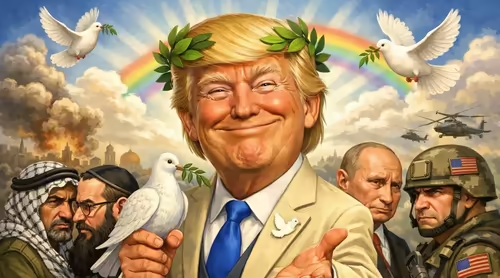
When former U.S. President Donald Trump penned a letter to Norway’s Prime Minister Jonas Gahr Støre in January 2026, few expected it to ignite a firestorm of geopolitical speculation. But one chilling line—“I am no longer obligated to think purely of peace”—has sent shockwaves through diplomatic circles, intelligence agencies, and foreign policy think tanks worldwide .
At first glance, the remark seemed like emotional retaliation over Trump’s long-standing grievance with the Nobel Peace Prize committee, which awarded the 2009 prize to Barack Obama. But as analysts dig deeper, a more alarming truth emerges: this isn’t about ego—it’s about doctrine. Trump isn’t rejecting peace as an outcome; he’s rejecting it as a constraint on American power. And at the heart of this shift lies his enduring obsession: **Greenland**.
Table of Contents
- Takeaway 1: Peace as a Strategic Constraint
- Takeaway 2: The Greenland Connection
- Takeaway 3: Diplomatic Blackmail or Calculated Signaling?
- Takeaway 4: Norway’s Delicate Position
- Takeaway 5: A Broader Shift in U.S. Foreign Policy
- Conclusion: What Trump’s Letter Really Means
- Sources
Takeaway 1: Peace as a Strategic Constraint
The most critical insight from Trump’s letter to Norway PM is philosophical. For decades, U.S. foreign policy—even under hardline administrations—operated within a framework that valued peace as both a moral ideal and a strategic stabilizer. Trump explicitly discards that framework.
As one senior Atlantic Council analyst noted, “He’s saying America should be free to act unilaterally, aggressively, and without moral hesitation if it serves national interest. Peace isn’t the goal—it’s just one possible tool” . This marks a departure from post-WWII consensus and aligns with Trump’s “America First” worldview, where alliances are transactional and deterrence trumps diplomacy.
Takeaway 2: The Greenland Connection
Why Norway? Because Norway chairs the Nordic Council and wields influence over Denmark—the sovereign power over Greenland. Trump’s 2019 attempt to “buy” Greenland was ridiculed, but his interest never faded. Now, with his “Golden Dome” missile defense plan gaining traction, controlling or securing access to Greenland’s Thule Air Base is seen as vital for monitoring Russian and Chinese Arctic activity .
Norway, a NATO ally and Arctic nation, has been quietly strengthening ties with Denmark on regional security. Trump’s letter may be a veiled warning: don’t stand in the way of U.S. Arctic ambitions. The subtext is clear—American strategic interests in the High North outweigh traditional diplomatic niceties.
Takeaway 3: Diplomatic Blackmail or Calculated Signaling?
While some media outlets framed the letter as “emotional blackmail” tied to the Nobel Prize, experts argue it’s far more deliberate. The timing coincides with:
- NATO’s upcoming Arctic defense summit in Oslo.
- U.S. congressional hearings on expanding the “Golden Dome” space-based missile shield.
- China’s renewed bids for observer status in the Arctic Council.
By publicly challenging Norway—a small but influential ally—Trump is testing the limits of alliance loyalty. It’s less about personal slights and more about signaling that the U.S. will act unilaterally if its core security demands aren’t met .
Takeaway 4: Norway’s Delicate Position
Norwegian officials have responded with remarkable restraint. Prime Minister Støre’s office issued a brief statement affirming “Norway’s commitment to transatlantic cooperation,” avoiding direct confrontation .
But behind closed doors, Oslo is alarmed. As a nation that prides itself on peace diplomacy (it hosts the Nobel Peace Prize ceremony and mediates global conflicts), being targeted by such language from a potential future U.S. president is deeply unsettling. Norway must now balance its NATO obligations with its identity as a neutral peacemaker—a tightrope walk made harder by Trump’s rhetoric.
Takeaway 5: A Broader Shift in U.S. Foreign Policy
This letter isn’t an isolated incident. It reflects a growing faction within the Republican Party that views multilateralism as weakness. Think tanks like the Heritage Foundation have published papers advocating for “unconstrained sovereignty,” arguing that moral constraints on military action hinder U.S. competitiveness against China and Russia .
If Trump returns to the White House in 2028, this letter could be a preview of a foreign policy that prioritizes raw power over partnership—a world where “peace” is not a guiding principle, but a conditional outcome.
Conclusion: What Trump’s Letter Really Means
Trump’s letter to Norway PM is far more than a tantrum over a decade-old Nobel snub. It’s a manifesto of a new American realism—one that discards ethical guardrails in pursuit of strategic dominance. With the Arctic becoming the next global battleground, and Greenland at its epicenter, this letter should be read not as bluster, but as a blueprint. The world may soon face a U.S. foreign policy that sees peace not as a virtue, but as a vulnerability to be shed when convenient. For deeper analysis on how this fits into Trump’s 2026 policy agenda, see our feature on [INTERNAL_LINK:trump-2028-foreign-policy-blueprint].
Sources
- “5 takeaways from Donald Trump’s threatening letter to Norway PM,” Times of India.
- “Trump’s ‘Peace’ Doctrine: A Break from Post-Cold War Norms,” Atlantic Council.
- “Why Greenland Matters in the New Cold War,” Council on Foreign Relations.
- “U.S.-Nordic Relations Under Strain,” Chatham House.
- “Norway responds to Trump letter with diplomatic caution,” Reuters.
- “Unconstrained Sovereignty: Rethinking American Power,” The Heritage Foundation.