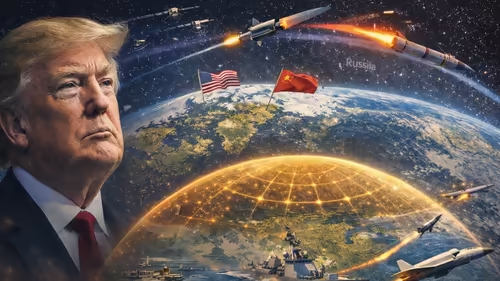
It sounds like a plot from a Cold War thriller: a U.S. president fixated on buying a vast, icy island to install an impenetrable missile shield high above the Earth. But in 2026, this is not fiction—it’s the very real and highly controversial core of Trump’s Greenland gambit. Far from a whimsical tweet, this strategic obsession with the world’s largest island is now being framed as a critical national security imperative, tied directly to his ambitious “Golden Dome” missile defense proposal .
This isn’t just about territory; it’s about controlling the ultimate high ground in a new era of great-power competition. With its unique geographic position, Greenland offers the United States an unparalleled vantage point to monitor and counter threats from both Russia and China, making it a potential game-changer in global military strategy .
Table of Contents
- What Is Trump’s Greenland Gambit?
- The Golden Dome: A Shield in the Sky
- Why Greenland Is the Arctic Crown Jewel
- Global Reactions: Russia and China on Alert
- Legal and Ethical Implications
- Conclusion: A New Cold War in the Arctic?
- Sources
What Is Trump’s Greenland Gambit?
Back in 2019, Donald Trump’s public musing about purchasing Greenland from Denmark was widely ridiculed as absurd. Fast forward to 2026, and the idea has evolved from a punchline into a serious policy discussion. His renewed focus is no longer just about ownership but about securing long-term, exclusive strategic access to the island’s key military and surveillance infrastructure .
The centerpiece of this strategy is the Thule Air Base, America’s northernmost military installation. Already a vital hub for space surveillance and early-warning radar systems, Trump envisions expanding its role dramatically under the umbrella of his Golden Dome initiative. This shift transforms Trump’s Greenland gambit from a real estate fantasy into a calculated geopolitical maneuver aimed at achieving near-total strategic dominance in the Northern Hemisphere .
The Golden Dome: A Shield in the Sky
The “Golden Dome” is Trump’s proposed next-generation missile defense system, designed to be a comprehensive, layered shield capable of intercepting any incoming threat—from ballistic missiles to hypersonic glide vehicles—before they can reach U.S. soil .
Unlike previous systems that were largely ground-based, the Golden Dome concept reportedly integrates space-based sensors and potentially even interceptors. This would create a truly global defense network, and Greenland’s location is absolutely critical for its success. Positioned between North America and Eurasia, it provides the perfect launch and monitoring point for such a system.
Key components of the Golden Dome likely include:
- Advanced Space-Based Sensors: For tracking missiles from their initial launch phase.
- Hypersonic Threat Interceptors: To counter the latest generation of Russian and Chinese weapons.
- AI-Powered Command Network: To process data and coordinate responses in real-time.
Why Greenland Is the Arctic Crown Jewel
Greenland’s strategic value cannot be overstated. It’s not just its size, but its location that makes it so coveted. From Greenland, the U.S. can project power deep into the Arctic Circle, a region that is rapidly becoming the new frontier for resource extraction, shipping lanes, and military competition .
For Russia, which has been aggressively militarizing its own Arctic coastline, a fortified U.S. presence in Greenland is a direct threat to its northern flank. For China, which has declared itself a “near-Arctic state,” it blocks their ambitions to establish a significant foothold in the region through economic and scientific ventures .
In essence, controlling Greenland gives the U.S. a master key to the entire Arctic theater, allowing it to monitor submarine movements, missile trajectories, and air traffic across a vast expanse of the globe.
Global Reactions: Russia and China on Alert
Unsurprisingly, both Moscow and Beijing have reacted with alarm to the news of Trump’s intensified focus on Greenland. Russian officials have condemned the move as a dangerous escalation that threatens strategic stability, while Chinese state media has framed it as an example of American imperialism seeking to monopolize the planet’s final frontier .
Experts at the Stockholm International Peace Research Institute (SIPRI) warn that such a move could trigger a new arms race, as both nations may feel compelled to develop more advanced offensive capabilities to overwhelm or bypass the Golden Dome system . This dynamic risks turning the Arctic—a region that has historically been a zone of scientific cooperation—into a flashpoint for military confrontation.
Legal and Ethical Implications
Beyond the geopolitical chess game, Trump’s plan raises serious legal and ethical questions. Greenland is a self-governing territory of the Kingdom of Denmark, and its people have consistently rejected full independence or foreign annexation. Any attempt by the U.S. to exert undue influence over its sovereignty would be a clear violation of international norms .
Furthermore, the militarization of space, a key component of the Golden Dome, is a contentious issue. The 1967 Outer Space Treaty, to which the U.S. is a signatory, prohibits the placement of weapons of mass destruction in orbit, but the lines are blurrier for conventional missile defense systems. Pushing these boundaries could set a dangerous precedent for the future of space as a peaceful domain.
Conclusion: A New Cold War in the Arctic?
Trump’s Greenland gambit is far more than a political stunt. It represents a fundamental rethinking of American defense strategy for the 21st century, one that places the Arctic at the center of a new great-power struggle. While the promise of an impenetrable shield like the Golden Dome is alluring, the potential consequences—escalating tensions with nuclear-armed rivals, destabilizing a fragile region, and pushing the boundaries of international law—are profound and deeply concerning. As the U.S. weighs its next move, the entire world will be watching to see if this bold vision leads to greater security or a dangerous new chapter in global conflict. For more on how climate change is opening the Arctic to competition, see our analysis on [INTERNAL_LINK:arctic-geopolitics-climate-change].
Sources
- “A ‘golden’ bid for dominance: Decoding Trump’s Greenland grab,” Times of India.
- “Why Greenland is so important to the U.S. military,” Council on Foreign Relations.
- “Trump’s Greenland obsession is back – and it’s serious this time,” The Guardian.
- “Thule Air Base: America’s Arctic Sentinel,” U.S. Air Force Fact Sheet.
- “The Future of Missile Defense: The ‘Golden Dome’ Concept,” Center for Strategic and International Studies (CSIS).
- “The Scramble for the Arctic,” BBC News.
- “China’s Arctic Ambitions,” The Diplomat.
- “Russia warns against U.S. militarization of Greenland,” Reuters.
- “Arctic Militarization Trends,” Stockholm International Peace Research Institute (SIPRI).
- “The Legal Status of Greenland,” Danish Ministry of Foreign Affairs.