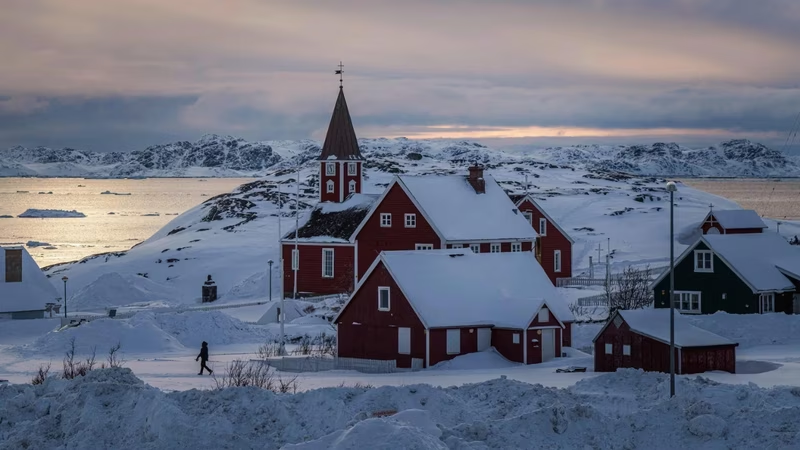
The icy expanse of Greenland has suddenly become the hottest geopolitical flashpoint of 2026. With former President Donald Trump once again publicly musing about a U.S. takeover of the world’s largest island, Europe finds itself on the defensive, scrambling to formulate a coherent and powerful counter-strategy . This isn’t just about a piece of remote territory; it’s a direct challenge to European sovereignty and a test of the transatlantic alliance’s resolve.
For the EU and its key member states, the stakes couldn’t be higher. Trump’s Greenland fixation is less a whimsical fantasy and more a calculated probe into Europe’s ability to defend its own backyard. The continent’s response is shaping up to be a sophisticated blend of diplomacy, economic statecraft, and hard-nosed military planning—a strategy built on cash, talks, and troops.
Table of Contents
- Why Trump’s Greenland Obsession Matters
- Europe’s Counter-Strategy: Cash, Talks, and Troops
- NATO’s Pivotal Role in the Arctic
- The Stakes for Transatlantic Relations
- Conclusion: A New Chapter in Arctic Geopolitics
- Sources
Why Trump’s Greenland Obsession Matters
At first glance, the idea of the U.S. purchasing or forcibly taking Greenland seems outlandish. However, experts warn that Trump’s Greenland rhetoric is a deliberate tactic to expose European vulnerabilities and assert an American sphere of influence that leaves little room for its allies’ independent action . It’s a stark reminder of a “America First” foreign policy that views international partnerships through a transactional lens.
Beyond the political theater, Greenland’s value is immense and multifaceted:
- Military Significance: Home to the critical Thule Air Base, Greenland is a linchpin in North American missile defense and Arctic surveillance. Its location offers unparalleled strategic depth for monitoring both Russian and Chinese activities in the High North .
- Economic Potential: The island sits on vast, untapped reserves of rare earth minerals essential for modern technology and green energy, making it a key player in the global competition for critical resources .
- Geopolitical Leverage: As climate change opens new Arctic shipping lanes, control over Greenland translates to significant influence over future trade routes between North America, Europe, and Asia .
Europe’s Counter-Strategy: Cash, Talks, and Troops
Europe is not sitting idly by. Its response to Trump’s Greenland threat is a three-pillar approach designed to reinforce its position without triggering a direct confrontation with its most powerful ally.
Cash: Investing in Sovereignty
The primary lever is economic. Denmark, as Greenland’s sovereign power, and the broader EU are significantly increasing financial aid and investment in the island’s infrastructure, education, and sustainable development. The goal is clear: to demonstrate that Greenland’s future is best secured within the European framework, offering prosperity and autonomy without the need for a disruptive—and unwanted—American annexation. This economic statecraft aims to win hearts and minds in Nuuk, the capital of Greenland.
Talks: Diplomatic Unity and Dialogue
Diplomatically, the EU is presenting a united front. Brussels is engaging in high-level talks with both Copenhagen and Washington to firmly but respectfully reiterate that Greenland is Danish territory and any suggestion of a forced sale is unacceptable. Simultaneously, Europe is strengthening its dialogue with other Arctic nations like Canada and Norway to build a coalition that upholds the rules-based international order in the region. This diplomatic push is about de-escalation while standing firm on core principles of sovereignty.
Troops: Bolstering Deterrence Through NATO
Where diplomacy and economics may fall short, Europe is turning to its ultimate security guarantee: NATO. Recognizing that the Arctic is no longer a peaceful frontier but a zone of strategic competition, the alliance is actively developing a more robust posture in the High North .
NATO’s Pivotal Role in the Arctic
NATO’s role has never been more critical. The alliance, which includes seven Arctic states, is moving beyond mere rhetoric to concrete action. Its mission is now explicitly defined as preventing the militarization of the region by external powers, upholding stability, and guaranteeing freedom of navigation .
A credible NATO presence in the Arctic serves as a powerful deterrent. It signals to all actors, including a potentially aggressive U.S. administration, that any move against a NATO member’s territory (Denmark) would be considered an attack on the entire alliance under Article 5. As one NATO leader stated, “NATO will defend its interests in the Arctic. We have a responsibility to protect all our Allies” . This collective defense umbrella is Europe’s strongest card.
The strategy involves enhancing surveillance capabilities, conducting more frequent joint military exercises in the region, and ensuring rapid reinforcement can be deployed if needed . This holistic approach to Arctic security is designed to maintain peace through strength .
The Stakes for Transatlantic Relations
The crisis over Trump’s Greenland ambition is a stress test for the entire transatlantic relationship. It forces Europe to confront its long-standing dependence on U.S. security guarantees while simultaneously trying to preserve the alliance. The EU’s multi-faceted response is an attempt to walk this tightrope—showing it can act independently to protect its interests while keeping the door open for cooperation within the NATO framework.
This situation could accelerate Europe’s drive for greater strategic autonomy, a concept that has gained traction in recent years. If the U.S. is seen as an unpredictable actor willing to undermine its allies’ sovereignty, Europe may feel compelled to invest even more heavily in its own defense capabilities and diplomatic initiatives, such as those led by the European External Action Service (EEAS).
Conclusion: A New Chapter in Arctic Geopolitics
The renewed focus on Trump’s Greenland is a symptom of a larger shift in global power dynamics. The Arctic, once a frozen periphery, is now a central arena for great-power competition. Europe’s response—combining economic investment, diplomatic unity, and a strengthened NATO shield—is a pragmatic and necessary defense of its values and its territory. The coming months will reveal whether this strategy of cash, talks, and troops is enough to deter a potential land grab and preserve the fragile peace in the world’s most rapidly changing region. For now, Europe has drawn its line in the melting ice.
Sources
- Xu Yelu, “US president again threatens to take over Greenland,” January 10, 2026.
- “Analysis: From Venezuela to Greenland, the EU scrambles,” Times of India.
- “Prioritize a Holistic Arctic Security Strategy for NATO,” September 16, 2025.
- “NATO in the Arctic,” various sources.
- “NATO’s Military Leader: “The Arctic in 2025 Is at a…,” October 25, 2025.
- “NATO, Industry and Innovators discuss Arctic space security,” November 12, 2025.
- ““NATO will defend Allied interests in the Arctic” says Chair…,” October 21, 2024.
- “Greenland holds great importance for the United States,” February 24, 2025.
- “U.S. Attention Returns to Greenland as Arctic Stakes Rise.”
- “Greenland at the center of NATO’s arctic strategy.”