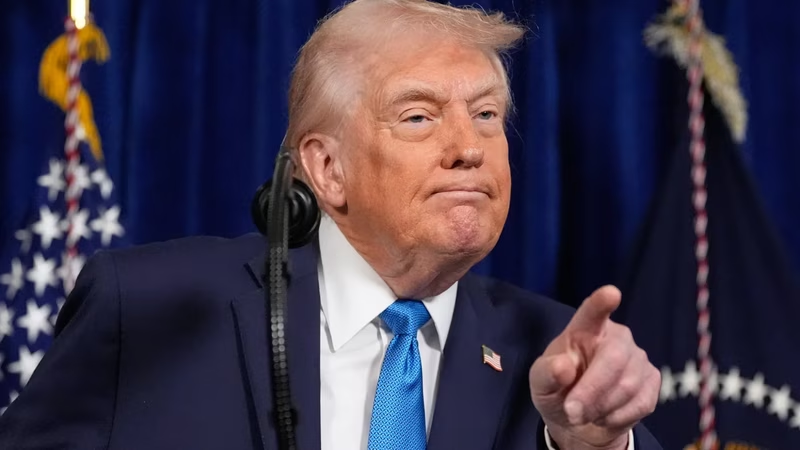
The world is watching Venezuela, but it’s not just the political turmoil or economic collapse that has everyone’s attention. It’s the arrival of a new, assertive, and uniquely Trumpian foreign policy doctrine: the Donroe Doctrine. With his second term underway, President Donald Trump has wasted no time in flexing American muscle in its traditional backyard, Latin America. And Venezuela, a nation long at odds with Washington, is the first testing ground for this bold—and potentially dangerous—strategy .
Table of Contents
- What is the ‘Donroe Doctrine’?
- Why Venezuela is the First Test
- A Modern Take on an Old Idea: The Monroe Doctrine
- What Comes Next for Latin America?
- Conclusion: The World’s Response to the Donroe Doctrine
- Sources
What is the ‘Donroe Doctrine’?
Coinciding with the start of his second administration, the term “Donroe Doctrine”—a portmanteau of “Don” (for Donald) and “Monroe”—has emerged to describe Trump’s aggressive stance in the Western Hemisphere . This isn’t your grandfather’s diplomacy. The Donroe Doctrine appears to be built on a foundation of unilateral action, economic coercion, and a clear message to global rivals like China and Russia: the Americas are America’s sphere of influence, and interference will not be tolerated .
At its core, the doctrine signals a return to a more interventionist and overtly nationalistic US foreign policy in the region, prioritizing American interests—particularly access to critical resources like Venezuela’s vast oil reserves—above all else .
Why Venezuela is the First Test
Venezuela is the perfect storm for the launch of such a doctrine. For years, the country has been a thorn in Washington’s side, with its socialist government under Nicolás Maduro maintaining close ties with US adversaries, including Russia and China. The ongoing political and humanitarian crisis has created a power vacuum that the Donroe Doctrine seems eager to fill .
Reports indicate that the Trump administration has already taken concrete, unorthodox steps. These include approving a package of emergency regulations and, most notably, ordering a full blockade of sanctioned oil tankers to and from Venezuela . This move directly targets the Maduro regime’s primary source of revenue and is a clear demonstration of the doctrine’s enforcement mechanism: a mix of hard power and economic strangulation .
As one observer noted, these actions are “unorthodox and contrary to international law – but if they make China and Russia think twice, that’s the point” .
A Modern Take on an Old Idea: The Monroe Doctrine
To understand the Donroe Doctrine, you have to look back to its namesake, the original Monroe Doctrine of 1823. Articulated by President James Monroe, it was a foundational US foreign policy warning European powers to cease any attempts at colonization or political interference in the newly independent nations of the Americas . It effectively declared the Western Hemisphere as the United States’ exclusive sphere of influence .
While the original doctrine was a defensive declaration against European colonialism, the modern Donroe Doctrine appears to be an offensive tool of active intervention. It’s less about preventing others from acting and more about asserting America’s right to act unilaterally to shape the political and economic landscape of its neighbors . This aggressive reinterpretation has been dubbed by some as “Gunboat diplomacy 2.0” .
Key Differences: Monroe vs. Donroe
| Aspect | Monroe Doctrine (1823) | Donroe Doctrine (2026) |
|---|---|---|
| Primary Goal | Prevent European colonization/interference | Assert US dominance & secure resources |
| Method | Diplomatic warning | Unilateral action, sanctions, blockade |
| Tone | Defensive | Offensive and interventionist |
What Comes Next for Latin America?
The warning from experts is clear: Venezuela is just the beginning. “Trump has started with Venezuela – but he may not stop there,” a recent analysis cautioned, pointing out that there are “plenty more hostile or” nations in the region that could find themselves in the crosshairs .
President Trump has been vocal about his intent to put an “unprecedented focus on Latin America” during his second term . This focus is expected to extend beyond security to encompass trade, immigration, and resource control. His administration has already signaled a willingness to use a wide range of tools, from massive deportation campaigns to economic pressure, to achieve its goals across the region [[19], [22]].
The potential for this doctrine to deepen authoritarianism and erode human rights in the region is a major concern for international observers . The question on everyone’s mind is who’s next on the list after Venezuela.
Conclusion: The World’s Response to the Donroe Doctrine
The Donroe Doctrine represents a seismic shift in US foreign policy, moving from a rules-based international order to one of raw, transactional power politics centered on the Western Hemisphere. Its first test in Venezuela is a high-stakes gamble. While it may succeed in pressuring the Maduro regime and deterring rivals like China and Russia, it also risks alienating allies, escalating regional instability, and setting a precedent for a more volatile and unilateral global order. The world, especially nations in Latin America, is now on high alert, waiting to see if the canary in the coal mine in Venezuela is just a warning or the start of a much larger storm. For more on the historical context of US interventionism, see our deep dive on [INTERNAL_LINK:history-of-us-foreign-policy-in-latin-america].
Sources
- Times of India: Trump’s ‘Donroe Doctrine’ faces first test in Venezuela
- The Guardian: Trump’s gangster foreign policy is taking shape in Venezuela
- Foreign Affairs: The Trump Doctrine in Venezuela
- South China Morning Post: Trump’s Assertive “Donroe Doctrine”
- Britannica: Monroe Doctrine
- DiploFoundation: Monroe Doctrine and Gunboat diplomacy 2.0
- History.com: Monroe Doctrine
- Congressional Research Service: Venezuela: Political Crisis and U.S. Policy
- The Nation: Trump’s new world order is taking shape in Venezuela
- Wilson Center: Trump will focus on Latin America in his second mandate
- Yale Law School: President Trump Targets Latin American Countries and Nationals
- Amnesty International: What Trump’s Second Term Might Mean for Latin America
- CSIS: TRUMP 2.0’S FOREIGN POLICY IN THE AMERICAS
- Just Security: Tracking Trump and Latin America: Security— December 17, 2025