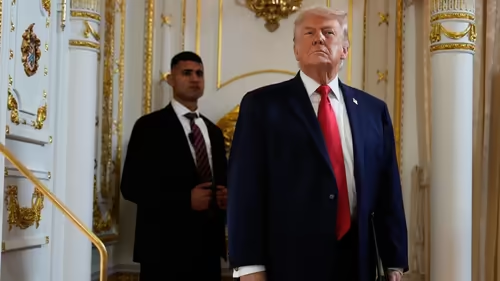
In a move that has stunned the international diplomatic community, former President Donald Trump has unveiled a bold—and expensive—new vision for global conflict resolution: the Board of Peace. This isn’t just another think tank or advisory committee. The draft charter, circulated to around 60 countries, comes with a staggering price tag: a $1 billion contribution for a seat at the table .
Countries like India, Pakistan, and Canada have reportedly received invitations, raising immediate questions about its legitimacy, its mission, and its potential to disrupt the established world order centered on the United Nations . With high-profile figures like Marco Rubio and Jared Kushner at its helm, this initiative is impossible to ignore. But what exactly is it, and should the world take it seriously?
Table of Contents
- What is the Board of Peace?
- The $1 Billion Buy-In: Who’s Invited?
- Key Players Behind the Scenes
- Board of Peace vs. UN Security Council: A Direct Rival?
- Global Reactions and Implications
- Conclusion: What’s Next for the Board of Peace?
- Sources
What is the Board of Peace?
Initially conceived as a mechanism to address the crisis in Gaza, the Board of Peace has rapidly evolved into something far more ambitious. According to the draft charter, its mission is to “restore governance and resolve conflicts” on a global scale . This broad mandate immediately positions it as a potential alternative to existing international bodies.
The structure is unique. It’s not a treaty-based organization like the UN, but rather a private initiative backed by significant financial muscle. The charter outlines that member states would serve three-year terms, which are renewable, suggesting a long-term strategic vision beyond any single administration .
The $1 Billion Buy-In: Who’s Invited?
The most controversial aspect of the Board of Peace is its explicit financial requirement. The Trump administration is asking nations to contribute $1 billion in cash to secure a permanent seat . This pay-to-play model has drawn sharp criticism, with many arguing it prioritizes wealth over diplomatic merit or moral authority.
Reports confirm that invitations have been sent to a wide array of nations, including:
- India
- Pakistan
- Canada
- Several Gulf states
- Key European allies
This diverse list suggests an attempt to build a coalition that cuts across traditional geopolitical lines, potentially leveraging economic incentives to create a new bloc of influence .
Key Players Behind the Scenes
The leadership of the Board of Peace reads like a who’s who of Trump’s inner circle and powerful global financiers. The White House has officially named its core members, who will be instrumental in shaping its agenda .
At the top is Donald Trump himself, who serves as the chair of the board . The operational leadership includes:
- Marco Rubio: The US Secretary of State, providing official government backing.
- Jared Kushner: Trump’s senior advisor and son-in-law, who has a history of brokering Middle East deals.
- Tony Blair: The former UK Prime Minister, lending international credibility.
- Ajay Banga: President of the World Bank Group, connecting the initiative to global financial institutions.
- Marc Rowan: A billionaire investor, representing the private capital side of the equation .
This blend of political power, diplomatic experience, and financial clout is a deliberate strategy to give the Board of Peace both legitimacy and the resources to act swiftly.
Board of Peace vs. UN Security Council: A Direct Rival?
The timing and scope of the Board of Peace invite direct comparison with the UN Security Council (UNSC). The UNSC, with its 15 members (including 5 permanent ones with veto power), is the primary body responsible for maintaining international peace and security under the UN Charter .
However, the UNSC is often criticized for being gridlocked by vetoes and slow to act. The Board of Peace appears designed to circumvent these issues. By being a smaller, privately-funded group, it can theoretically make decisions and deploy resources much faster. Its funding model, described as “voluntary funding from Member States,” gives it financial independence from the complex UN budgetary process .
While the UN relies on a mix of peacekeeping operations and political missions that involve military and civilian personnel , the Board of Peace seems poised to leverage private investment and diplomatic pressure as its primary tools, similar in spirit to initiatives like the Investing for Peace (I4P) framework . This could mark a significant shift from public, multilateral diplomacy to a more agile, private-public partnership model.
Global Reactions and Implications
The international response has been a mix of skepticism and cautious interest. For nations frustrated with the inefficiencies of the UN, the Board of Peace offers a tempting alternative. However, the $1 billion price tag is a major barrier, effectively limiting membership to wealthy or resource-rich states.
Critics argue that this model could lead to a form of “checkbook diplomacy,” where global influence is directly tied to financial contribution rather than principles or international law. It also raises concerns about accountability and transparency, as a private board is not subject to the same scrutiny as a public body like the UN General Assembly .
For countries like India, which has long sought a permanent seat on the UNSC, the invitation presents a complex dilemma. Accepting could offer a new platform for influence, but it might also be seen as undermining the very multilateral system India has traditionally supported.
Conclusion: What’s Next for the Board of Peace?
Trump’s Board of Peace is more than just a policy proposal; it’s a bold experiment in reimagining global governance for the 21st century. Whether it becomes a legitimate force for peace or a short-lived, billionaire-backed vanity project remains to be seen. Its success will depend entirely on who decides to join, how its funds are used, and whether it can deliver tangible results where traditional institutions have failed. One thing is certain: the world is watching.
Sources
- Times of India: India, Pakistan, Canada & more: $1 billion buys a seat on Trump’s ‘UN’ – who’s invited?
- Reuters: Trump’s Gaza peace board seeks $1bn buy-in as it eyes wider role
- United Nations: The Security Council
- White House Briefing: White House unveils names of Gaza ‘Board of Peace’