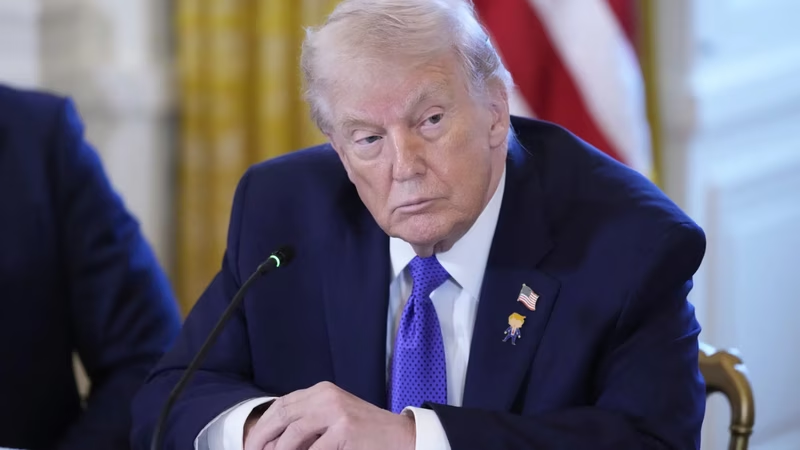
Tensions between Washington and Tehran are reaching a boiling point. In a dramatic escalation of rhetoric, former President Donald Trump has publicly declared that the “USA is ready to help” Iranian citizens protesting against their government’s violent crackdown . But this isn’t just tough talk—multiple sources report that the Trump administration is actively exploring concrete military options, including large-scale airstrikes on key Iranian military targets .
This development casts a long shadow over an already volatile region. With Iran’s Supreme Leader accusing the U.S. of fomenting unrest, and American officials debating the merits of direct intervention, the world is watching to see if words will turn into action. This article dives deep into what’s behind Trump’s warning to Iran, the potential military plans on the table, and what it all means for global stability.
Table of Contents
- Trump Warns Iran: The Official Statement
- Inside the Military Options Being Considered
- The Iranian Protests and Tehran’s Response
- Iran’s Accusation of US Interference
- Historical Context: Trump’s Iran Policy
- Global Reactions and Potential Consequences
- Conclusion: A Dangerous New Chapter
- Sources
Trump Warns Iran: The Official Statement
The core of this crisis stems from a public statement by Donald Trump, in which he directly addressed the Iranian regime. “The people of Iran are suffering under a brutal dictatorship,” he said. “The USA is ready to help.” While the phrase “ready to help” is deliberately vague, its implication in the current climate is unmistakable: the U.S. is prepared to take a more active role in supporting the protest movement .
This message was not delivered in a vacuum. It came as images and videos of Iranian security forces violently suppressing peaceful demonstrators flooded international media. By positioning the U.S. as a potential ally to the Iranian people, Trump is drawing a clear moral line—but also setting the stage for a potential confrontation with the Islamic Republic’s leadership.
Inside the Military Options Being Considered
Beyond the rhetoric, credible reports indicate that the Trump administration has moved beyond mere posturing. According to defense insiders, discussions are underway at the highest levels regarding a series of potential military strikes . These are not small-scale operations but rather significant actions designed to degrade Iran’s military capabilities.
The potential targets under review are believed to include:
- Missile production facilities used to arm proxy groups across the region.
- Naval bases along the Strait of Hormuz, a critical global shipping chokepoint.
- Command and control centers that coordinate the activities of the Islamic Revolutionary Guard Corps (IRGC).
It’s important to note that these plans are still in the discussion phase. No final decision has been made, and such an operation would carry enormous strategic risk, potentially triggering a wider regional war.
The Iranian Protests and Tehran’s Response
The catalyst for this entire crisis is a wave of domestic unrest within Iran. Sparked by economic hardship and political repression, the protests have grown in size and intensity. In response, the Iranian government has deployed its security apparatus with extreme force, leading to numerous civilian casualties and mass arrests .
The regime in Tehran views any external support for these protests as an existential threat. Their narrative is one of national sovereignty under siege by foreign powers, a story they use to rally domestic support and justify their crackdown.
Iran’s Accusation of US Interference
Iran’s Supreme Leader, Ayatollah Ali Khamenei, has been quick to respond to Trump’s comments. In a fiery speech, he accused the United States of being the “primary instigator” of the unrest, claiming that the protests are a “foreign-backed plot” to destabilize the Islamic Republic .
This accusation is a standard playbook for the Iranian regime during times of internal crisis. By blaming external actors like the U.S. and Israel, they attempt to deflect responsibility for their own governance failures and unify the population against a common enemy.
Historical Context: Trump’s Iran Policy
This moment cannot be understood without looking back. During his first term, Trump famously withdrew the U.S. from the Joint Comprehensive Plan of Action (JCPOA), the international nuclear deal, and implemented a policy of “maximum pressure” through crippling sanctions .
That policy aimed to force Iran back to the negotiating table on more favorable terms but ultimately led to increased hostility, including the 2020 drone strike that killed IRGC commander Qasem Soleimani. The current situation appears to be a continuation of that hardline approach, suggesting a belief that only overwhelming pressure can change Tehran’s behavior.
Global Reactions and Potential Consequences
The international community is watching with deep concern. Allies in Europe, who were signatories to the original nuclear deal, are likely to oppose any unilateral U.S. military action, fearing it could shatter diplomatic efforts and spike global oil prices .
A military strike could have cascading effects:
- Disruption of oil shipments through the Strait of Hormuz.
- Retaliatory attacks by Iranian proxy groups in Iraq, Syria, and Yemen.
- A potential acceleration of Iran’s nuclear program in defiance of the West.
[INTERNAL_LINK:history-of-us-iran-relations] provides a deeper look at the decades-long animosity that has led to this precipice.
Conclusion: A Dangerous New Chapter
Trump’s warning to Iran is far more than a soundbite; it’s a signal of a potential, dangerous shift in U.S. foreign policy. With military options on the table and the Iranian regime feeling cornered, the risk of miscalculation is high. While the desire to support the Iranian people’s right to protest is morally compelling, the path of military intervention is fraught with peril. The coming days will be critical in determining whether this crisis de-escalates through diplomacy or spirals into a conflict with global ramifications.
Sources
- Trump’s public statement on Iran protests .
- Reports on the consideration of airstrikes on Iranian military targets .
- Details on the nature and scale of the Iranian protests .
- Supreme Leader Khamenei’s accusations of US interference .
- [INTERNAL_LINK:trump-maximum-pressure-iran-policy]
- U.S. Department of State – Official Website