Table of Contents
- Trump’s Stern Warning: A Direct Challenge to Tehran
- The Context Behind Iran’s Crackdown on Protesters
- What Does Trump Mean by ‘Very Strong Action’?
- Historical Precedent: Trump’s Iran Policy in Office
- International Reactions and the Biden Administration’s Stance
- Why This Moment Is Critical for U.S.-Iran Relations
- Conclusion: A High-Stakes Geopolitical Flashpoint
- Sources
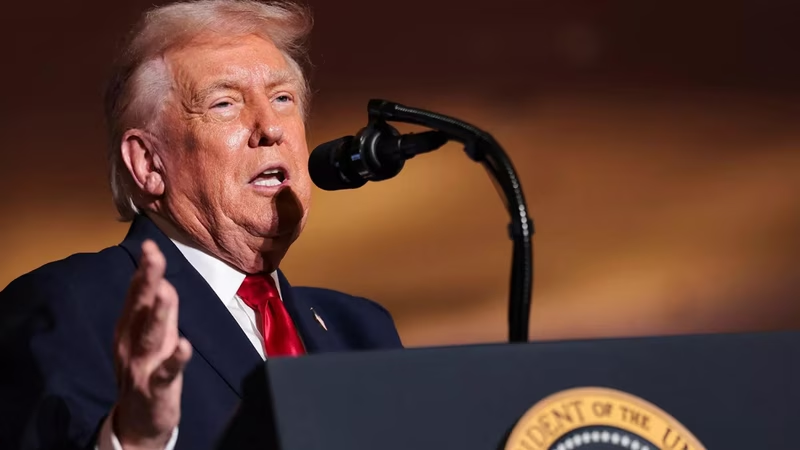
In a dramatic escalation of rhetoric, former U.S. President Donald Trump has directly warned Iran against executing protesters involved in the country’s ongoing wave of civil unrest. In a public statement that echoes his hardline foreign policy approach, Trump declared that if Iran proceeds with hangings, the United States would respond with what he called “very strong action” . This high-stakes message—delivered with characteristic bluntness—has reignited global attention on the deteriorating human rights situation in Iran and the potential for renewed U.S. intervention. The Trump warns Iran episode is more than just political posturing; it reflects deepening anxieties about state violence and America’s role in defending democratic values abroad.
Trump’s Stern Warning: A Direct Challenge to Tehran
Speaking from an undisclosed location, Trump did not mince words. “If they start hanging people—thousands of them—it’s not going to work out well for Iran,” he said, adding, “We’ll see how that’s going to work out” . His language, while vague on specifics, carries unmistakable menace. The phrase “very strong action” deliberately leaves room for interpretation—ranging from intensified sanctions to covert operations or even military options.
Crucially, Trump emphasized that the U.S. is “monitoring the situation closely,” suggesting intelligence assets are actively tracking developments inside Iran . For a nation already under severe economic pressure from Western sanctions, such a warning from a former—and potentially future—commander-in-chief could further destabilize the regime’s calculations.
The Context Behind Iran’s Crackdown on Protesters
The protests gripping Iran stem from a complex mix of economic despair, political repression, and social frustration. Sparked initially by fuel price hikes and exacerbated by rampant inflation (over 40% annually), demonstrations have evolved into broader calls for systemic change . Women’s rights activists, youth groups, and labor unions have all joined the movement, chanting slogans against Supreme Leader Ayatollah Ali Khamenei.
In response, Iranian authorities have deployed security forces with brutal efficiency. Reports from human rights organizations like Amnesty International detail arbitrary arrests, torture in detention, and expedited death sentences for protest-related charges . At least two dozen individuals have already been sentenced to death, with fears that mass executions could follow—a tactic the regime has used before to instill fear.
What Does Trump Mean by ‘Very Strong Action’?
While Trump didn’t specify his intended measures, analysts point to several possibilities based on his past playbook:
- Economic Sanctions: Reinstating or expanding “maximum pressure” sanctions targeting Iran’s oil exports, banking sector, and key officials.
- Cyber Operations: Disabling critical infrastructure (e.g., power grids, communication networks) as seen in past U.S.-Israeli operations like Stuxnet.
- Diplomatic Isolation: Rallying allies to expel Iranian diplomats or downgrade relations.
- Covert Support: Providing intelligence or logistical aid to opposition groups—though this remains highly speculative and risky.
Notably, direct military strikes are considered unlikely unless U.S. personnel or interests are directly threatened. Still, the mere threat of force can alter Tehran’s calculus.
Historical Precedent: Trump’s Iran Policy in Office
During his presidency (2017–2021), Trump pursued an aggressive “maximum pressure” campaign against Iran. He unilaterally withdrew from the 2015 nuclear deal (JCPOA) in 2018, reimposed crippling sanctions, and ordered the 2020 drone strike that killed Quds Force commander Qasem Soleimani . That assassination brought the two nations to the brink of war.
His current warning aligns with that legacy. Trump has long framed Iran as a “rogue state” sponsoring terrorism and oppressing its people. His latest comments suggest he views the protest crackdown not just as a humanitarian issue but as a strategic opportunity to weaken a longtime adversary.
International Reactions and the Biden Administration’s Stance
While Trump’s remarks grabbed headlines, the official U.S. government position remains under President Joe Biden’s control. The Biden administration has condemned Iran’s violence but stopped short of endorsing military action. Instead, it has focused on multilateral diplomacy and targeted sanctions against specific security units .
European allies, including the UK, France, and Germany, have echoed U.S. concerns but urged restraint. The UN Human Rights Council has launched an independent investigation into the crackdown . Meanwhile, regional powers like Saudi Arabia and Israel watch nervously, fearing spillover instability or a U.S.-Iran confrontation that could disrupt energy markets.
Why This Moment Is Critical for U.S.-Iran Relations
The convergence of domestic unrest in Iran and a heated U.S. presidential election cycle creates a volatile mix. If Trump returns to office in 2028, his threats may become policy. Even now, his statements influence global perceptions and market sentiment. Oil prices have already seen minor fluctuations following his remarks .
For Iran’s leadership, the dilemma is acute: crack down harder and risk international retaliation, or ease up and appear weak domestically. So far, they’ve chosen repression—but Trump’s warning suggests there may be a breaking point.
Conclusion: A High-Stakes Geopolitical Flashpoint
The Trump warns Iran episode underscores how quickly internal dissent can become an international crisis. While his language may be theatrical, the underlying message is serious: the world is watching, and consequences are real. As protests continue and executions loom, the U.S.—whether under Biden or a potential future Trump administration—faces a defining test of its commitment to human rights versus strategic pragmatism. One thing is certain: in the shadow of the gallows, every word carries weight. For deeper insights into Middle East geopolitics, explore our analysis on [INTERNAL_LINK:iran-us-relations-history]. To verify facts about global human rights standards, refer to the Office of the United Nations High Commissioner for Human Rights.
Sources
- Times of India – ‘Well see how that’s going to work out’: Trump warns Iran against hanging protestors
- Reuters – Iran protests: Causes and timeline of unrest in 2026
- Amnesty International – Iran: Death sentences for protest-related charges
- BBC News – Trump’s withdrawal from Iran nuclear deal explained
- U.S. Department of State – Statement on Iran’s human rights abuses
- United Nations – UN launches probe into Iran protest crackdown
- Bloomberg – Oil markets react to U.S.-Iran tensions