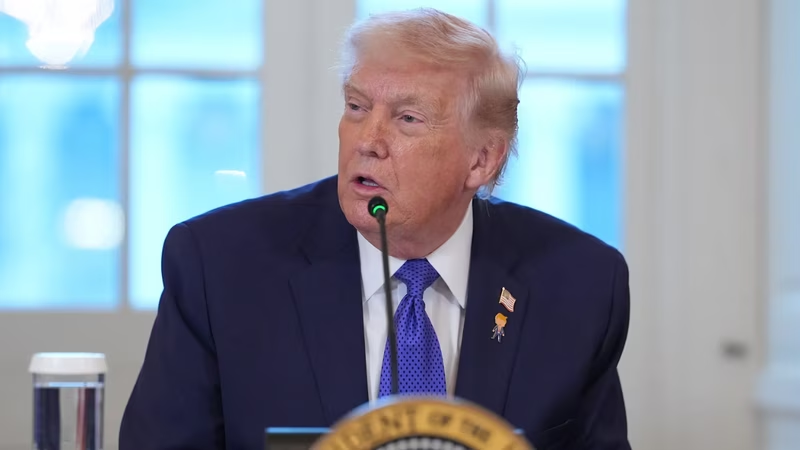
“You’re dealing with us.” Those four words, spoken by President Donald Trump to a room full of America’s top oil executives at the White House, signal a seismic shift in US policy toward Venezuela . In a move that blends high-stakes geopolitics with raw economic ambition, Trump declared his administration would be the sole gatekeeper for which American companies get to tap into Venezuela’s crippled but colossal oil industry.
This isn’t just about business; it’s about power, control, and a potential $100 billion investment opportunity in a nation sitting on the world’s largest proven oil reserves . The plan hinges on a critical assumption: the capture or removal of President Nicolás Maduro. With that condition met, Trump promises a new era where the US, not Caracas, decides who gets a piece of the pie.
Table of Contents
- The White House Summit: A Meeting of Oil and Power
- Why Venezuela? The World’s Largest Oil Reserves
- From Sanctions to Security: The US Policy Reversal
- The $100 Billion Bet on a Post-Maduro Future
- Global Implications and Potential Backlash
- Conclusion: A New Chapter in Energy Geopolitics
- Sources
The White House Summit: A Meeting of Oil and Power
The recent White House gathering wasn’t your typical industry roundtable. It was a strategic command session. In attendance were titans like Chevron, which has maintained a limited presence in Venezuela despite sanctions, alongside giants like ExxonMobil and ConocoPhillips, both of which had major projects halted years ago .
Trump’s message was clear and direct: his administration would “probably decide today or ‘very shortly’ which oil companies would be allowed to go into Venezuela” . This centralized control is unprecedented. Instead of a free market opening, the US government is positioning itself as the ultimate franchisor for one of the planet’s most valuable resource plays. Smaller firms, many with ties to Denver’s energy sector, were also summoned, suggesting a broader coalition is being formed .
Why Venezuela? The World’s Largest Oil Reserves
The allure is simple: scale. Venezuela is home to an estimated 303 billion barrels of proven crude oil reserves . To put that in perspective, that’s more than Saudi Arabia, Canada, and Iran combined. This represents nearly one-fifth of the entire world’s known supply .
For decades, this immense wealth was the backbone of Venezuela’s economy. However, a combination of mismanagement, corruption, and crippling US sanctions has seen its production plummet from over 3 million barrels per day in the late 1990s to a fraction of that today . The potential for a massive rebound, should stability return, is what makes this such a tantalizing prize for American energy firms.
From Sanctions to Security: The US Policy Reversal
This aggressive push marks a dramatic reversal from the Trump administration’s own previous policy. Just a few years ago, the US was imposing wave after wave of unilateral sanctions specifically designed to strangle Venezuela’s oil exports—the very lifeblood of the Maduro regime .
Key actions included a 2017 ban on trading Venezuelan debt and a 2019 designation of the state-owned oil company PDVSA, effectively cutting it off from the US financial system [[5], [6]]. Now, the same administration is offering to provide security guarantees for American companies to step in and rebuild that very same industry. The justification is a change in leadership; the US is betting that a post-Maduro government would be a reliable partner, and they want to ensure American firms are first in line.
The $100 Billion Bet on a Post-Maduro Future
The Trump administration’s vision is audacious. They are pitching a $100 billion investment to completely revitalize Venezuela’s oil infrastructure, which has fallen into severe disrepair. This isn’t just about drilling new wells; it’s about rebuilding refineries, pipelines, and export terminals.
The promise of US-provided security is central to this pitch. For any company, the risk of operating in a politically volatile nation is immense. By pledging military and logistical support, the US aims to de-risk the investment and make it a no-brainer for its domestic energy champions. This strategy directly serves a core Trumpian goal: securing long-term, stable energy resources for the United States while simultaneously delivering a massive economic windfall to key American industries.
Global Implications and Potential Backlash
This unilateral approach is unlikely to go unchallenged. Other global powers, notably Russia and China, have their own significant investments and interests in Venezuela’s oil sector. A US-dominated carve-up of the industry could trigger a fierce diplomatic and economic backlash from these nations.
Furthermore, the plan assumes a smooth transition of power in Caracas, which is far from guaranteed. Even if Maduro is removed, the political landscape in Venezuela remains deeply fractured. The perception that the US is simply replacing one form of control (sanctions) with another (direct corporate management) could fuel nationalist sentiment and create long-term instability, undermining the very security the US promises to provide.
Conclusion: A New Chapter in Energy Geopolitics
The Trump Venezuela oil strategy is a bold, high-risk, high-reward gambit. It leverages America’s geopolitical might to secure preferential access to the world’s largest oil reserves for its domestic corporations. While the promise of a $100 billion economic revival is compelling, the plan rests on a series of precarious assumptions about Venezuela’s political future and the willingness of the international community to accept a new era of US-directed resource extraction. The world is now watching to see if this is a masterstroke of economic statecraft or a dangerous overreach that could backfire spectacularly.
Sources
- Trump meets with oil executives at the White House
- Trump meets U.S. oil companies on investment in
- Oil executives meet with Trump on Venezuela: Update
- Big and small oil companies summoned to meet Trump on
- History of U.S. involvement in Venezuela’s petroleum industry
- Venezuela-Related Sanctions – State Department Home
- US Sanctions Against the Venezuelan Oil Industry
- What will happen to US sanctions on Venezuela after
- Venezuela holds the world’s largest proven crude oil
- Venezuela holds the world’s largest proven crude oil
- Top 10 countries with the largest oil reserves in 2025