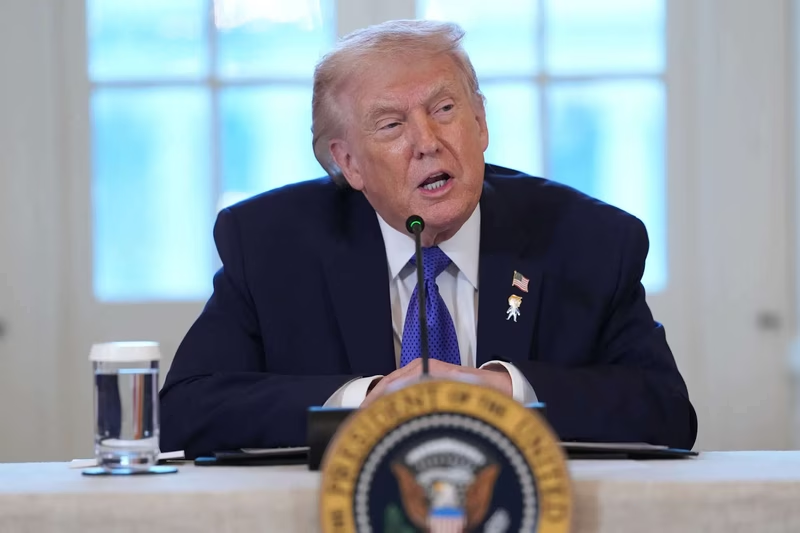
In a move that has sent shockwaves through global energy markets and Washington corridors alike, former President Donald Trump has dropped a bombshell: 50 million barrels of Venezuela oil are allegedly already “on their way to the US.” Speaking at a recent economic summit, Trump framed the deal as a masterstroke of his administration’s foreign policy, claiming it would bolster American energy independence and unlock billions in value .
But is this claim grounded in reality, or is it another piece of political theater from a figure known for grand pronouncements? The announcement comes at a time of renewed interest in Venezuela’s vast oil reserves—the largest in the world—and growing pressure on the Biden administration to secure stable, non-OPEC energy sources amid volatile global prices .
Table of Contents
- Trump’s Bold Claim: Breaking It Down
- The State of Venezuela Oil Production
- Sanctions Relief and the US Strategy
- Oil Executives, Security, and Private Investment
- Geopolitical Implications for the US and Global Markets
- Conclusion: Is This Deal Real or Rhetoric?
- Sources
Trump’s Bold Claim: Breaking It Down
Trump’s exact words were striking: “We’re working along really well with Venezuela… 50 million barrels of oil are on their way to the United States. That’s $4.2 billion worth” . He positioned this not just as a transaction, but as a strategic victory—one that gives the US “control over Venezuelan oil production and sales.”
If true, this would represent one of the most significant shifts in US energy imports in years. For context, 50 million barrels is enough to supply the entire United States for roughly two and a half days—a substantial volume that could temporarily ease domestic supply concerns .
The State of Venezuela Oil Production
To assess the plausibility of Trump’s claim, we must first understand the current state of Venezuela’s oil industry. Once a powerhouse, the sector has been crippled by years of underinvestment, mismanagement, and crippling US sanctions imposed during the Trump administration itself in 2019 .
Production has plummeted from over 3 million barrels per day (bpd) in the early 2000s to around 800,000–900,000 bpd in late 2025. While there have been modest increases thanks to limited sanctions waivers granted to companies like Chevron, the infrastructure remains fragile .
Exporting 50 million barrels in one go would require nearly two months of Venezuela’s total output—raising serious logistical and operational questions.
Sanctions Relief and the US Strategy
The key to any major Venezuela oil deal lies in US sanctions policy. In 2023, the Biden administration offered a temporary six-month sanctions waiver to the Maduro government in exchange for democratic reforms—a deal that ultimately collapsed when elections were deemed unfair .
However, the US has maintained targeted licenses for a few American firms, primarily Chevron, to operate in Venezuela. Trump’s claim may be referencing oil produced under these existing licenses, though even Chevron’s output is far below what would be needed to fulfill such a large shipment quickly.
Experts suggest Trump might be conflating future potential with current reality. As one analyst noted, “There’s a big difference between a handshake deal and barrels actually clearing customs in Houston” .
Oil Executives, Security, and Private Investment
Beyond the numbers, Trump emphasized a broader strategy: encouraging private US investment in Venezuela’s oil sector. He claimed his administration had provided “security assurances” to oil executives wary of operating in a politically unstable environment .
This aligns with a long-standing Republican argument that engagement—not isolation—is the best path to reform in Venezuela. By offering legal protections and political backing, the US could incentivize American companies to rebuild Venezuela’s oil infrastructure, which in turn could stabilize production and create leverage over the Maduro regime.
Such a strategy, however, remains highly controversial. Critics argue it risks legitimizing an authoritarian government without guaranteed democratic concessions.
Geopolitical Implications for the US and Global Markets
A genuine surge in Venezuela oil exports to the US would have wide-ranging consequences:
- Energy Security: It would reduce reliance on Middle Eastern and Russian crude, enhancing US energy resilience.
- OPEC Dynamics: Venezuela is a founding OPEC member. Increased US-aligned production could weaken the cartel’s cohesion, especially if Caracas prioritizes bilateral deals over group quotas.
- China & Russia: Both nations have deep economic ties with Venezuela. A US re-entry into the country’s oil sector could displace their influence, marking a significant geopolitical win for Washington.
For more on how global oil flows shape foreign policy, see our analysis on [INTERNAL_LINK:geopolitics-of-global-oil-markets].
Conclusion: Is This Deal Real or Rhetoric?
While Trump’s announcement of 50 million barrels of Venezuela oil heading to the US makes for a compelling headline, the evidence suggests it’s more aspirational than actual. Current production levels, sanctions constraints, and logistical realities make an immediate shipment of that scale highly improbable.
That said, the claim highlights a serious and ongoing strategic debate: should the US re-engage with Venezuela’s oil sector as a tool of both energy security and political influence? Whether fact or fiction, Trump’s statement has reignited a crucial conversation about America’s role in one of the world’s most resource-rich—and troubled—nations.
Sources
- Times of India: On its way to US: Trump makes big claim on Venezuela oil
- U.S. Department of Treasury: Sanctions and Venezuela General License Updates
- Reuters: Venezuela’s oil output rises but still far below potential
- Chevron Corporation: Chevron Resumes Limited Operations in Venezuela
- Council on Foreign Relations: What Is the Crisis in Venezuela?