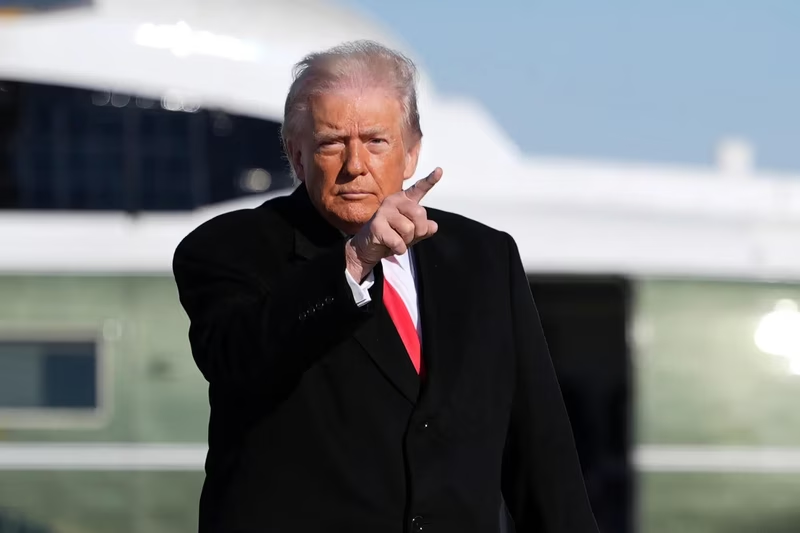
In a move that blends Cold War-era rhetoric with modern-day political theater, former US President Donald Trump has thrown a massive geopolitical wrench into the works. At a recent campaign rally, Trump didn’t just criticize the Iranian regime—he issued a direct call to action to its citizens: “Take over your institutions.” He went even further, pledging that if they succeeded, “we will help you” .
This isn’t just tough talk; it’s an explicit endorsement of regime change from a man who could very well be back in the White House in 2027. The statement, echoing the language of past US interventions, has sent shockwaves through diplomatic circles and raised urgent questions about the potential consequences of such incendiary rhetoric.
Table of Contents
- The Statement and Its Context
- “Trump Urges Iranians to Revolt”: A History of US Intervention
- Why Now? The Domestic and Geopolitical Calculus
- Potential Consequences for Iran and the Region
- The Biden Administration’s Dilemma
- Conclusion: A High-Stakes Rhetorical Gamble
- Sources
The Statement and Its Context
Trump’s comments came during a fiery campaign speech where he lambasted the current US administration’s handling of Iran, particularly regarding its nuclear program and support for proxy groups in the Middle East. He framed his call for revolt as a moral imperative, painting the Iranian government as a brutal dictatorship that has “stolen” the country from its people .
By promising direct American assistance, Trump is not merely expressing solidarity; he’s outlining a potential future policy. This goes far beyond the usual diplomatic condemnations and enters the realm of active subversion—a stance that is both legally and ethically fraught under international law.
“Trump Urges Iranians to Revolt”: A History of US Intervention
This is not the first time a US leader has encouraged unrest in Iran. The most infamous example is the 1953 CIA-backed coup that overthrew democratically elected Prime Minister Mohammad Mosaddegh, an event that continues to poison US-Iran relations to this day . More recently, US administrations have provided moral and sometimes material support to various protest movements, like the 2009 Green Movement and the 2022 “Woman, Life, Freedom” uprising.
However, Trump’s language is uniquely direct and personal. Previous presidents have generally used more cautious phrasing, emphasizing support for the “Iranian people” while stopping short of explicitly calling for the violent overthrow of the government. His pledge of help crosses a significant rhetorical line.
Why Now? The Domestic and Geopolitical Calculus
Trump’s timing is no accident. It serves multiple purposes:
- Domestic Politics: With the 2026 midterms and his own potential 2028 presidential run in mind, Trump is reinforcing his image as a strong, unapologetic leader on foreign policy, contrasting himself sharply with President Biden’s more cautious diplomacy.
- Geopolitical Signaling: The statement is a clear message to Tehran that a second Trump term would mean a complete abandonment of the nuclear deal (JCPOA) and a return to a maximum pressure campaign, now with the added threat of supporting internal destabilization.
- Rallying His Base: For his core supporters, this kind of bold, America-first rhetoric is catnip. It reinforces his narrative of restoring US dominance on the world stage.
Potential Consequences for Iran and the Region
The fallout from these remarks could be severe and unpredictable.
Inside Iran, the hardline government will likely use Trump’s words as propaganda to discredit any domestic opposition, painting protesters as foreign agents doing Washington’s bidding. This could lead to even harsher crackdowns on dissent. As Human Rights Watch has documented, the Iranian state is already highly effective at using national security as a pretext for repression .
Regionally, it could escalate tensions. Iran might accelerate its nuclear program or increase support for its proxies in Iraq, Syria, and Yemen as a form of deterrence. It also puts US allies in the region, who are often trying to balance relations with both Washington and Tehran, in a difficult position.
The Biden Administration’s Dilemma
President Biden’s team now faces a tricky situation. They must distance themselves from Trump’s inflammatory comments to avoid being seen as endorsing regime change, which could undermine their own diplomatic efforts. Yet, they also cannot appear weak on Iran, especially with ongoing concerns about its nuclear ambitions.
The official State Department line will likely reaffirm support for the Iranian people’s right to peaceful protest while stressing that the US does not seek to dictate Iran’s internal affairs—a careful but potentially unconvincing balancing act in the face of Trump’s bluntness.
Conclusion: A High-Stakes Rhetorical Gamble
When Trump urges Iranians to revolt, he’s playing a dangerous game. While his intent may be to project strength and appeal to his base, the real-world impact could be to empower Iran’s most repressive elements, endanger innocent protesters, and further destabilize an already volatile region. History has shown that calls for foreign uprisings from powerful outsiders often lead to unintended and tragic consequences. Whether this is a masterstroke of psychological warfare or a reckless provocation will depend entirely on what happens next—and who is ultimately listening.
For deeper analysis on US foreign policy, see our feature on [INTERNAL_LINK:us-middle-east-strategy]. You can also read the Council on Foreign Relations’ primer on US-Iran relations for a non-partisan historical overview .
Sources
- Times of India: Original Article
- CIA Historical Documents on the 1953 Iran Coup: CIA Reading Room
- Human Rights Watch – Iran Reports: https://www.hrw.org/middle-east/n-africa/iran
- Council on Foreign Relations – US-Iran Relations: https://www.cfr.org/backgrounder/us-iran-relations