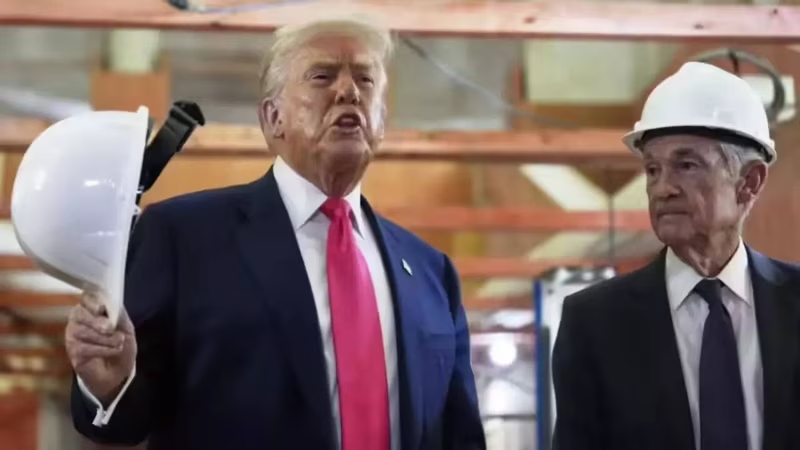
Trump Threatens to Fire Fed Chair Powell: A Deep Dive
Donald Trump is at it again. In a recent outburst, the former president doubled down on his years-long vendetta against Federal Reserve Chair Jerome Powell, declaring he’d “love to fire” him. The comments, which also hinted at a potential announcement of a successor as early as next month, have sent ripples through political and financial circles. But what’s the real story here? Is this a genuine threat with legal teeth, or just another chapter in their ongoing political drama?
This isn’t just political gossip—it’s a story with massive implications for the US economy, market stability, and the very principle of central bank independence. Let’s cut through the noise and get to the heart of the matter.
Table of Contents
- The History of the Trump-Powell Feud
- Can Trump Actually Fire Fed Chair Powell?
- The Market Reaction to Trump’s Threats
- Who Are the Top Contenders to Replace Powell?
- Why This Threat Matters More Than You Think
- Conclusion
- Sources
The History of the Trump-Powell Feud
The animosity between Trump and Powell is nothing new. It’s a saga that dates back to Trump’s first term. Ironically, Trump himself nominated Powell for the role in 2017, praising him as a “very good man” . However, the honeymoon ended quickly when Powell, prioritizing inflation control, began raising interest rates in 2018—a move that directly contradicted Trump’s desire for a “cheap money” policy to juice the economy .
Trump publicly berated Powell, calling him “not even in the same league” as other central bankers . This tension has simmered for years, resurfacing whenever monetary policy doesn’t align with Trump’s political or economic agenda. The latest barrage, where Trump accused Powell of “gross incompetence,” is just the newest episode in this long-running conflict .
Can Trump Actually Fire Fed Chair Powell?
This is the million-dollar question. The short answer is: it’s complicated and highly unlikely to succeed without a major legal battle.
The Federal Reserve was designed to be independent from direct political control to prevent exactly this kind of scenario. While the president appoints the Fed Chair, the law stipulates that a sitting Chair (who is also a Governor on the Board) can only be removed “for cause.” This legal term generally means “inefficiency, neglect of duty, or malfeasance in office” .
Political disagreements over interest rate policy—a core function of the Fed—do not constitute a valid “cause” for removal . In fact, any attempt to fire Powell over his monetary policy decisions would be widely seen as a direct assault on the Fed’s independence and would almost certainly be challenged in court . Most legal experts agree that such a move would be on shaky constitutional ground at best.
The Market Reaction to Trump’s Threats
Markets hate uncertainty, and the idea of a politicized central bank is a nightmare scenario for investors. We’ve seen this movie before. In a previous incident in July 2025, reports of Trump planning to fire Powell triggered an immediate sell-off in the S&P 500, which dropped as much as 0.7% before recovering after a quick denial from Trump .
This pattern shows a clear market consensus: the Fed’s independence is a cornerstone of financial stability. Any credible threat to that independence is met with swift and negative repricing of risk. Investors are “rattled” by these attacks, fearing a return to a more politically-driven monetary policy that could stoke inflation or create asset bubbles .
Who Are the Top Contenders to Replace Powell?
While the legal ability to fire Powell is dubious, Trump has made it clear he’s already planning for his successor. His administration, through Treasury Secretary Scott Bessent, has reportedly narrowed the list to five finalists . The leading names in the race are:
- Kevin Hassett: The current head of the National Economic Council and a known Trump loyalist. He’s widely seen as the frontrunner .
- Kevin Warsh: A former Fed governor known for his more hawkish, market-friendly views. He’s been a consistent favorite of Trump’s for years .
- Chris Waller: A current Fed governor who has sometimes broken with Powell, making him a potential compromise candidate .
- Michelle Bowman: Another sitting Fed governor, known for her focus on community banking.
- Rick Rieder: A top executive at BlackRock, representing a strong Wall Street perspective .
An appointment of someone like Hassett or Warsh would signal a clear desire to align the Fed’s policy more closely with the administration’s growth objectives, potentially at the expense of its traditional inflation-fighting mandate.
Why This Threat Matters More Than You Think
Beyond the headlines and market jitters, Trump’s comments represent a fundamental challenge to a key institution of American democracy. The Federal Reserve’s independence is not a mere technicality; it’s a critical firewall that prevents short-term political interests from hijacking long-term economic health. [INTERNAL_LINK:central-bank-independence-explained]
By publicly musing about firing a Fed Chair over policy disagreements, Trump is normalizing a dangerous precedent. It signals to future administrations that the Fed is just another political tool to be wielded, not an independent guardian of the currency. This erosion of institutional norms is a far more significant threat to the economy than any single interest rate decision.
Conclusion
While Donald Trump’s desire to fire Fed Chair Powell makes for sensational headlines, the legal and practical barriers are immense. The real story isn’t whether he can do it—it’s that he’s willing to even suggest it. This ongoing feud, combined with a clear plan to install a loyalist as the next Chair, points to a future where the Fed’s independence could be significantly compromised. For investors, policymakers, and citizens alike, this is a development that warrants close and serious attention.
Sources
- Wall Street Journal: Trump’s criticism of Fed chief Powell has long history
- Reuters: Trump intensifies criticism of Federal Reserve Chair Jerome Powell
- Federal Reserve: Jerome H. Powell Biography
- Brookings Institution: Can the President Fire the Federal Reserve Chair?
- CNBC: Markets signal that firing Powell is one line Trump can’t cross
- Politico: Trump narrows Fed chair replacement to five candidates