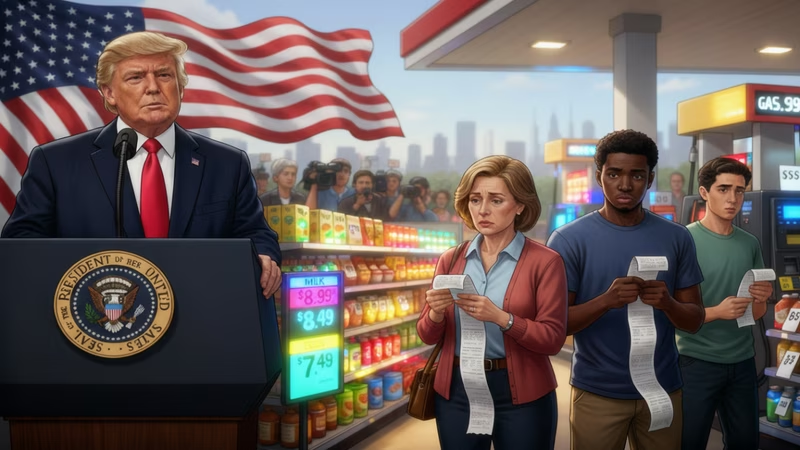
Imagine a single court ruling unleashing a $150 billion tidal wave of cash back into the global economy. That’s the seismic scenario facing Washington right now as the US Supreme Court weighs the fate of former President Donald Trump’s signature trade weapon: emergency tariffs .
For years, these duties—slapped on everything from Chinese electronics to European steel and aluminum—have been a cornerstone of America’s “America First” trade policy. But their legal foundation is now under intense scrutiny. If the Court rules they were imposed unlawfully, the US government could be on the hook for a historic Trump tariffs refund, sending shockwaves through supply chains, corporate balance sheets, and international relations.
Table of Contents
- The Legal Battle Over Trump’s Emergency Powers
- What is the IEEPA and Why Does it Matter?
- The $150 Billion Question: Who Gets a Refund?
- Global Impact: If Tariffs Are Struck Down
- What This Means for Future US Trade Policy
- Conclusion: A Ruling with Worldwide Repercussions
- Sources
The Legal Battle Over Trump’s Emergency Powers
The core of this case hinges on a critical question: Did President Trump overstep his authority by using the International Emergency Economic Powers Act (IEEPA) to justify broad-based tariffs? The IEEPA, passed in 1977, was designed to give presidents power to respond to “unusual and extraordinary threats” to national security, primarily targeting financial transactions and asset freezes—not import duties .
During recent oral arguments, several Supreme Court justices voiced strong skepticism about this interpretation. They questioned whether an economic dispute with trading partners like China or the EU truly constitutes the kind of “emergency” the IEEPA was meant to address. This judicial pushback has fueled widespread expectations that the Court may indeed strike down the tariffs as an unlawful use of executive power.
What is the IEEPA and Why Does it Matter?
The International Emergency Economic Powers Act (IEEPA) is a powerful but narrowly defined statute. Historically, it’s been used to impose sanctions on hostile regimes, freeze assets of terrorists, or block transactions during genuine national crises. Using it to levy across-the-board tariffs on allies and adversaries alike represents a significant expansion of its scope.
If the Court rules that the IEEPA cannot be used for this purpose, it would not only invalidate the specific Trump-era tariffs but also set a crucial precedent, reining in future presidents’ ability to unilaterally reshape trade policy without Congressional approval. For a detailed look at US trade laws, the official resources from the Office of the United States Trade Representative (USTR) provide essential context.
The $150 Billion Question: Who Gets a Refund?
This is where things get incredibly complex. The $150 billion figure represents the total revenue collected from these disputed tariffs since their inception. But getting that money back isn’t as simple as mailing out checks.
Key Players in the Refund Battle:
- US Importers: American companies that paid the duties on foreign goods are the primary claimants. They’ve long argued the tariffs increased their costs and made them less competitive.
- Foreign Governments: Nations like China, the EU, and Canada, which were targeted by these tariffs, will likely demand compensation or use the ruling to strengthen their own legal challenges at the World Trade Organization (WTO).
- The US Treasury: The government itself faces a massive fiscal headache. Returning such a colossal sum would create a significant hole in federal revenue, potentially impacting other budgetary priorities.
The legal process for claiming refunds would likely involve a flood of lawsuits and administrative claims, a process that could take years to resolve.
Global Impact: If Tariffs Are Struck Down
A ruling against the tariffs would have immediate and far-reaching consequences beyond US borders.
- Supply Chain Recalibration: Companies that restructured their global supply chains to avoid these tariffs might need to reassess their strategies, potentially leading to another wave of disruption.
- Retaliatory Measures Lifted: Countries that imposed counter-tariffs on US goods (like bourbon, motorcycles, and agricultural products) would likely be pressured to remove them, providing relief to American exporters.
- WTO Credibility Boost: Such a ruling would be seen as a major victory for the rules-based international trading system championed by the WTO, which had previously ruled against the US tariffs.
What This Means for Future US Trade Policy
Regardless of the outcome, this case is a watershed moment. If the Trump tariffs refund becomes a reality, it will serve as a stark warning to future administrations about the limits of executive power in trade. It underscores that while a president can act unilaterally in a crisis, fundamental shifts in economic policy require buy-in from Congress.
For investors and businesses, the key takeaway is the heightened uncertainty surrounding US trade policy. Any future administration looking to use tariffs as a primary tool will now face a much steeper legal and political hurdle. To understand how this fits into the broader landscape, see our analysis on [INTERNAL_LINK:future-of-us-trade-policy].
Conclusion: A Ruling with Worldwide Repercussions
The Supreme Court’s decision on the Trump tariffs refund is about more than just money; it’s a fundamental test of the separation of powers in the American system and a referendum on the direction of global trade. A ruling that strikes down the tariffs would mark a dramatic reversal of a key Trump-era policy and force a major reset in how the US engages with its trading partners. For businesses, governments, and consumers around the world, the stakes couldn’t be higher.
Sources
- Times of India: Original Article
- Office of the United States Trade Representative (USTR): Official Trade Policy Resources
- Congressional Research Service: Reports on IEEPA and Trade Authorities
- World Trade Organization (WTO): Dispute Settlement Body Rulings